
We read your photo as:
What are the differences between monocotyledonous and dicotyledonous plants, and what are adaptations of xylem vessels?
Biology
ScanSolve AI Answer
-
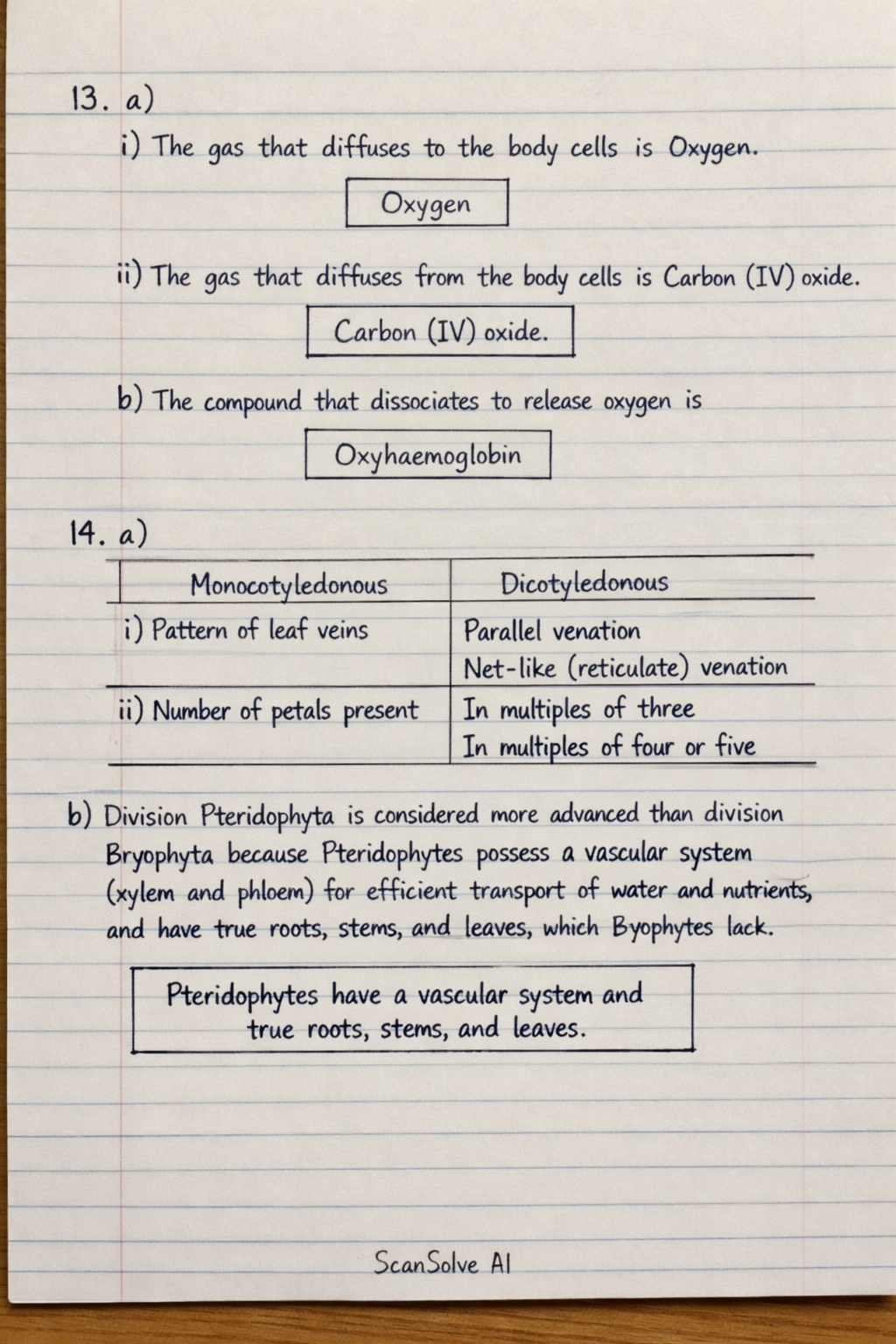
a) i) The gas that diffuses to the body cells is Oxygen.
ii) The gas that diffuses from the body cells is Carbon (IV) oxide.
b) The compound that dissociates to release oxygen is Oxyhaemoglobin.
-
a)
Monocotyledonous Dicotyledonous i) Pattern of leaf veins Parallel venation Net-like (reticulate) venation ii) Number of petals present In multiples of three In multiples of four or five b) Division Pteridophyta is considered more advanced than division Bryophyta because Pteridophytes possess a vascular system (xylem and phloem) for efficient transport of water and nutrients, and have true roots, stems, and leaves, which Bryophytes lack.
-
Three adaptations of xylem vessels and their functions are:
- Lignified walls: Provide mechanical support to the plant and prevent the vessels from collapsing under tension during water transport.
- Continuous hollow tubes: Form an uninterrupted pipeline for efficient and rapid transport of water and dissolved minerals from roots to leaves.
- Narrow lumen: Increases the effect of capillary action, aiding in the upward movement of water.
Last one for today! Send it over.
Was this helpful?
Still stuck on this one?
Ask a follow-up, and the answer starts from this question.
Got a different question?Ask your own question
More Biology Questions
QWhat is the difference between monocot and dicot plants?QSimilarities between monocots and dicots stemQExplain how the xylem are adapted to their function.QCompare and contrast the root systems and leaf venation of monocots and dicots.QCompare and contrast the advantages of monocotyledonous and dicotyledonous plants, focusing on their…
Handwritten Step-by-Step Solution
Get this as a handwritten image on WhatsApp — like a tutor wrote it for you.
Try on WhatsApp