
We read your photo as:
What are the different classes of Biosafety Cabinets, and what are their characteristics?
Biology
ScanSolve AI Answer
Answer
Biosafety Cabinets (BSCs) are enclosed, ventilated workspaces designed to protect personnel, products, and the environment from biological hazards. They are classified into three main types: Class I, Class II, and Class III.
-
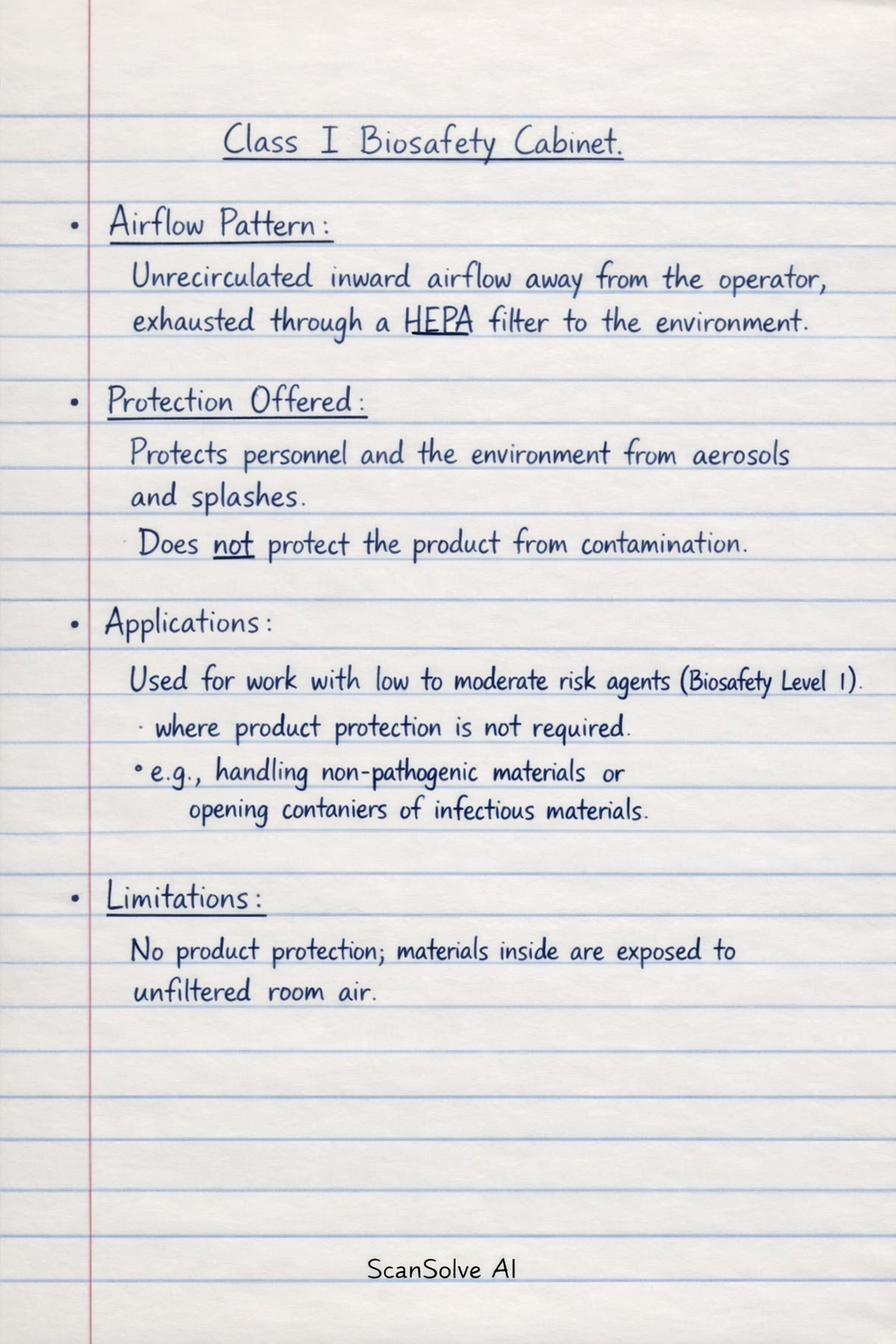
Class I Biosafety Cabinet
- Airflow Pattern: Unrecirculated inward airflow away from the operator, exhausted through a HEPA filter to the environment.
- Protection Offered: Protects personnel and the environment from aerosols and splashes. Does not protect the product from contamination.
- Applications: Used for work with low to moderate risk agents (Biosafety Level 1 and 2) where product protection is not required, such as handling non-pathogenic materials or for specific procedures like opening containers of infectious materials.
- Limitations: No product protection; materials inside are exposed to unfiltered room air.
-
Class II Biosafety Cabinet
- Airflow Pattern: Inward airflow at the work opening for personnel protection, downward HEPA-filtered laminar airflow for product protection, and HEPA-filtered exhaust to the environment or recirculated into the room (depending on subclass).
- Protection Offered: Provides protection for personnel, product, and the environment.
- Applications: Widely used for work with moderate risk agents (Biosafety Level 2 and 3) in microbiology, tissue culture, and clinical laboratories where both product and personnel protection are critical. Class II cabinets are further divided into types A1, A2, B1, and B2 based on exhaust and recirculation patterns.
- Limitations: Requires proper maintenance of HEPA filters and airflow balance. Some subclasses (e.g., B2) require dedicated exhaust systems.
-
Class III Biosafety Cabinet
- Airflow Pattern: Totally enclosed, gas-tight system with negative pressure. Air enters through HEPA filters and is exhausted through two HEPA filters or a HEPA filter and an incinerator. Work is performed through attached rubber gloves.
- Protection Offered: Provides maximum protection for personnel, product, and the environment. It is the highest level of containment.
- Applications: Used for work with high-risk biological agents (Biosafety Level 4) that pose a severe or lethal threat, such as Ebola virus or Marburg virus.
- Limitations: Less ergonomic due to fixed gloves, requires specialized installation and maintenance, and is more expensive than Class I or II cabinets.
Was this helpful?
Still stuck on this one?
Ask a follow-up, and the answer starts from this question.
Got a different question?Ask your own question
More Biology Questions
QWhat is biosafety and what are the different risk groups?QWhat are the safety precautions and hazard symbols related to chemicals in a laboratory setting?QWhat are the reasons behind each laboratory safety rule?QClassify the following biological hazards: toxic, corrosive, and radioactive substances and explain…QTypes of laboratory animal house
Handwritten Step-by-Step Solution
Get this as a handwritten image on WhatsApp — like a tutor wrote it for you.
Try on WhatsApp