
What are the five application of invertebrate paleontology in geologic studies
ScanSolve AI Answer
Here are five applications of invertebrate paleontology in geologic studies:
-
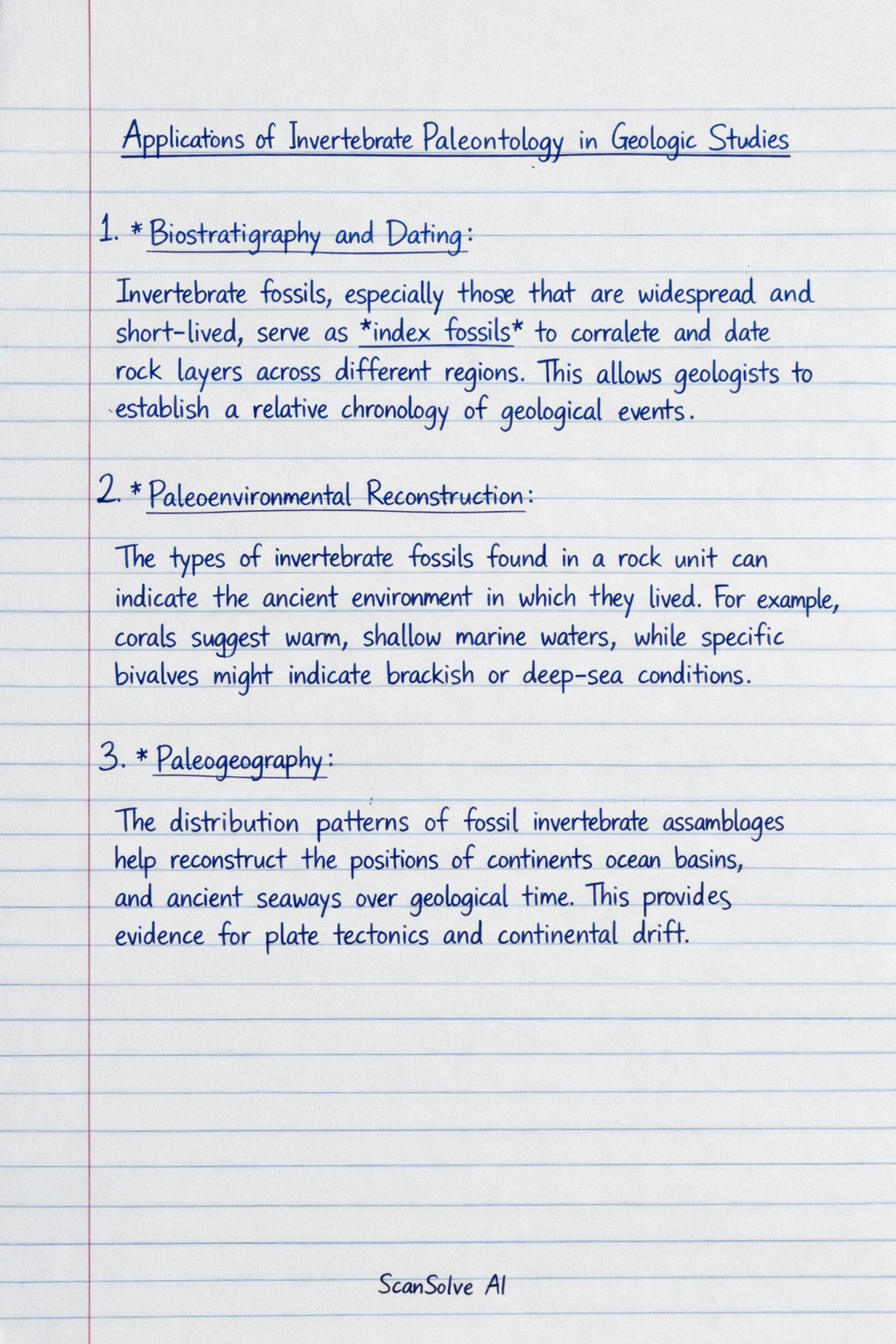
Biostratigraphy and Dating: Invertebrate fossils, especially those that are widespread and short-lived, serve as index fossils to correlate and date rock layers across different regions. This allows geologists to establish a relative chronology of geological events.
-
Paleoenvironmental Reconstruction: The types of invertebrate fossils found in a rock unit can indicate the ancient environment in which they lived. For example, corals suggest warm, shallow marine waters, while specific bivalves might indicate brackish or deep-sea conditions.
-
Paleogeography: The distribution patterns of fossil invertebrate assemblages help reconstruct the positions of continents, ocean basins, and ancient seaways over geological time. This provides evidence for plate tectonics and continental drift.
-
Evolutionary Studies: Invertebrate fossils provide a rich record of life's history, illustrating evolutionary trends, diversification events, and mass extinctions. They offer direct evidence for the processes of evolution and speciation.
-
Petroleum Exploration: Certain fossil assemblages, particularly microfossils of invertebrates, can be used to identify potential hydrocarbon source rocks or reservoir rocks. They help in understanding the depositional environments conducive to oil and gas formation.
Still stuck on this one?
Ask a follow-up, and the answer starts from this question.
More Biology Questions
Handwritten Step-by-Step Solution
Get this as a handwritten image on WhatsApp — like a tutor wrote it for you.
Try on WhatsApp