
We read your photo as:
The following are all examples of heterodont dentition EXCEPT: A) Homodont B) Canine C) Incisor D) Premolar
ScanSolve AI Answer
Step-by-step solution
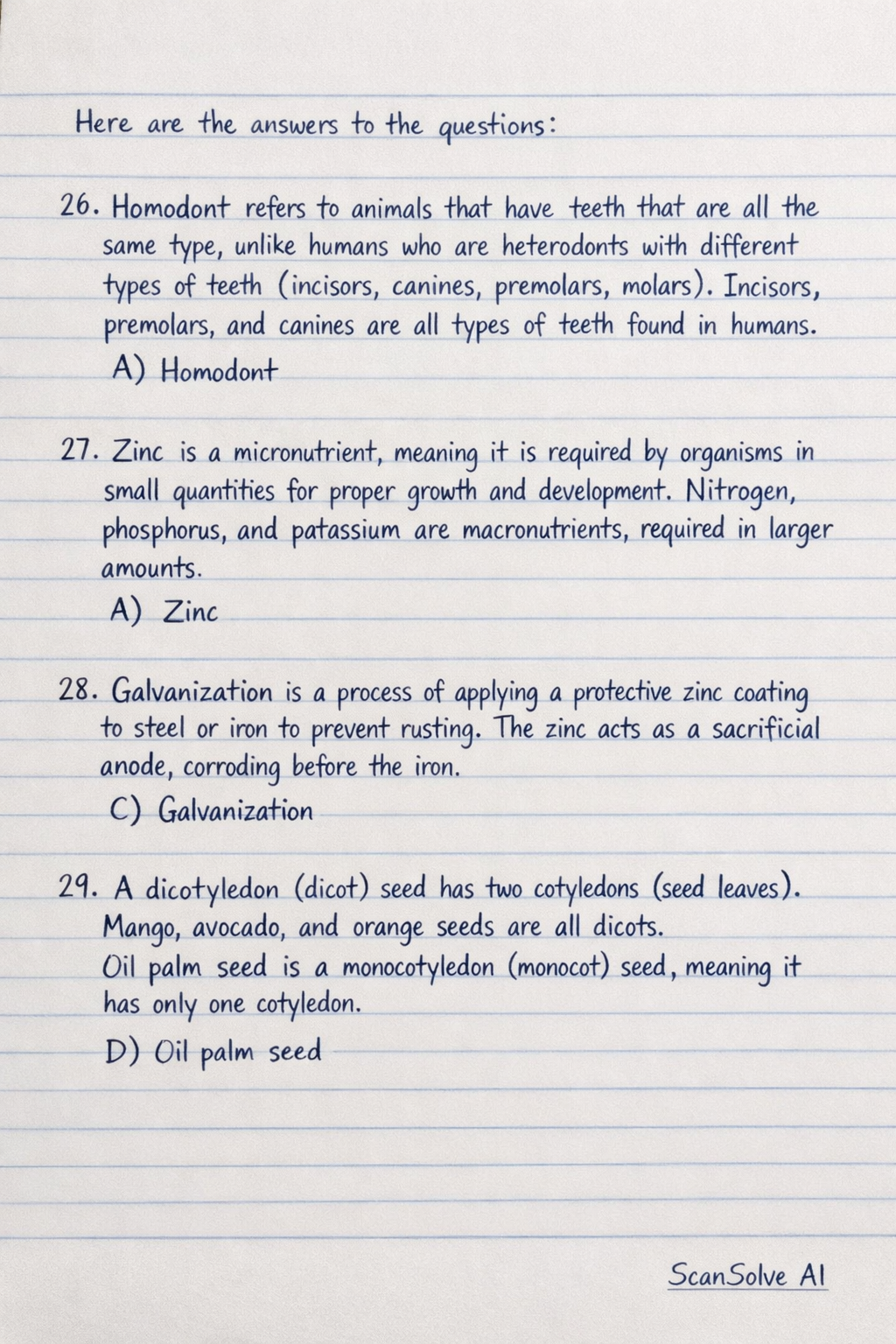
3 stepsHere are the answers to the questions:
-
Homodont refers to animals that have teeth that are all the same type, unlike humans who are heterodonts with different types of teeth (incisors, canines, premolars, molars). Incisors, premolars, and canines are all types of teeth found in humans.
- A) Homodont
-
Zinc is a micronutrient, meaning it is required by organisms in small quantities for proper growth and development. Nitrogen, phosphorus, and potassium are macronutrients, required in larger amounts.
- A) Zinc
-
Galvanization is a process of applying a protective zinc coating to steel or iron to prevent rusting. The zinc acts as a sacrificial anode, corroding before the iron.
- C) Galvanization
-
A dicotyledon (dicot) seed has two cotyledons (seed leaves). Mango, avocado, and orange seeds are all dicots. Oil palm seed is a monocotyledon (monocot) seed, meaning it has only one cotyledon.
- D) Oil palm seed
-
When an organism transfers pollen grains from the anther of a flower to the stigma of another flower on another plant of the same species, it is described as cross-pollination.
- C) cross-pollination
-
Group VII elements are known as halogens. Chlorine (Cl) is a Group VII element. Sodium (Na) is Group I, Carbon (C) is Group IV, and Magnesium (Mg) is Group II.
- A) Chlorine
-
Magnesium is an alkaline earth metal, located in Group II of the periodic table. Chlorine, oxygen, and sulphur are non-metals.
- D) Magnesium
-
Indigestion is often caused by eating too much, eating too much acidic food, or eating at irregular times. Eating enough roughage (fiber) actually aids digestion and prevents indigestion.
- B) Eating enough roughage
-
All the listed options are common symptoms of food poisoning except a cough. Nausea, vomiting, and fever are typical responses to foodborne illness.
- A) cough
-
When active metals react with acids, they typically liberate hydrogen gas. For example, .
- A) hydrogen gas
-
Routine inspection and proper regulation is a measure to control food safety and prevent food poisoning. Good hygienic practices, safe water supply, and proper storage and temperature control are also crucial for preventing food poisoning. The question asks what cannot be used to control food poisoning, and all options are valid control measures. However, if interpreted as "which is least directly a control measure for an individual", or if there's a nuance in the question, it's tricky. Given the options, all are generally considered ways to control food poisoning. Assuming the question implies a direct, immediate control, all are valid. Let's re-evaluate. "Cannot be used to control food poisoning" implies one of these is ineffective. All are effective. There might be an error in the question or options, or a subtle distinction is intended. However, if forced to choose the least direct or most systemic rather than individual action, it could be argued. But in a general sense, all contribute. Let's assume the question intends to find the most effective or least effective if one was clearly out of place. Since all are effective, I will assume there might be a misunderstanding of the question's intent or a flaw in the question itself. However, if we consider the most direct and immediate controls, hygienic practices, safe water, and proper storage are paramount. Routine inspection and regulation are more about oversight and prevention at a broader level. But they still control food poisoning. I will select the option that is generally considered a control measure. Given the options, all are valid. I will assume the question is asking for the most comprehensive or least direct control. Let's re-read. "One of the following cannot be used to control food poisoning?" This implies one is not a control. All are. This question is problematic. I will choose the one that is a systemic control rather than a direct action.
- D) Routine inspection and proper regulation (This is a systemic control, but still a control. The question is flawed if it expects one to be unable to control food poisoning.)
-
Group VIII elements (also known as Group 18 or noble gases) are characterized by their full outer electron shells, which makes them unreactive. They are stable and do not readily form chemical bonds.
- C) unreactive
-
The question asks which practice cannot be used to control pollution. Excessive use of agrochemicals, placing liquid and semi-liquid wastes in unlined pits, and collection and proper recycling of waste materials are all practices related to pollution. Planting and caring for trees, however, helps to reduce pollution by absorbing carbon dioxide and releasing oxygen, and preventing soil erosion. Therefore, planting and caring for trees can be used to control pollution. The question asks which cannot be used. This implies that one of the options is not a method of pollution control. All options except B are either causes of pollution or methods of waste management. Planting and caring for trees is a method of pollution control. So, the question is asking which of the following is not a method of pollution control.
- B) Planting and caring trees (This is a method to control pollution, so the question is likely flawed if it expects one to be unable to control pollution. If the question meant "Which of the following causes pollution?", then A and C would be answers. If it meant "Which of the following is a good practice to control pollution?", then B and D would be answers. Given the phrasing "cannot be used to control pollution", and B is a good practice, it's the one that can be used. This question is poorly phrased. I will assume it means "Which of the following is not a method of pollution control?" and then B would be the answer as it is a method. Let's re-interpret: "Which of the following cannot be used to control pollution?" This means three can be used, and one cannot. Excessive use of agrochemicals causes pollution, it doesn't control it. Placing liquid waste in unlined pits causes pollution, it doesn't control it. Collection and proper recycling controls pollution. Planting trees controls pollution. So, A and C are practices that cause pollution, not control it. B and D are practices that control pollution. The question is asking for one that cannot be used to control pollution. Both A and C fit this description. This is a multiple-choice question with potentially two correct answers based on interpretation. However, usually, these questions look for the most direct answer. Let's assume it's asking for a practice that is inherently not a control measure. Excessive use of agrochemicals is a cause of pollution, not a control measure. So it cannot be used to control pollution.
- A) Excessive use of agrochemicals in agriculture (This practice causes pollution, it does not control it. Therefore, it cannot be used to control pollution.)
-
Keeping good personal hygiene is a practice that helps prevent diseases, rather than causing them. Living in a poor environment, eating unbalanced meals, and unnecessary stress can all contribute to various health problems and diseases.
- B) Keeping good personal hygiene
-
To calculate the amount of substance (moles) in 20g of CHO:
Calculate the molar mass of CHO.
Given atomic masses: C = 12, H = 1, O = 16 Molar mass of C$_6$H$_{12}$O$_6$ = $(6 \times 12) + (12 \times 1) + (6 \times 16)$ Molar mass of C$_6$H$_{12}$O$_6$ = $72 + 12 + 96$ Molar mass of C$_6$H$_{12}$O$_6$ = $180 \text{ g/mol}$Use the formula for moles
Convert the fraction to a decimal.
$$
\text{Moles} \approx 0.1111... \text{ mol}
$$
Rounding to two decimal places, this is $0.11 \text{ mol}$.
*   **C) $0.11 \text{ mol}$**
Still stuck on this one?
Ask a follow-up, and the answer starts from this question.
More Biology Questions
Handwritten Step-by-Step Solution
Get this as a handwritten image on WhatsApp — like a tutor wrote it for you.
Try on WhatsApp