
We read your photo as:
The following two questions refer to the characteristics of Homo sapiens and other primates. 3.1.1 State FOUR structural characteristics of Homo sapiens that are similar to other primates. 3.1.2 Tabulate FOUR structural differences between the skull of Homo sapiens and that of other primates.
Biology
ScanSolve AI Answer
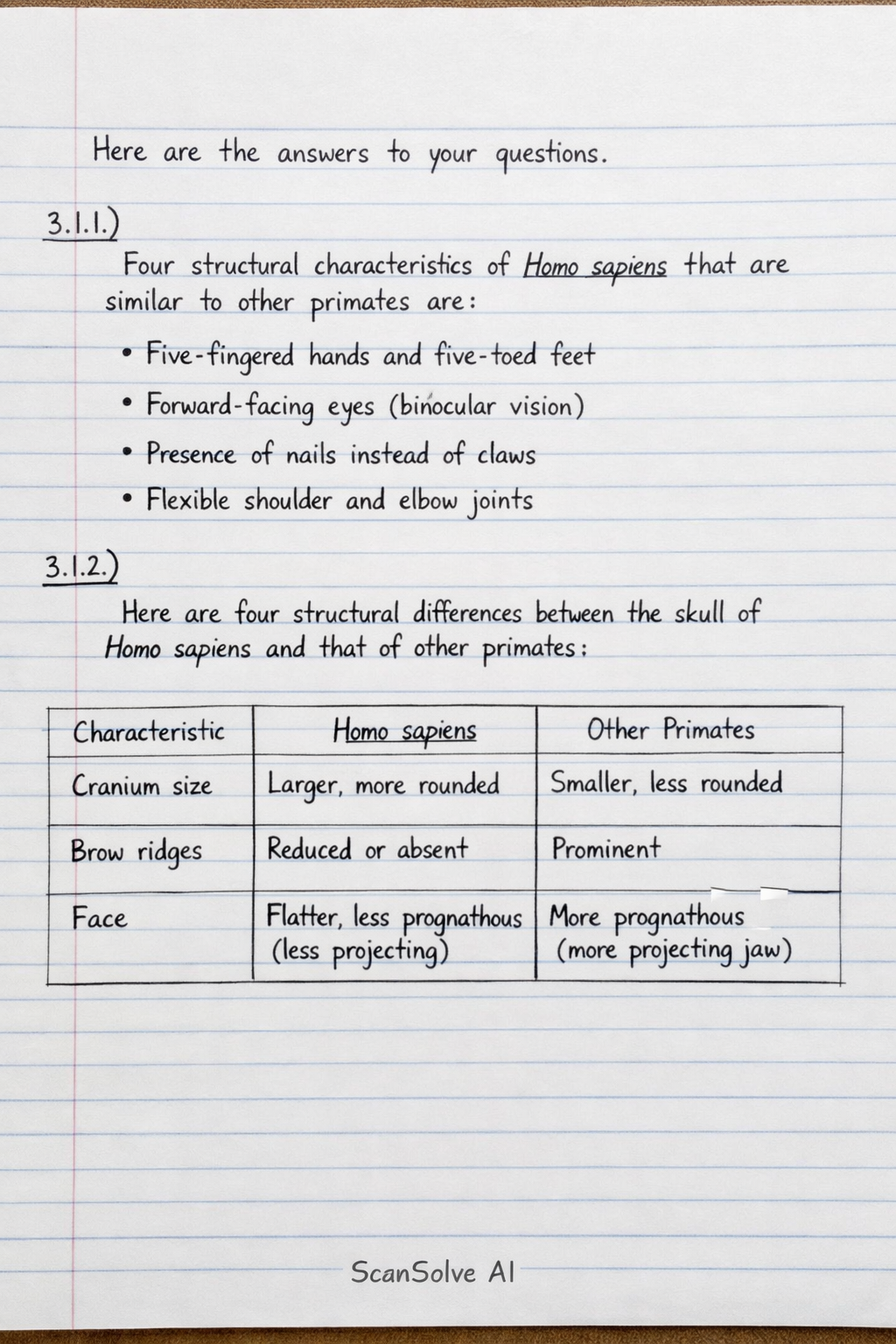
Here are the answers to your questions.
3.1.1)
Four structural characteristics of Homo sapiens that are similar to other primates are:
- Five-fingered hands and five-toed feet
- Forward-facing eyes (binocular vision)
- Presence of nails instead of claws
- Flexible shoulder and elbow joints
3.1.2)
Here are four structural differences between the skull of Homo sapiens and that of other primates:
| Characteristic | Homo sapiens | Other Primates |
|---|---|---|
| Cranium size | Larger, more rounded | Smaller, less rounded |
| Brow ridges | Reduced or absent | Prominent |
| Face | Flatter, less prognathous (less projecting) | More prognathous (more projecting jaw) |
| Foramen magnum | More centrally located at the base of the skull | More posteriorly located at the back of the skull |
| Chin | Present | Absent |
4.1.1)
One possible advantage of having an opposable thumb is that it allows for a precision grip, which is essential for manipulating objects and making tools.
4.1.2)
Four characteristics that humans share with primates, other than an opposable thumb, are:
- Five-fingered hands and five-toed feet
- Forward-facing eyes (binocular vision)
- Presence of nails instead of claws
- Flexible shoulder and elbow joints
Was this helpful?
Still stuck on this one?
Ask a follow-up, and the answer starts from this question.
Got a different question?Ask your own question
More Biology Questions
QA) How do humans differ from other mammals?QWhich pelvis, 1 or 2, belongs to hominid? List TWO characteristics of the pelvis that supports your…QList FOUR characteristics from the list above that are similar to that of Australopithecus…QBy analysing the DNA of humans and living apes, scientists have produced the phylogenetic tree…QStudy the phylogenetic tree below showing a possible representation of human evolution and answer…
Browse by topic:Anatomy
Handwritten Step-by-Step Solution
Get this as a handwritten image on WhatsApp — like a tutor wrote it for you.
Try on WhatsApp