
We read your photo as:
What is the importance of blood clotting and what are the differences between xylem and phloem tissues in plants?
ScanSolve AI Answer
Step-by-step solution
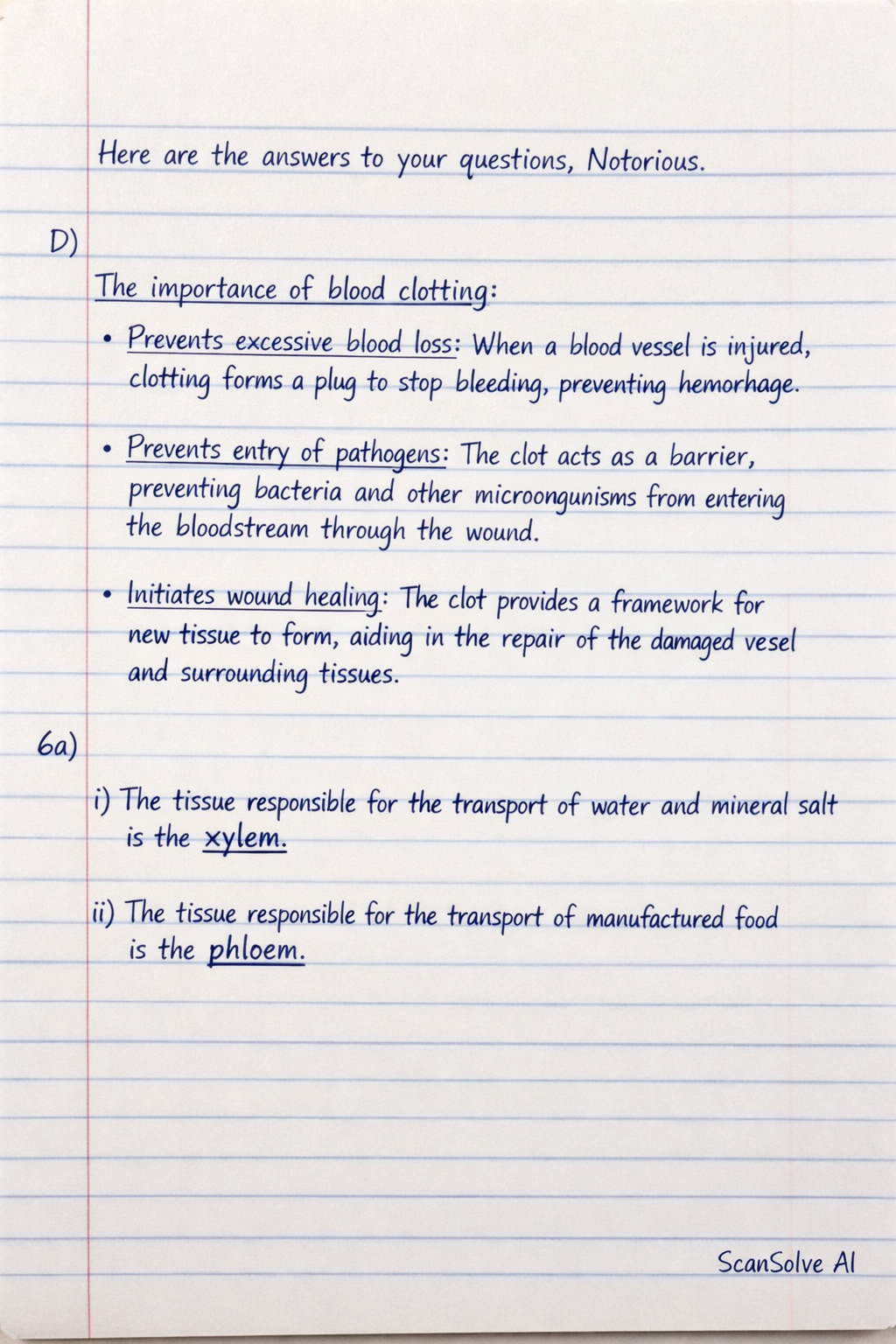
6 stepsHere are the answers to your questions, Notorious.
D)
The importance of blood clotting:
- Prevents excessive blood loss: When a blood vessel is injured, clotting forms a plug to stop bleeding, preventing hemorrhage.
- Prevents entry of pathogens: The clot acts as a barrier, preventing bacteria and other microorganisms from entering the bloodstream through the wound.
- Initiates wound healing: The clot provides a framework for new tissue to form, aiding in the repair of the damaged vessel and surrounding tissues.
6a)
i) The tissue responsible for the transport of water and mineral salt is the xylem.
ii) The tissue responsible for the transport of manufactured food is the phloem.
6b)
Here are the distinctions between xylem and phloem:
- Xylem transports water and dissolved minerals from the roots to the rest of the plant, primarily in an upward direction. Its main conducting cells (tracheids and vessel elements) are dead at maturity and provide structural support.
- Phloem transports manufactured food (sugars, primarily sucrose) from the leaves (where it's produced) to other parts of the plant where it's needed for growth or storage. Its transport can be in any direction (up or down) and its main conducting cells (sieve tube elements) are living.
6c)
Manufactured food (sugars, mainly sucrose) is transported from the leaves to the roots through a process called translocation in the phloem.
Sugars produced in the leaves (source) are actively loaded into the sieve tube elements of the phloem.
This increases the solute concentration inside the sieve tubes, causing water to move from the adjacent xylem into the phloem by osmosis.
The influx of water creates high turgor pressure at the source end of the phloem.
At the roots (sink), sugars are actively unloaded from the sieve tubes for consumption or storage.
The removal of sugars decreases the solute concentration in the sieve tubes at the sink, causing water to move out by osmosis, reducing the turgor pressure.
This pressure gradient drives the bulk flow of the sugar-rich sap from the high-pressure source (leaves) to the low-pressure sink (roots).
1)
The importance of osmoregulation:- Maintains constant internal environment: Osmoregulation ensures that the water potential and solute concentration of body fluids remain stable, which is crucial for the proper functioning of cells and enzymes.
- Prevents cell damage: It prevents cells from either swelling and bursting (due to excessive water intake) or shrinking and shriveling (due to excessive water loss), both of which can be fatal.
ii)
Three ways the kidney helps to maintain water balance in the body:- Selective reabsorption of water: The kidneys reabsorb varying amounts of water from the filtrate back into the blood in the renal tubules (proximal convoluted tubule, loop of Henle, distal convoluted tubule, and collecting duct) based on the body's hydration needs.
- Regulation by Antidiuretic Hormone (ADH): When the body is dehydrated, the pituitary gland releases ADH, which increases the permeability of the collecting ducts and distal convoluted tubules to water, leading to more water reabsorption and the production of concentrated urine.
- Glomerular filtration: The kidneys filter a large volume of blood plasma, and the subsequent reabsorption processes ensure that only the necessary amount of water is retained, while excess water is excreted.
iii)
Two consequences of kidney failure:- Accumulation of toxic waste products: The kidneys fail to remove metabolic waste products like urea and creatinine from the blood, leading to a buildup of toxins (uremia), which can cause nausea, fatigue, and confusion.
- Fluid and electrolyte imbalance: The kidneys cannot properly regulate water and electrolyte levels (e.g., sodium, potassium, calcium), leading to fluid retention (edema), high blood pressure, and dangerous imbalances that can affect heart and nerve function.
2)
The microorganisms involved in producing:i) Bread: Yeast (Saccharomyces cerevisiae)
ii) Beer: Yeast (Saccharomyces cerevisiae)
iii) Yoghurt: Lactic acid bacteria (e.g., Lactobacillus bulgaricus and Streptococcus thermophilus)
Still stuck on this one?
Ask a follow-up, and the answer starts from this question.
More Biology Questions
Handwritten Step-by-Step Solution
Get this as a handwritten image on WhatsApp — like a tutor wrote it for you.
Try on WhatsApp