
We read your photo as:
What are the key anatomical and vascular features of the pleura, including its innervation and blood supply?
ScanSolve AI Answer
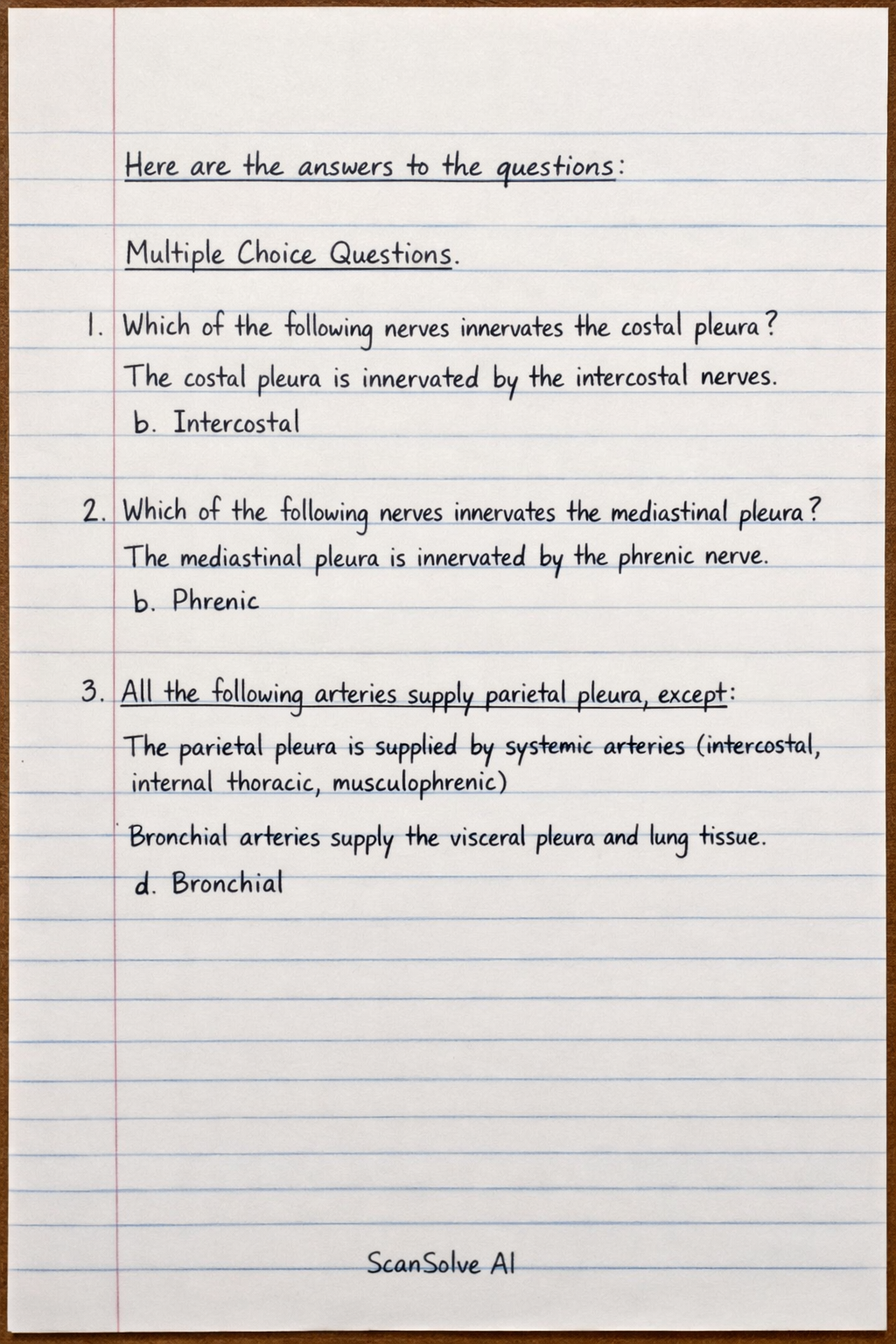
Here are the answers to the questions:
Multiple Choice Questions
-
Which of the following nerves innervates the costal pleura? The costal pleura is innervated by the intercostal nerves.
- b. Intercostal
-
Which of the following nerves innervates the mediastinal pleura? The mediastinal pleura is innervated by the phrenic nerve.
- b. Phrenic
-
All the following arteries supply parietal pleura, except: The parietal pleura is supplied by systemic arteries (intercostal, internal thoracic, musculophrenic). Bronchial arteries supply the visceral pleura and lung tissue.
- d. Bronchial
-
One of the following is a part of parietal pleura: This question is flawed as all options (Bronchial, Musculophrenic, Internal thoracic, Superior epigastric) are arteries, not parts of the parietal pleura. The parts of the parietal pleura are costal, diaphragmatic, mediastinal, and cervical. Based on the provided answer key (4.a), there might be a misunderstanding or error in the question or options. If the question intended to ask which artery is not a primary supply to the parietal pleura, then bronchial would be a plausible answer, but it is listed as a "part" of the pleura.
- a. Bronchial (Note: This option is an artery, not a part of the pleura. The question is likely flawed.)
-
All are main big fissures of the lung, except: This question is flawed as all options (Right costodiaphragmatic recess, Left costodiaphragmatic recess, Right costomediastinal recess, Left costomediastinal recess) are pleural recesses, not fissures of the lung. The main fissures of the lung are the oblique and horizontal fissures. Based on the provided answer key (5.c), there might be a misunderstanding or error in the question or options.
- c. Right costomediastinal recess (Note: This option is a pleural recess, not a lung fissure. The question is likely flawed.)
Frequently Asked Questions
- Write short notes on:
- a. Comparison of visceral and parietal pleura The visceral pleura is the inner layer that tightly adheres to the lung surface, extending into the fissures. It is insensitive to pain and is innervated by autonomic nerves. The parietal pleura is the outer layer that lines the thoracic cavity, including the ribs, diaphragm, and mediastinum. It is sensitive to pain and is innervated by somatic nerves (intercostal and phrenic).
- b. Paracentesis thoracis Paracentesis thoracis, also known as thoracentesis, is a medical procedure involving the insertion of a needle into the pleural space to remove fluid or air. It is performed for diagnostic purposes (e.g., analyzing pleural fluid) or therapeutic purposes (e.g., relieving dyspnea caused by pleural effusion or pneumothorax).
- c. Name four clinical types of pleura
The four anatomical parts of the parietal pleura are often referred to in a clinical context:
- Costal pleura
- Diaphragmatic pleura
- Mediastinal pleura
- Cervical pleura (or cupula)
- d. Sites where pleura extends beyond thoracic cage The pleura extends beyond the bony thoracic cage at the cervical pleura (cupula), which projects into the root of the neck, superior to the first rib.
Viva Voce
-
What are the parts of parietal pleura? Name their nerve supply. The parts of the parietal pleura are the costal pleura, diaphragmatic pleura, mediastinal pleura, and cervical pleura.
- Costal pleura: Innervated by intercostal nerves.
- Diaphragmatic pleura: The peripheral part is innervated by intercostal nerves, and the central part by the phrenic nerve.
- Mediastinal pleura: Innervated by the phrenic nerve.
- Cervical pleura: Innervated by intercostal nerves (T1) and the phrenic nerve.
-
Which nerves innervate the visceral pleura and why? The visceral pleura is innervated by autonomic nerves (sympathetic and parasympathetic fibers from the pulmonary plexus). It is insensitive to pain, temperature, and touch because it lacks somatic sensory innervation. Its primary role is not sensation but rather to facilitate lung movement and respond to autonomic stimuli.
-
Name the root value of phrenic nerve. What are the parts of parietal pleura innervated by this nerve? The phrenic nerve has a root value from the cervical spinal nerves C3, C4, and C5. The parts of the parietal pleura innervated by the phrenic nerve are the mediastinal pleura and the central part of the diaphragmatic pleura.
-
Name the sites where pleura extends beyond thoracic cage. The pleura extends beyond the bony thoracic cage at the cervical pleura (cupula), which projects into the root of the neck, superior to the first rib.
-
What are the differences between visceral and parietal pleurae?
- Visceral pleura: Covers the lung surface, adheres tightly, is insensitive to pain, receives autonomic innervation, and is supplied by bronchial arteries.
- Parietal pleura: Lines the thoracic cavity, is sensitive to pain, receives somatic innervation (intercostal and phrenic nerves), and is supplied by systemic arteries (intercostal, internal thoracic, musculophrenic).
Still stuck on this one?
Ask a follow-up, and the answer starts from this question.
More Biology Questions
Handwritten Step-by-Step Solution
Get this as a handwritten image on WhatsApp — like a tutor wrote it for you.
Try on WhatsApp