
We read your photo as:
What are the key concepts in infection control and prevention in healthcare settings?
ScanSolve AI Answer
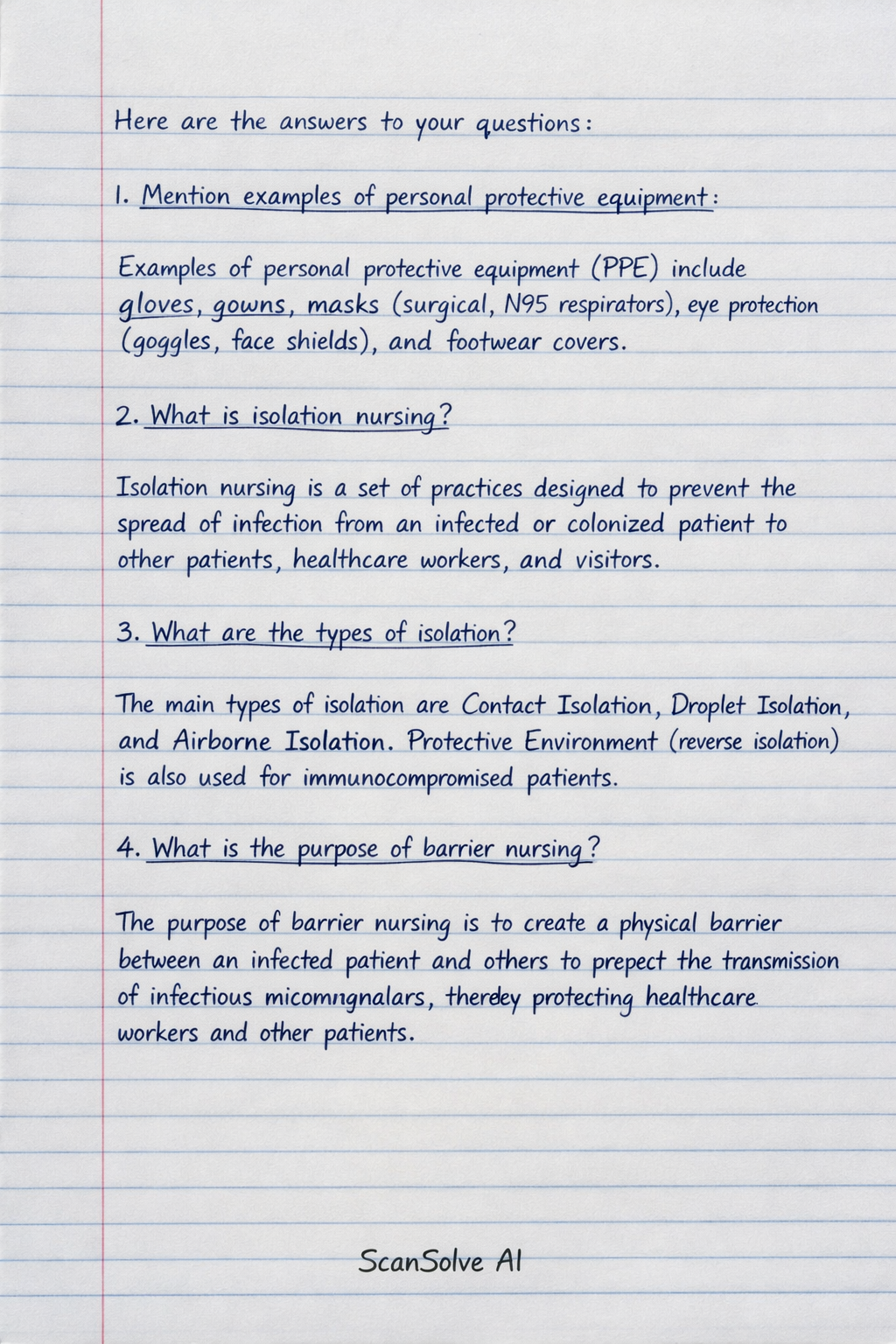
Here are the answers to your questions:
1. Mention examples of personal protective equipment.
Examples of personal protective equipment (PPE) include gloves, gowns, masks (surgical, N95 respirators), eye protection (goggles, face shields), and footwear covers.
2. What is isolation nursing?
Isolation nursing is a set of practices designed to prevent the spread of infection from an infected or colonized patient to other patients, healthcare workers, and visitors.
3. What are the types of isolation?
The main types of isolation are Contact Isolation, Droplet Isolation, and Airborne Isolation. Protective Environment (reverse isolation) is also used for immunocompromised patients.
4. What is the purpose of barrier nursing?
The purpose of barrier nursing is to create a physical barrier between an infected patient and others to prevent the transmission of infectious microorganisms, thereby protecting healthcare workers and other patients.
5. What are hospital acquired infections (HAIs)?
Hospital acquired infections (HAIs), also known as nosocomial infections, are infections that patients acquire while receiving medical care in a healthcare facility and were not present or incubating at the time of admission.
6. Mention ways to prevent hospital infections.
Ways to prevent hospital infections include hand hygiene, proper use of personal protective equipment (PPE), environmental cleaning and disinfection, sterilization of medical equipment, safe injection practices, and isolation precautions.
7. What is a nursing procedure?
A nursing procedure is a systematic, step-by-step method or course of action performed by nurses to provide patient care, achieve specific health outcomes, and maintain patient safety.
8. What are the principles of safe nursing procedures?
Principles of safe nursing procedures include maintaining asepsis, ensuring patient identification, promoting patient comfort and privacy, using proper body mechanics, adhering to medication safety protocols, and documenting accurately.
9. What is patient identification?
Patient identification is the process of accurately verifying a patient's identity to ensure that the correct care is provided to the correct individual, typically using at least two identifiers such as name and date of birth.
10. Why is patient identification important?
Patient identification is crucial to prevent medical errors, ensure patient safety, and deliver appropriate care by confirming that treatments, medications, and procedures are administered to the intended patient.
11. What are the rights of medication administration?
The rights of medication administration are: Right Patient, Right Drug, Right Dose, Right Route, Right Time, Right Documentation, Right Reason, Right Assessment, and Right Response.
12. What is bed making?
Bed making in nursing involves preparing a patient's bed with clean linens in a specific manner to ensure comfort, hygiene, and safety, whether the bed is occupied or unoccupied.
13. Mention types of bed making.
Types of bed making include occupied bed making, unoccupied bed making (open or closed), and post-operative bed making (or surgical bed).
14. What is an occupied bed?
An occupied bed is a bed made while the patient remains in it, requiring careful technique to ensure patient comfort and safety during the process.
15. What is an unoccupied bed?
An unoccupied bed is a bed made when the patient is out of bed, allowing for easier and more thorough changing of linens.
16. What is a post-operative bed?
A post-operative bed, also known as a surgical or recovery bed, is specially prepared for a patient returning from surgery, often with linens folded back and equipment readily available for easy transfer and monitoring.
17. What are the purposes of bed making?
The purposes of bed making are to provide a clean and comfortable environment for the patient, promote hygiene, prevent skin breakdown, ensure patient safety, and facilitate therapeutic positioning.
18. What is patient positioning?
Patient positioning refers to placing a patient in a specific body alignment to promote comfort, prevent complications (like pressure ulcers or contractures), facilitate medical procedures, or improve physiological function.
19. Mention types of patient positions.
Types of patient positions include Fowler's, Semi-Fowler's, Supine, Prone, Lateral, Sims', Trendelenburg, and Reverse Trendelenburg.
20. Describe the Fowler's position.
Fowler's position is a semi-sitting position where the head of the bed is elevated between 45 and 60 degrees. The patient's knees may be slightly bent. It is used to improve breathing and comfort.
21. Describe the lateral position.
The lateral position involves the patient lying on their side, either right or left, with the top leg flexed and placed in front of the bottom leg. This position helps relieve pressure on the back and sacrum.
22. Describe the prone position.
The prone position involves the patient lying flat on their abdomen with their head turned to one side. This position is used for specific medical procedures or to improve oxygenation in some respiratory conditions.
23. Describe the Sims position.
Sims' position is a semi-prone position where the patient lies on their left side with the left arm behind the body, the right arm flexed in front, and the right knee sharply flexed towards the chest, while the left leg is slightly flexed. It is often used for rectal examinations or enema administration.
Still stuck on this one?
Ask a follow-up, and the answer starts from this question.
More Biology Questions
Handwritten Step-by-Step Solution
Get this as a handwritten image on WhatsApp — like a tutor wrote it for you.
Try on WhatsApp