The likely implication of the factors on the community would be A. increased food production and reduced disease outbreak. B. reduced competition and reduced population size. C. increased competition and food shortage. D. increased population size and reduced competition.

Biology
The likely implication of the factors on the community would be A. increased food production and reduced disease outbreak. B. reduced competition and reduced population size. C. increased competition and food shortage. D. increased population size and reduced competition.

ScanSolve AI Answer

9 steps

Answer

C

here are the answers to the questions:

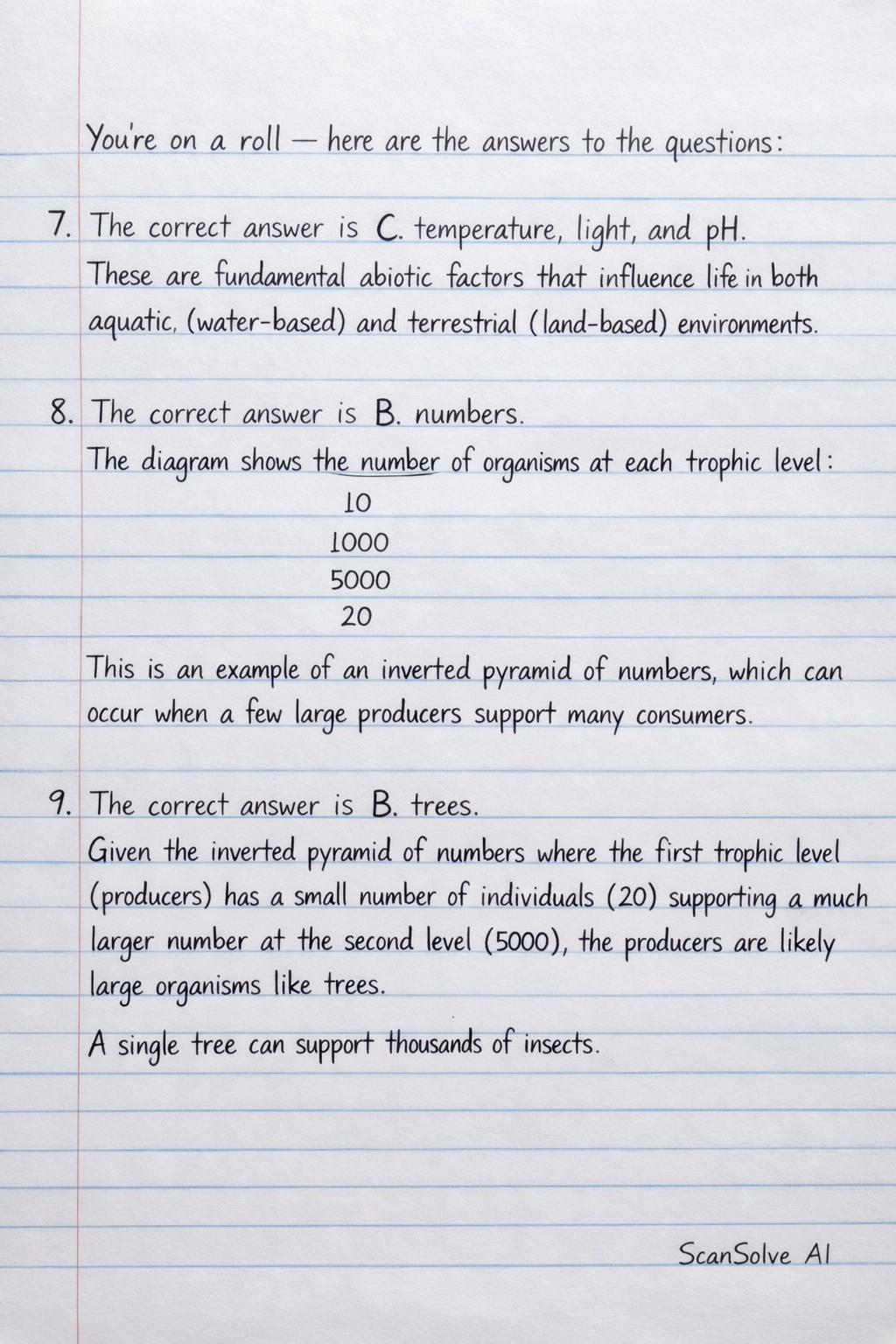
  1. The correct answer is C. temperature, light, and pH. These are fundamental abiotic factors that influence life in both aquatic (water-based) and terrestrial (land-based) environments.

  2. The correct answer is B. numbers. The diagram shows the number of organisms at each trophic level (10, 1000, 5000, 20). This is an example of an inverted pyramid of numbers, which can occur when a few large producers support many consumers.

  3. The correct answer is B. trees. Given the inverted pyramid of numbers where the first trophic level (producers) has a small number of individuals (20) supporting a much larger number at the second level (5000), the producers are likely large organisms like trees. A single tree can support thousands of insects.

  4. The correct answer is C. increased competition and food shortage. A high birth rate, low mortality, and high immigration all lead to a rapid increase in population size. When resources are limited, this population growth will inevitably result in increased competition for those resources and a shortage of food.

  5. (Question 11 is not visible in the image.)

  6. The correct answer is A. Flagellum and cilia. Both flagella and cilia are hair-like organelles primarily used for locomotion (movement) in various unicellular organisms and specialized cells.

  7. The correct answer is B. movement and nutrition. Hydra use their tentacles primarily to capture food (nutrition) and also for some forms of movement, such as somersaulting. If the tentacles are impaired, these functions would be affected.

  8. The correct answer is B. II, IV and V. The organism shown is a Euglena, which has characteristics of both plants and animals.

    • I (Flagellum) is for movement (animal-like).
    • II (Nucleus) is a general eukaryotic feature.
    • III (Chloroplasts) are for photosynthesis (plant-like).
    • IV (Eyespot) is for light detection (sensory, animal-like).
    • V (Contractile vacuole) is for osmoregulation (animal-like). Option B includes the nucleus (general eukaryotic, present in animals), eyespot (sensory, animal-like), and contractile vacuole (osmoregulation, animal-like), and importantly, it does not include the plant-like chloroplasts (III).
  9. The correct answer is D. photosynthesis. Part III in the diagram represents the chloroplasts, which are the organelles responsible for carrying out photosynthesis in Euglena.

Drop the next question 📸

Was this helpful?

Need help with your own homework?

Get instant step-by-step solutions to any question. Free to start.

Ask Your Question
Handwritten step-by-step solution preview

Handwritten Step-by-Step Solution

Get this as a handwritten image on WhatsApp — like a tutor wrote it for you.

Try on WhatsApp

Still have questions?

The likely implication of the factors on the community would be A. increased food production and reduced disease outbreak. B. reduced competition and reduced population size. C. increased competition and food shortage. D. increased population size and reduced competition.
Biology

This biology question covers important biological concepts and processes. The step-by-step explanation below helps you understand the underlying mechanisms and reasoning.

ScanSolve AI Answer
here are the answers to the questions: 7. The correct answer is C. temperature, light, and pH. These are fundamental abiotic factors that influence life in both aquatic (water-based) and terrestrial (land-based) environments. 8. The correct answer is B. numbers. The diagram shows the number of organisms at each trophic level (10, 1000, 5000, 20). This is an example of an inverted pyramid of numbers, which can occur when a few large producers support many consumers. 9. The correct answer is B. trees. Given the inverted pyramid of numbers where the first trophic level (producers) has a small number of individuals (20) supporting a much larger number at the second level (5000), the producers are likely large organisms like trees. A single tree can support thousands of insects. 10. The correct answer is C. increased competition and food shortage. A high birth rate, low mortality, and high immigration all lead to a rapid increase in population size. When resources are limited, this population growth will inevitably result in increased competition for those resources and a shortage of food. 11. (Question 11 is not visible in the image.) 12. The correct answer is A. Flagellum and cilia. Both flagella and cilia are hair-like organelles primarily used for locomotion (movement) in various unicellular organisms and specialized cells. 13. The correct answer is B. movement and nutrition. Hydra use their tentacles primarily to capture food (nutrition) and also for some forms of movement, such as somersaulting. If the tentacles are impaired, these functions would be affected. 14. The correct answer is B. II, IV and V. The organism shown is a Euglena, which has characteristics of both plants and animals. I (Flagellum) is for movement (animal-like). II (Nucleus) is a general eukaryotic feature. III (Chloroplasts) are for photosynthesis (plant-like). IV (Eyespot) is for light detection (sensory, animal-like). V (Contractile vacuole) is for osmoregulation (animal-like). Option B includes the nucleus (general eukaryotic, present in animals), eyespot (sensory, animal-like), and contractile vacuole (osmoregulation, animal-like), and importantly, it does not include the plant-like chloroplasts (III). 15. The correct answer is D. photosynthesis. Part III in the diagram represents the chloroplasts, which are the organelles responsible for carrying out photosynthesis in Euglena. Drop the next question 📸