
We read your photo as:
What is the medical term for cramping of the fingers (as seen in hyperventilation syndrome)?
ScanSolve AI Answer
-
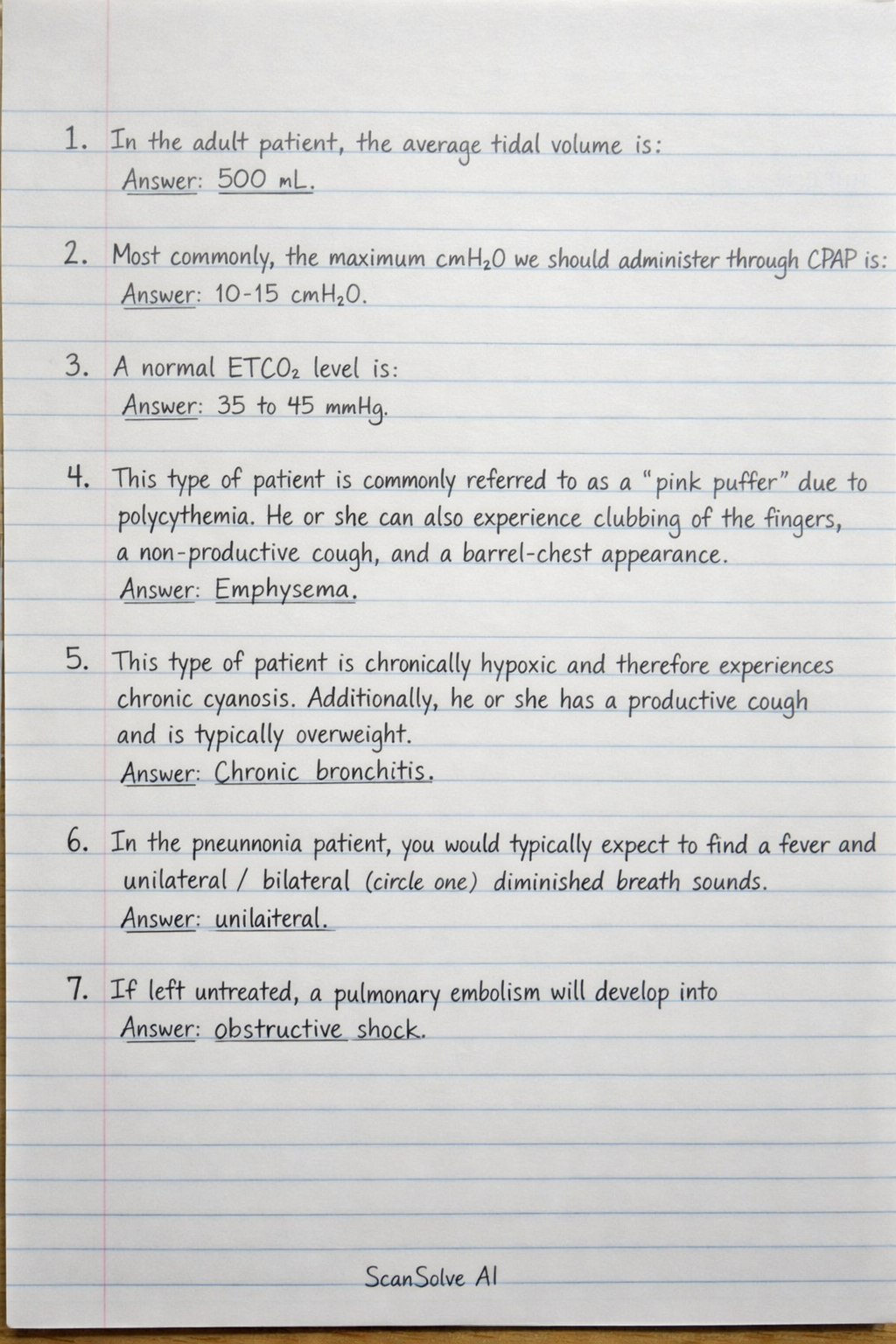
In the adult patient, the average tidal volume is: Answer: 500 mL.
-
Most commonly, the maximum cmH2O we should administer through CPAP is: Answer: 10-15 cmH2O.
-
A normal ETCO2 level is: Answer: 35 to 45 mmHg.
-
This type of patient, is commonly referred to as a "pink puffer" due to polycythemia. He or she can also experience clubbing of the fingers, a non-productive cough, and a barrel-chest appearance. Answer: Emphysema.
-
This type of patient is chronically hypoxic and therefore experience chronic cyanosis. Additionally, he or she has a productive cough and is typically overweight. Answer: Chronic bronchitis.
-
In the pneumonia patient, you would typically expect to find a fever and unilateral/bilateral (circle one) diminished breath sounds. Answer: unilateral.
-
If left untreated, a pulmonary embolism will develop into obstructive shock. Answer: obstructive.
-
Which characteristic type of capnography waveform is seen during an asthma attack or COPD exacerbation? Answer: Shark fin waveform.
-
How much anatomical dead space is typically found in the adult patient? Answer: 150 mL.
-
The oxygen concentration from a nasal cannula is: Answer: 24 to 44 %.
-
What is the medical term for cramping of the fingers (as seen in hyperventilation syndrome)? Answer: Carpopedal spasm.
Still stuck on this one?
Ask a follow-up, and the answer starts from this question.
More Biology Questions
Handwritten Step-by-Step Solution
Get this as a handwritten image on WhatsApp — like a tutor wrote it for you.
Try on WhatsApp