
We read your photo as:
The plant is heterozygous for green leaves. Green (G) is dominant over variegated (g).
ScanSolve AI Answer
Step-by-step solution
10 stepsHere are the solutions to the genetics problems:
3.1.1
The plant is heterozygous for green leaves. Green (G) is dominant over variegated (g).
The genotype is .
3.1.2
The plant (Gg) undergoes self-pollination (Gg x Gg).
The Punnett square for Gg x Gg is:
| G | g | |
|---|---|---|
| G | GG | Gg |
| g | Gg | gg |
The genotypic ratio is 1 GG : 2 Gg : 1 gg.
The phenotypic ratio is 3 Green (GG, Gg) : 1 Variegated (gg).
Total offspring = 64.
a) Number of plants that will have variegated leaves:
Determine the proportion of variegated offspring (gg).
Calculate the number of variegated plants.
Expected number of plants with variegated leaves:
b) Number of plants that will be heterozygous for green leaves:
Determine the proportion of heterozygous offspring (Gg).
Calculate the number of heterozygous plants.
Expected number of plants heterozygous for green leaves:
c) Number of plants that will be homozygous:
Determine the proportion of homozygous offspring (GG or gg).
Calculate the number of homozygous plants.
Expected number of homozygous plants:
2.5
Symbols: T = normal allele, t = recessive Tay-Sachs allele.
A couple are both heterozygous for Tay-Sachs (Tt x Tt).
The Punnett square for Tt x Tt is:T t T TT Tt t Tt tt The genotypic ratio is 1 TT : 2 Tt : 1 tt.
Tay-Sachs disorder is recessive, so a child with the disorder has the genotype tt.Determine the proportion of offspring with Tay-Sachs (tt).
Convert the proportion to a percentage.
The percentage chance of having a child with Tay-Sachs disorder is .
2.6
One in every 27 people in the population group has at least one allele for Tay-Sachs (Tt or tt).
Total sample size = 360,000 people.Identify the proportion of people with at least one allele for Tay-Sachs.
Calculate the expected number of people with the allele in the sample.
Since the number of people must be a whole number, we round to the nearest whole number.
You expect people to have the allele for Tay-Sachs.
Still stuck on this one?
Ask a follow-up, and the answer starts from this question.
More Biology Questions
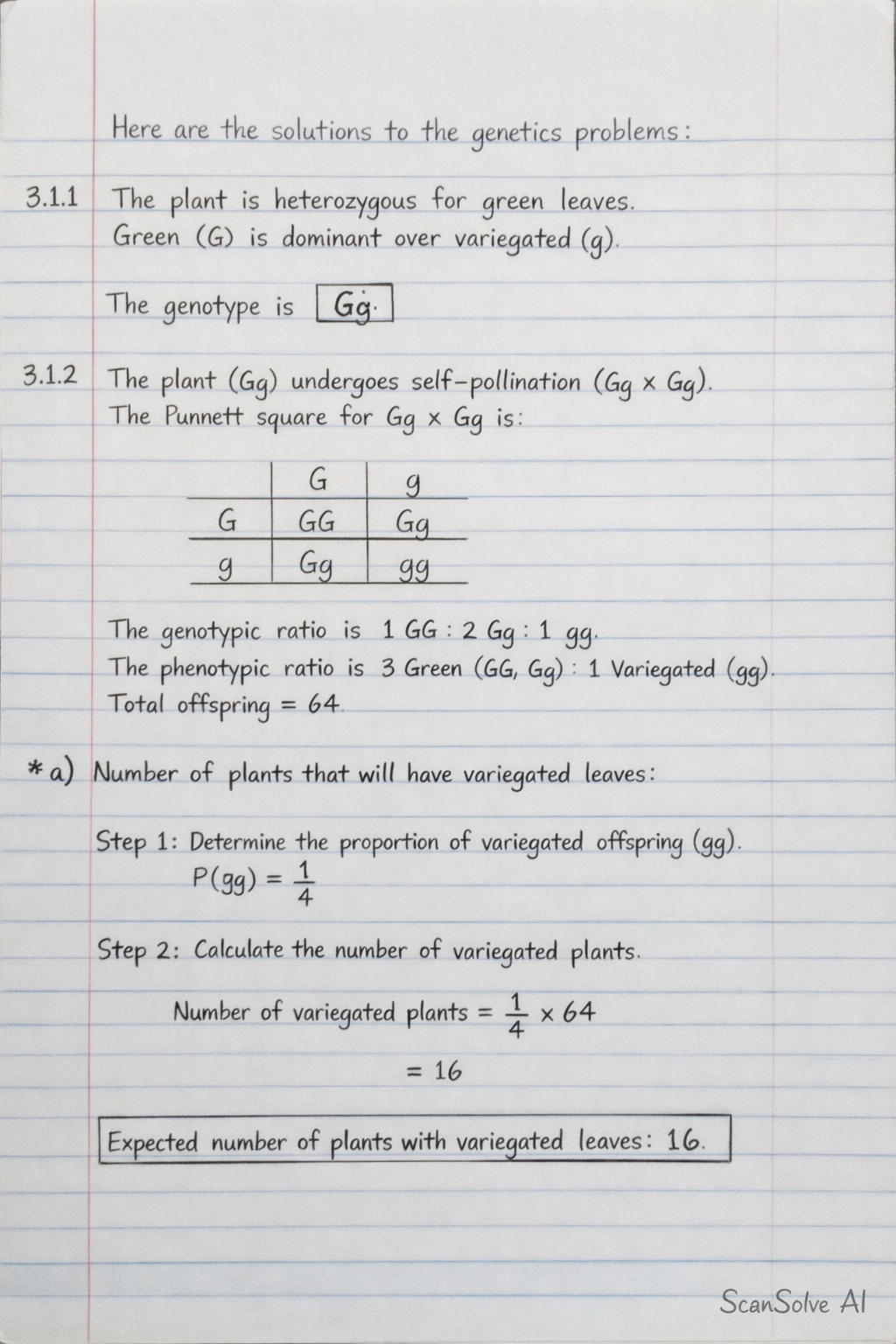
Handwritten Step-by-Step Solution
Get this as a handwritten image on WhatsApp — like a tutor wrote it for you.
Try on WhatsApp