
We read your photo as:
What are the pre-analytical, pre-collection, collection, and post-collection variables affecting laboratory results, and what is the proper drawing order for collection tubes?
Biology
ScanSolve AI Answer
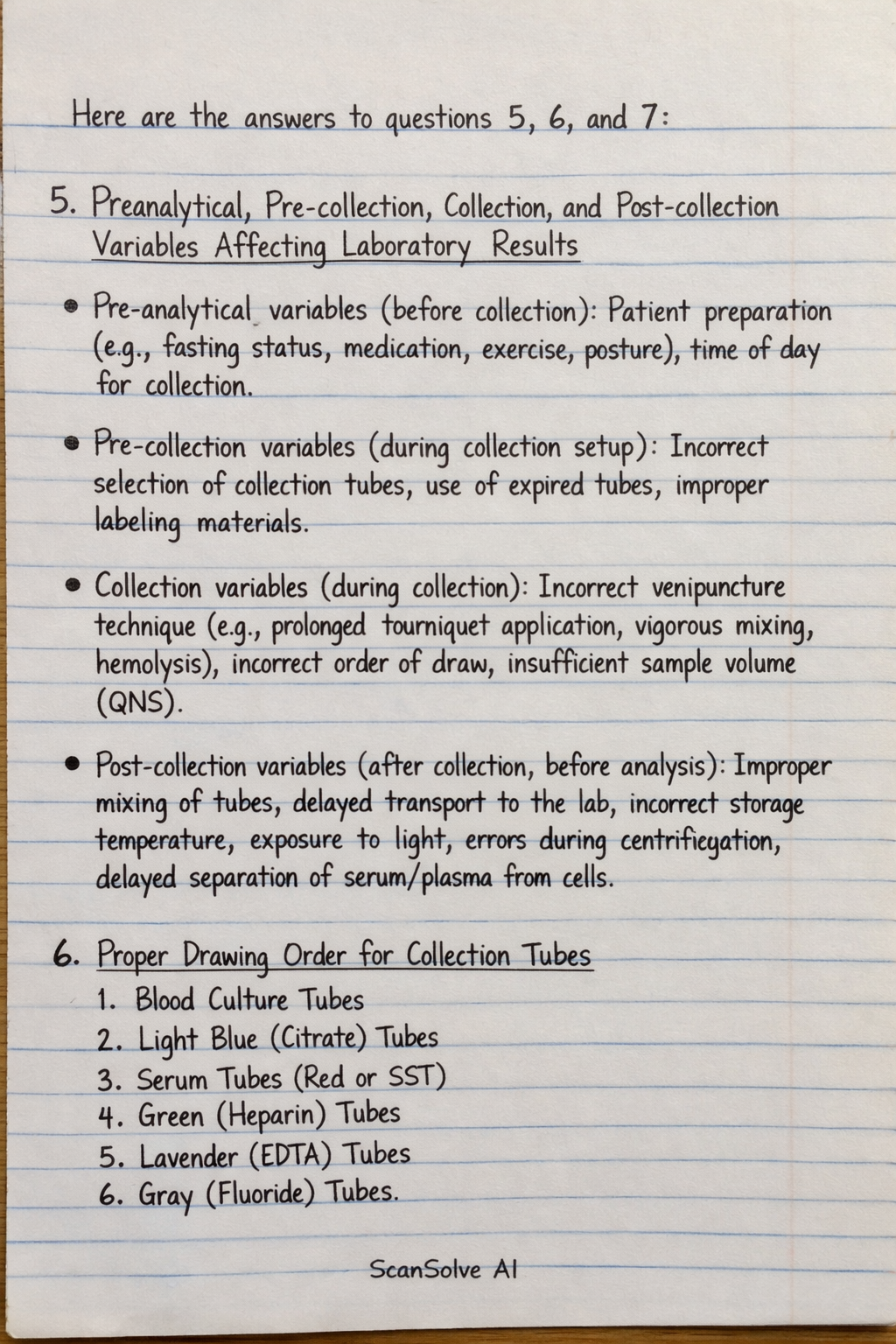
Here are the answers to questions 5, 6, and 7:
5. Preanalytical, Pre-collection, Collection, and Post-collection Variables Affecting Laboratory Results
- Pre-analytical variables (before collection): Patient preparation (e.g., fasting status, medication, exercise, posture), time of day for collection.
- Pre-collection variables (during collection setup): Incorrect selection of collection tubes, use of expired tubes, improper labeling materials.
- Collection variables (during collection): Incorrect venipuncture technique (e.g., prolonged tourniquet application, vigorous mixing, hemolysis), incorrect order of draw, insufficient sample volume (QNS).
- Post-collection variables (after collection, before analysis): Improper mixing of tubes, delayed transport to the lab, incorrect storage temperature, exposure to light, errors during centrifugation, delayed separation of serum/plasma from cells.
6. Proper Drawing Order for Collection Tubes
The standard order of draw is crucial to prevent cross-contamination of additives:
- Blood Culture (Sterile tube, typically yellow top)
- Coagulation Tube (Sodium Citrate, light blue top)
- Serum Tube (with or without clot activator, with or without gel separator; red, gold, or tiger top)
- Heparin Tube (Lithium, Sodium, or Ammonium Heparin; green top)
- EDTA Tube (K2EDTA or K3EDTA; lavender/purple top)
- Glycolytic Inhibitor Tube (Sodium Fluoride/Potassium Oxalate; gray top)
7. General Steps for Processing Samples
- Reception and Accessioning: Samples are received, patient and sample information is verified, and a unique laboratory identification number is assigned.
- Centrifugation: If serum or plasma is required, blood samples are spun to separate cellular components from the fluid portion.
- Aliquotting: The separated serum, plasma, or other fluid is transferred into smaller, labeled tubes for specific tests or storage.
- Storage: Samples are stored under appropriate conditions (e.g., refrigerated, frozen, room temperature, protected from light) until testing or archiving.
- Distribution: Aliquoted samples are distributed to the relevant laboratory sections for analysis.
- Disposal: Remaining sample material and used collection tubes are properly disposed of after testing and retention periods.
Was this helpful?
Still stuck on this one?
Ask a follow-up, and the answer starts from this question.
Got a different question?Ask your own question
More Biology Questions
QDifferent types of tubes use for blood collection, their content and functionQWhat must be checked first prior to taking a blood sample?QWhat are the steps for performing a volumetric acid-base analysis in the correct order?QGroup presentation collection of blood samplesQWhat three pieces of information should be found on a blood container label, and why is each…
Handwritten Step-by-Step Solution
Get this as a handwritten image on WhatsApp — like a tutor wrote it for you.
Try on WhatsApp