

This biology question covers important biological concepts and processes. The step-by-step explanation below helps you understand the underlying mechanisms and reasoning.
ScanSolve AI Answer
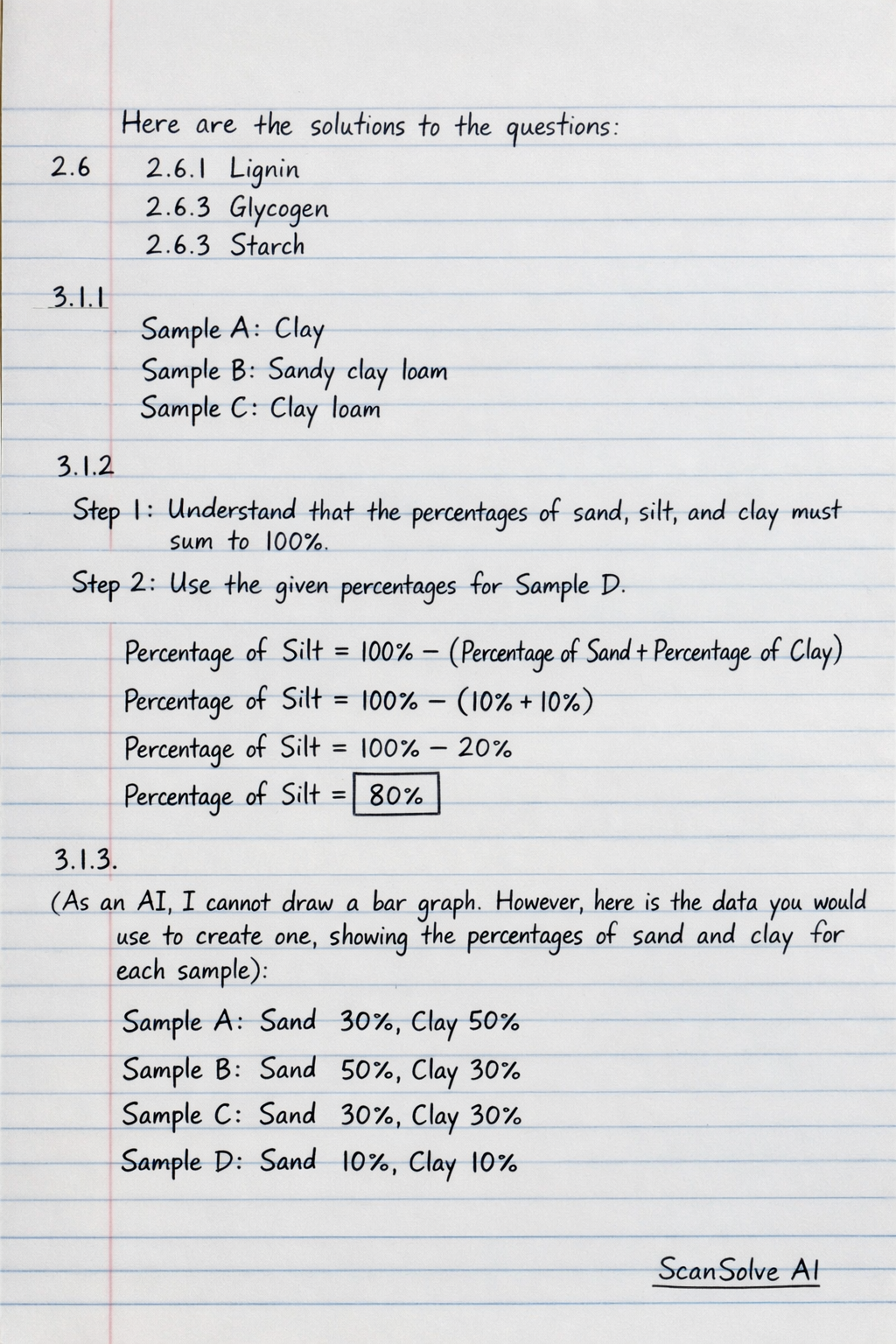
Here are the solutions to the questions: 2.6 2.6.1 Lignin* 2.6.2 Glycogen* 2.6.3 Starch* 3.1.1 Sample A: Clay* Sample B: Sandy clay loam* Sample C: Clay loam* 3.1.2 Step 1: Understand that the percentages of sand, silt, and clay must sum to 100\%. Step 2: Use the given percentages for Sample D. Percentage of Silt = 100\% - (Percentage of Sand + Percentage of Clay) Percentage of Silt = 100\% - (10\% + 10\%) Percentage of Silt = 100\% - 20\% = 80\% 3.1.3 (As an AI, I cannot draw a bar graph. However, here is the data you would use to create one, showing the percentages of sand and clay for each sample): Sample A: Sand 30\%, Clay 50\% Sample B: Sand 50\%, Clay 30\% Sample C: Sand 30\%, Clay 30\% Sample D: Sand 10\%, Clay 10\% 3.2 3.2.1 Soil aeration: Clay particles are very small, leading to small pore spaces. This reduces the amount of air in the soil, resulting in poor aeration*. 3.2.2 Soil water retention: Due to their small size and large surface area, clay particles create many small pores that hold water tightly. This results in high water retention*. 3.2.3 Soil fertility: Clay particles have a high capacity to hold onto positively charged nutrient ions (cation exchange capacity), preventing them from leaching away. This contributes to high soil fertility*. 3.3 3.3.1 Four different types of soil aggregates based on their shapes: Granular* (or Spheroidal) Platy* Blocky* (Angular blocky or Subangular blocky) Prismatic* (or Columnar) 3.3.2 Three importance of a good soil structure: It improves water infiltration and drainage*, allowing water to move through the soil effectively. It enhances soil aeration*, providing sufficient oxygen for root respiration and microbial activity. It reduces soil erosion* by making the soil more resistant to the impact of rain and wind. 3.4 3.4.1 Red colour: Indicates the presence of iron oxides* (e.g., hematite). Suggests good drainage and aeration* in the soil. 3.4.2 Dark colour: Indicates a high content of organic matter* (humus). Suggests good soil fertility* and water-holding capacity. 3.5 Two forms of soil water: Gravitational water* Capillary water* 3.6 Two ways in which the soil can lose water: Evaporation* from the soil surface. Transpiration* by plants. 4.1 Step 1: State the formula for bulk density. Bulk Density = MassVolume Step 2: Substitute the given values into the formula. Bulk Density = 400 g60 cm^3 Step 3: Calculate the bulk density. Bulk Density ≈ 6.67 g/cm^3 The bulk density of the soil sample is 6.67 g/cm^3. 4.2 High bulk density indicates that the soil is compacted. This means there is less total pore space within the soil. Reduced pore space directly leads to decreased porosity and consequently poor aeration, as there is less room for air to circulate. 4.3 Three importance of