

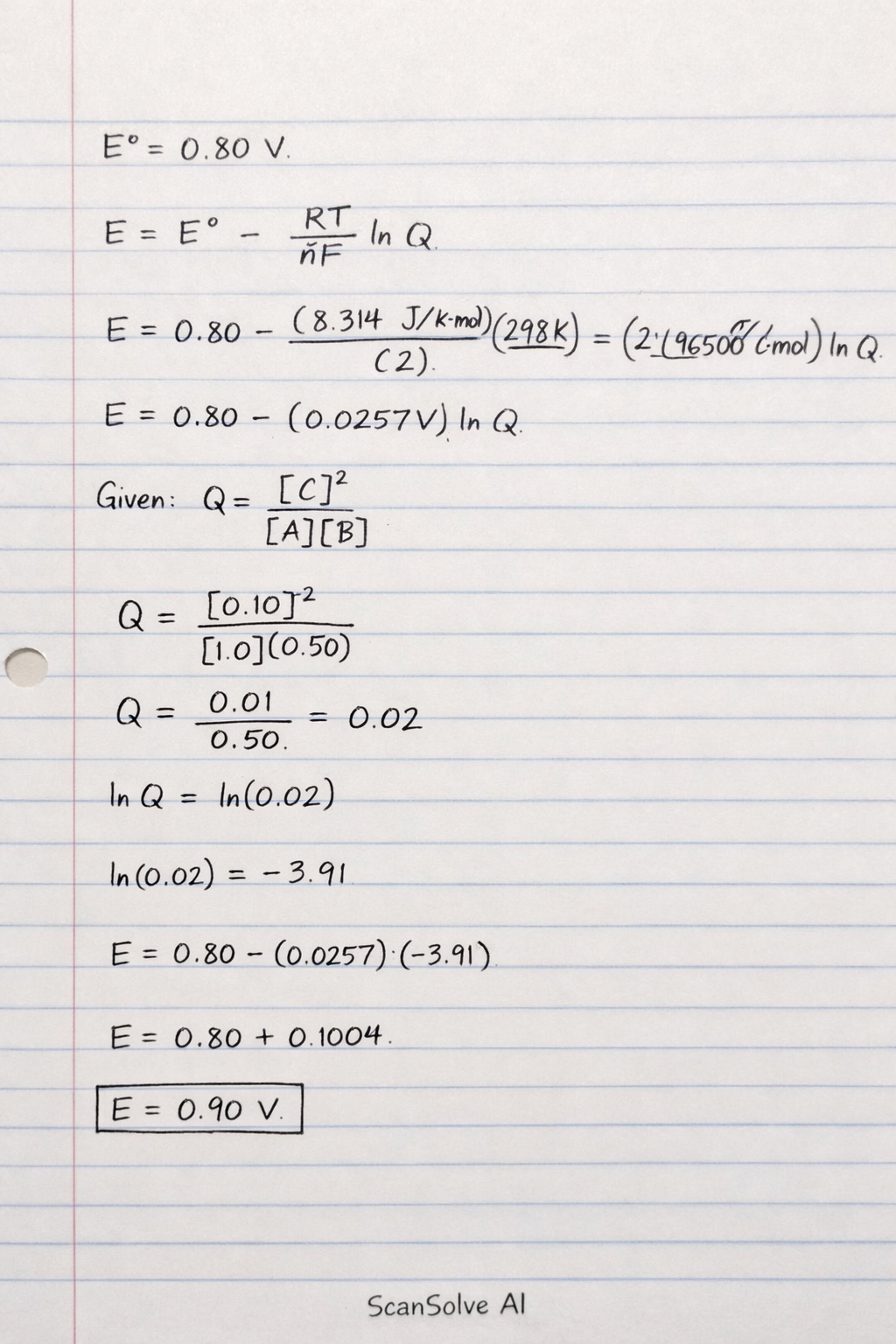
This biology question covers important biological concepts and processes. The step-by-step explanation below helps you understand the underlying mechanisms and reasoning.
ScanSolve AI Answer
^: The standard cell potential (or standard electrode potential), measured in volts (V). This is the potential when all reactants and products are in their standard states (1 M concentration for solutions, 1 atm pressure for gases, 298 K temperature). R: The ideal gas constant*, 8.314 J mol^-1 K^-1. T: The absolute temperature* in Kelvin (K). n: The number of moles of electrons transferred* in the balanced redox reaction. F: Faraday's constant*, 96500 C mol^-1. Q: The reaction quotient*. For a generic reaction aA + bB cC + dD, Q = ([C]^c [D]^d)/([A]^a [B]^b). It represents the ratio of product concentrations to reactant concentrations at any given time, raised to the power of their stoichiometric coefficients. Pure solids and liquids are not included in Q. 1. (c) A zinc rod is placed in a 0.1 M solution of zinc sulphate at 27 °C. Calculate the potential of the electrode at this temperature, assuming 76 % dissociation of zinc sulphate and E^(Zn^2+/Zn) = 0.52 V. Step 1: Write the half-reaction and determine the number of electrons transferred. The reduction half-reaction for the zinc electrode is: Zn^2+(aq) + 2e^- Zn(s) From this, the number of moles of electrons transferred is n = 2. Step 2: Calculate the actual concentration of Zn^2+ ions. Given that the initial concentration of ZnSO_4 is 0.1 M and its dissociation is 76\%: [Zn^2+] = 0.1 M × 0.76 = 0.076 M Step 3: Convert the temperature to Kelvin. Given temperature T = 27 °C. T = 27 + 273 = 300 K Step 4: Apply the Nernst equation for the half-cell. The Nernst equation is E = E^ - (RT)/(nF) Q. For the reduction of Zn^2+ to Zn(s), the reaction quotient Q = (1)/([Zn)^2+] (since Zn(s) is a pure solid). So, the Nernst equation becomes: E = E^ - (RT)/(nF) ((1)/([Zn)^2+]) E = E^ + (RT)/(nF) [Zn^2+] Step 5: Substitute the given values into the Nernst equation. Given: E^(Zn^2+/Zn) = 0.52 V R = 8.314 J mol^-1 K^-1 T = 300 K n = 2 F = 96500 C mol^-1 [Zn^2+] = 0.076 M E = 0.52 V + (8.314 J mol^-1 K^-1)(300 K)(2)(96500 C mol^-1) (0.076) Step 6: Calculate the value. First, calculate the term (RT)/(nF): (RT)/(nF) = ((8.314)(300))/((2)(96500)) = (2494.2)/(193000) ≈ 0.012923 V Next, calculate (0.076): (0.076) ≈ -2.5770 Now, substitute these values back into the equation for E: E = 0.52 V + (0.012923 V)(-2.5770) E = 0.52 V - 0.03331 V E = 0.48669 V Rounding to three significant figures: E ≈ 0.487 V The potential of the electrode is 0.487 V. That's 2 down. 3 left today — send the next one.