
We read your photo as:
The table shows the percentage of gases in inhaled and exhaled air. Account for the differences in percentages, particularly for nitrogen, water vapour, and carbon(iv) oxide.
ScanSolve AI Answer
12. The table below shows the percentage of gases in samples of inhaled and exhaled air.
| Gas | Percentage in Inhaled air | Percentage in Exhaled air |
|---|---|---|
| Oxygen | 20.55 | 16.01 |
| Carbon(iv) oxide | 0.04 | 3.99 |
| Nitrogen | 78.53 | 75.20 |
| Water vapour | 0.48 | 4.42 |
| Other gases | 0.40 | 0.38 |
a. Use the information in the table to explain why the percentage of nitrogen is lower in exhaled air than in the inhaled air. (1mk)
The percentage of nitrogen is lower in exhaled air because the volume of other gases, specifically carbon(iv) oxide and water vapour, increases significantly in exhaled air, diluting the nitrogen and thus reducing its relative percentage, even though nitrogen itself is not used or absorbed by the body.
Account for:
i. Percentage of water vapour in exhaled and inhaled air. (2mks)
Exhaled air has a higher percentage of water vapour (4.42%) compared to inhaled air (0.48%) because air becomes saturated with water vapour as it passes over the moist surfaces of the respiratory tract and lungs.
ii. Percentage of carbon(iv) oxide in the inhaled and exhaled air. (2mks)
Exhaled air has a significantly higher percentage of carbon(iv) oxide (3.99%) compared to inhaled air (0.04%) because carbon(iv) oxide is a waste product of cellular respiration in the body's tissues and is transported to the lungs for expulsion.
ESSAYS
13. Describe abiotic factors found in an ecosystem (20 marks)
Abiotic factors are the non-living physical and chemical components of an ecosystem that influence the organisms living within it.
- Light: Essential for photosynthesis, providing energy for producers. It also influences plant growth patterns, flowering, and the daily and seasonal activities of animals (photoperiodism).
- Temperature: Affects metabolic rates, enzyme activity, and the distribution of species. Organisms have specific temperature ranges for survival, and extreme temperatures can be lethal.
- Water: Crucial for all life processes, acting as a solvent, transport medium, and reactant in many biochemical reactions. Its availability (precipitation, humidity) dictates the types of organisms that can thrive in an area.
- Soil: Provides anchorage for plants and is a source of nutrients and water. Its characteristics, such as pH, texture (sand, silt, clay), mineral content, and organic matter, determine soil fertility and suitability for different plant species.
- Air/Atmosphere: Supplies essential gases like oxygen for respiration, carbon dioxide for photosynthesis, and nitrogen for nitrogen fixation. Wind, a component of air movement, affects seed dispersal, evaporation rates, and can cause physical damage to plants.
- pH: The acidity or alkalinity of soil and water significantly impacts nutrient availability and the survival of organisms. Most organisms have a narrow optimal pH range.
- Salinity: The concentration of salts in water or soil affects the osmotic balance of organisms. High salinity can lead to dehydration in non-adapted species.
- Topography/Altitude: Features like slope, aspect (direction a slope faces), and elevation influence local microclimates, affecting light intensity, temperature, precipitation, and soil depth.
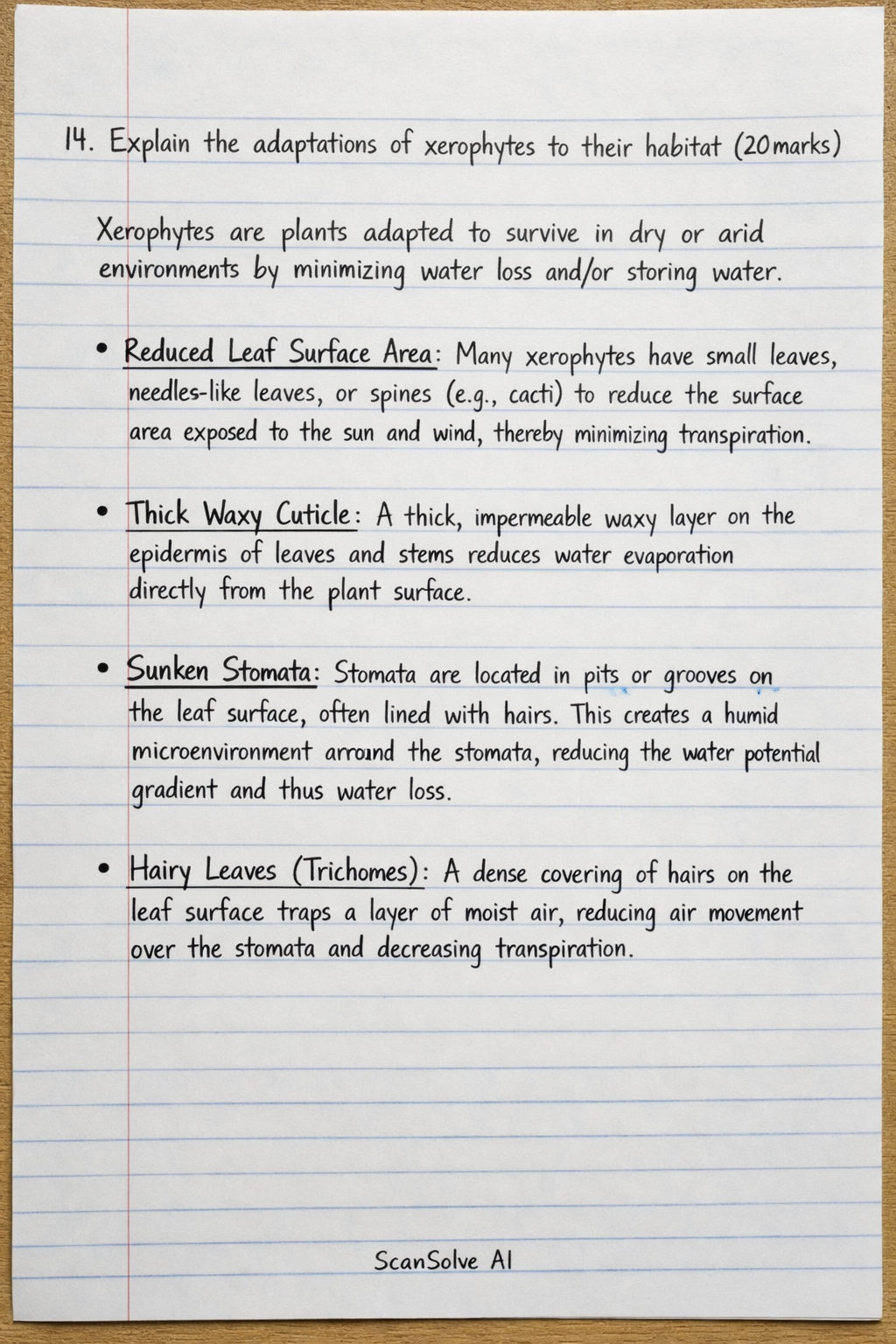
14. Explain the adaptations of xerophytes to their habitat (20 marks)
Xerophytes are plants adapted to survive in dry or arid environments by minimizing water loss and/or storing water.
- Reduced Leaf Surface Area: Many xerophytes have small leaves, needle-like leaves, or spines (e.g., cacti) to reduce the surface area exposed to the sun and wind, thereby minimizing transpiration.
- Thick Waxy Cuticle: A thick, impermeable waxy layer on the epidermis of leaves and stems reduces water evaporation directly from the plant surface.
- Sunken Stomata: Stomata are located in pits or grooves on the leaf surface, often lined with hairs. This creates a humid microenvironment around the stomata, reducing the water potential gradient and thus water loss.
- Hairy Leaves (Trichomes): A dense covering of hairs on the leaf surface traps a layer of moist air, reducing air movement over the stomata and decreasing transpiration.
- Rolled Leaves: Some xerophytes, like Marram grass, have leaves that roll inwards, enclosing the stomata within a humid chamber, protecting them from dry winds.
- Extensive Root Systems: Xerophytes often develop either very deep roots to access groundwater or wide-spreading shallow root systems to quickly absorb surface moisture after rainfall.
- Succulence: Many xerophytes, such as cacti and aloes, have fleshy stems or leaves adapted to store large quantities of water, allowing them to survive long dry periods.
- Reduced Number of Stomata: Fewer stomata on the leaf surface mean fewer pores through which water can escape via transpiration.
- Crassulacean Acid Metabolism (CAM) Photosynthesis: These plants open their stomata only at night to take in carbon dioxide, storing it as organic acids. During the day, stomata remain closed, and the stored CO2 is used for photosynthesis, significantly reducing water loss.
- Shedding Leaves: Some xerophytes shed their leaves during prolonged dry seasons to conserve water, reducing the total transpiring surface area.
- Short Life Cycle (Ephemerals): Certain desert plants complete their entire life cycle (germination, growth, flowering, seed production) within a few weeks during brief wet periods, surviving dry spells as dormant seeds.
15. Describe how the mammalian skin regulates body temperature (20 marks)
Mammalian skin plays a vital role in thermoregulation, maintaining a stable internal body temperature through various mechanisms.
- Sweat Glands: When the body temperature rises, sweat glands produce sweat, which is primarily water and salts. As sweat evaporates from the skin surface, it absorbs latent heat from the body, leading to a cooling effect.
- Blood Vessels (Arterioles):
- Vasodilation: In hot conditions, arterioles near the skin surface dilate (widen), increasing blood flow to the skin. This brings more warm blood closer to the surface, allowing heat to radiate away from the body into the cooler environment.
- Vasoconstriction: In cold conditions, arterioles constrict (narrow), reducing blood flow to the skin. This minimizes heat loss from the body surface, conserving core body heat.
- Hair/Fur:
- Piloerection: Small muscles called erector pili contract, causing hairs to stand upright. This traps a layer of insulating air close to the skin, reducing heat loss to the environment. This also causes "goosebumps."
- Insulation: A thick layer of fur or hair acts as a natural insulator, trapping air and preventing heat transfer from the body to the surroundings, particularly effective in cold climates.
- Adipose Tissue (Subcutaneous Fat): A layer of fat beneath the skin acts as an effective insulator, reducing heat loss from the body's core to the surface. This is particularly prominent in marine mammals.
- Sensory Receptors (Thermoreceptors): The skin contains specialized nerve endings that detect changes in external temperature. These receptors send signals to the hypothalamus in the brain, which is the body's thermoregulatory center, initiating appropriate responses to maintain temperature homeostasis.
Still stuck on this one?
Ask a follow-up, and the answer starts from this question.
More Biology Questions
Handwritten Step-by-Step Solution
Get this as a handwritten image on WhatsApp — like a tutor wrote it for you.
Try on WhatsApp