

This biology question covers important biological concepts and processes. The step-by-step explanation below helps you understand the underlying mechanisms and reasoning.
ScanSolve AI Answer
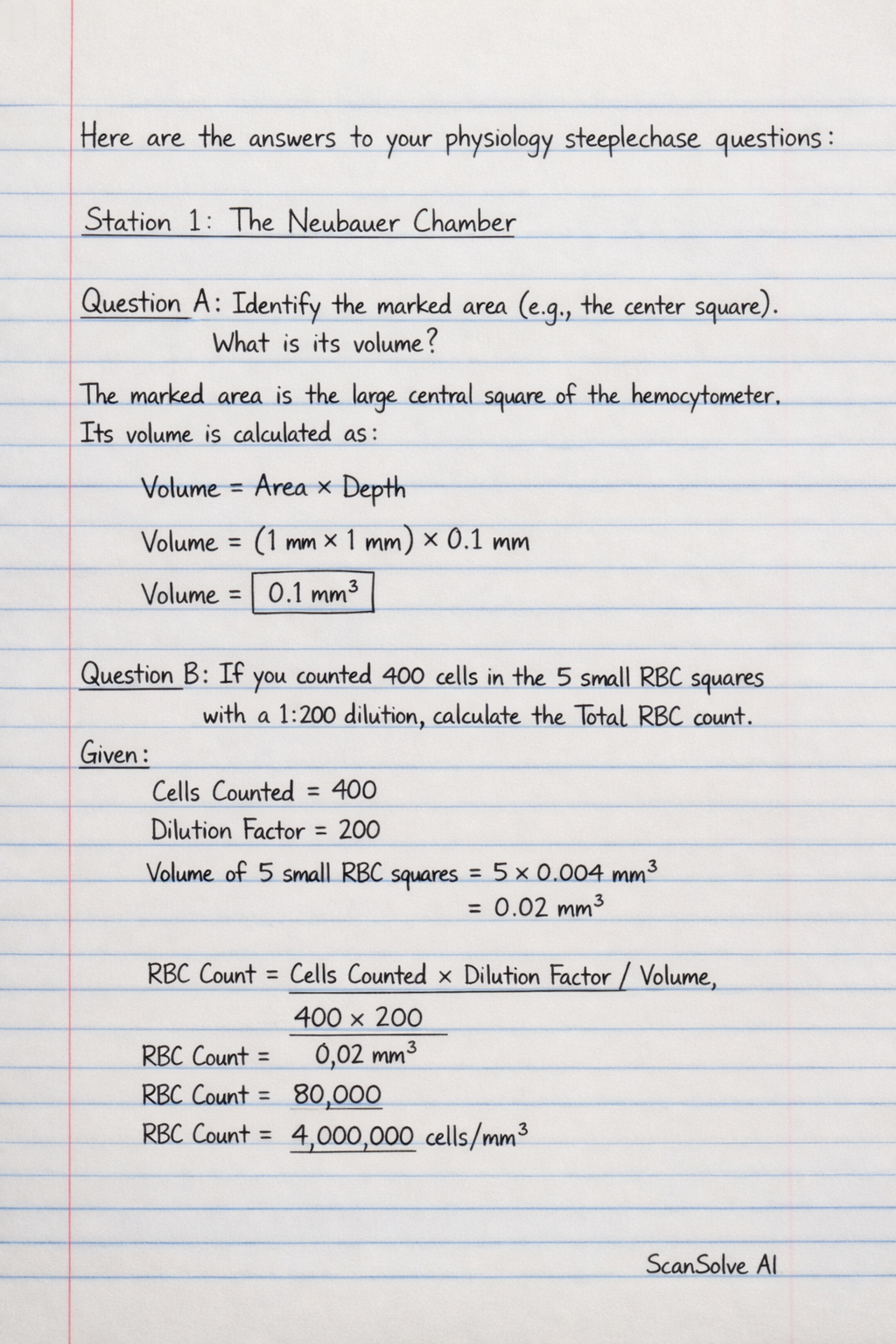
Here are the answers to your physiology steeplechase questions: Station 1: The Neubauer Chamber Question A: Identify the marked area (e.g., the center square). What is its volume? The marked area is the large central square of the hemocytometer. Its volume is calculated as: Volume = Area × Depth Volume = (1 mm × 1 mm) × 0.1 mm Volume = 0.1 mm^3 Question B: If you counted 400 cells in the 5 small RBC squares with a 1:200 dilution, calculate the Total RBC count. Given: Cells Counted = 400 Dilution Factor = 200 Volume of 5 small RBC squares = 5 × 0.004 mm^3 = 0.02 mm^3 Using the formula: Total Count = Cells Counted × Dilution FactorVolume of Squares Counted Total Count = (400 × 200)/(0.02 mm)^3 Total Count = (80000)/(0.02 mm)^3 Total Count = 4,000,000 cells/mm^3 Total Count = 4.0 × 10^6 cells/mm^3 Question C: Why is Hayem's fluid used for this count instead of distilled water? Hayem's fluid is isotonic, meaning it has a similar osmotic pressure to red blood cells. This prevents the red blood cells from undergoing hemolysis (bursting) or crenation (shrinking), which would occur if distilled water (hypotonic) or a hypertonic solution were used, respectively. Station 2: ESR & PCV (Wintrobe's Tube) Question A: Identify the instrument. What is the difference between the scale on the left and the scale on the right? The instrument is a Wintrobe tube. The scale on the left is for measuring ESR (Erythrocyte Sedimentation Rate), with 0 at the top and increasing values downwards. The scale on the right is for measuring PCV (Packed Cell Volume), with 0 at the bottom and increasing values upwards. Question B: Identify the clear layer at the top and the thin white layer in the middle. The clear layer at the top is plasma. The thin white layer in the middle is the buffy coat. Question C: Name one clinical condition that causes a 'Physiological' increase in ESR. One physiological condition that causes an increase in ESR is pregnancy. Station 3: Differential Leukocyte Count (DLC) Question A: Identify the cell in the field of view (e.g., a cell with a multi-lobed nucleus and fine pink granules). Based on the description (multi-lobed nucleus and fine pink granules), the cell is a Neutrophil. Question B: What is the normal percentage of this cell in a healthy adult? The normal percentage of neutrophils in a healthy adult is typically between 40% and 75%. Question C: In what clinical condition would you see an "Eosinophilia"? Eosinophilia (an increase in eosinophils) is commonly seen in clinical conditions such as allergic reactions (e.g., asthma, hay fever) and parasitic infections. 3 done, 2 left today. You're making progress.