
We read your photo as:
These are the questions that follow answer them correctly based on the based under the mphil biology course Research methods
ScanSolve AI Answer
Step-by-step solution
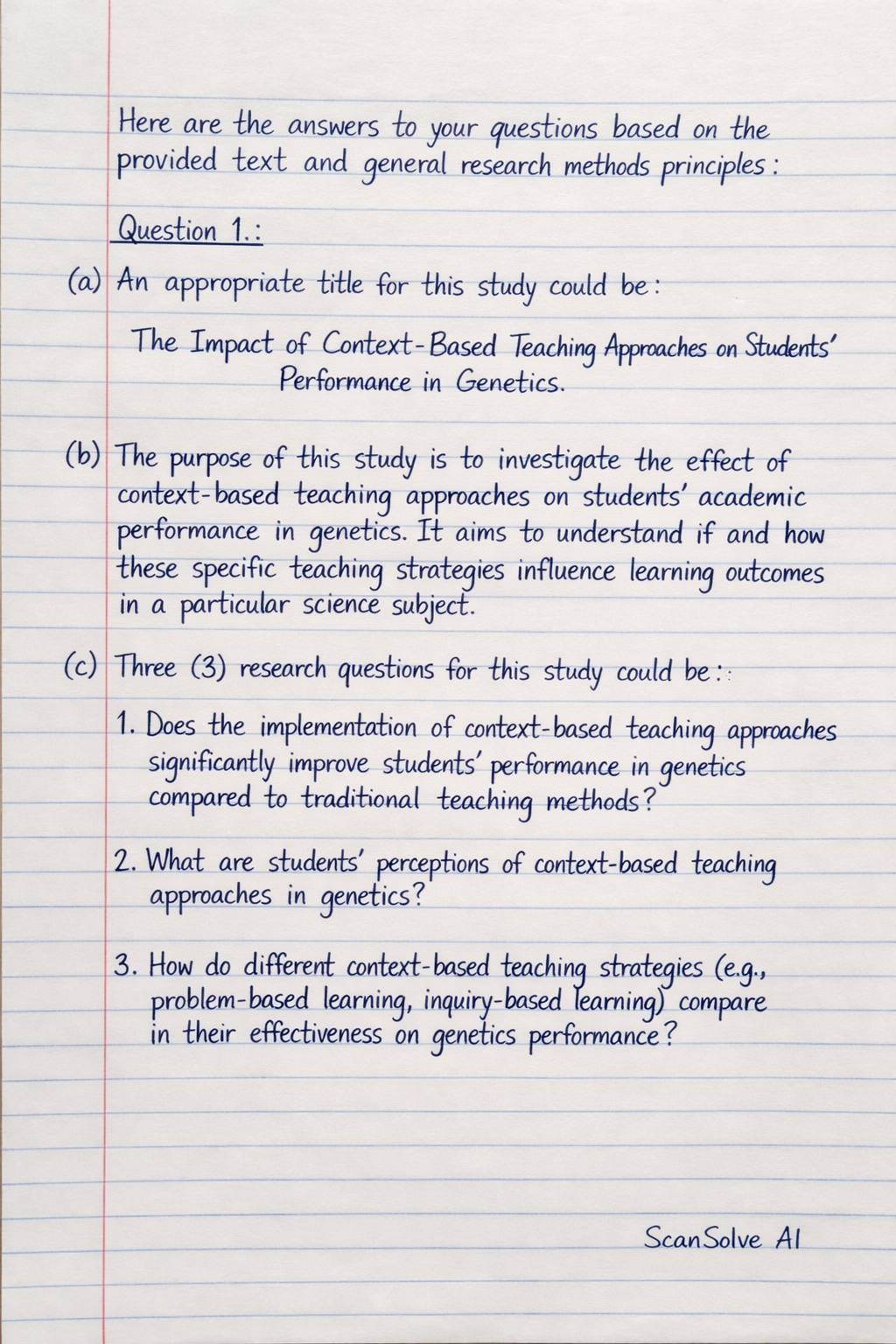
21 stepsHere are the answers to your questions based on the provided text and general research methods principles:
Question 1:
a) An appropriate title for this study could be:
- The Impact of Context-Based Teaching Approaches on Students' Performance in Genetics.
b) The purpose of this study is to investigate the effect of context-based teaching approaches on students' academic performance in genetics. It aims to understand if and how these specific teaching strategies influence learning outcomes in a particular science subject.
c) Three (3) research questions for this study could be:
- Does the implementation of context-based teaching approaches significantly improve students' performance in genetics compared to traditional teaching methods?
- What are students' perceptions of context-based teaching approaches in genetics?
- How do different context-based teaching strategies (e.g., problem-based learning, inquiry-based learning) compare in their effectiveness on genetics performance?
d) One (1) limitation of this study could be:
- Generalizability: The findings might be specific to the particular school or group of students studied and may not be broadly applicable to all educational settings or student populations.
e) An appropriate research design for this study is a quasi-experimental design, specifically a non-equivalent control group pretest-posttest design.
- Justification: This design is suitable because it allows for the comparison of an intervention (context-based teaching) with a control group (traditional teaching) while acknowledging that random assignment of students to groups might not be feasible in an existing school setting. A pretest measures baseline performance, and a posttest measures performance after the intervention, allowing for the assessment of change attributable to the teaching approach.
f) One (1) instrument that can be used to collect data for this study is a genetics achievement test.
- Justification: An achievement test directly measures students' understanding and knowledge of genetics concepts, providing quantitative data on their performance, which is the primary dependent variable of interest in this study.
g) An appropriate research paradigm for the study is post-positivism.
- Justification: Post-positivism acknowledges that absolute truth cannot be perfectly known but seeks to understand reality through empirical observation and measurement, often involving quantitative methods. It recognizes the potential for bias and error but strives for objectivity and generalizability, aligning with the goal of determining the impact of a teaching approach on performance.
Question 2:
a) The step-by-step process of organizing a literature review on "Determination of mercury and cadmium levels in omega-3 food supplements available on the Ghanaian market" involves:
Define Research Question/Scope
Clearly articulate the specific aspects of mercury and cadmium levels in omega-3 supplements in Ghana you want to explore. This helps narrow down the search.
Identify Keywords
Brainstorm relevant keywords such as "mercury," "cadmium," "omega-3 supplements," "fish oil," "Ghana," "heavy metals," "contamination," "food safety," "public health."
Search for Literature
Use academic databases (e.g., PubMed, Scopus, Web of Science, Google Scholar) and university library resources. Include grey literature if relevant.
Screen and Select Sources
Review titles and abstracts to identify relevant articles. Read full texts of promising articles, applying inclusion/exclusion criteria (e.g., studies on Ghanaian market, specific types of omega-3, relevant analytical methods).
Extract and Synthesize Information
For each selected article, extract key information such as study objectives, methodologies, findings (e.g., detected levels of mercury/cadmium), limitations, and conclusions. Look for patterns, discrepancies, and emerging themes.
Critically Evaluate Sources
Assess the quality and reliability of each study. Consider the methodology, sample size, analytical techniques used, and potential biases.
Organize and Structure the Review
Group similar studies, identify chronological trends, or categorize by themes (e.g., levels in different supplement types, health implications, regulatory aspects). Create an outline for the review.
Write the Review
Begin with an introduction stating the topic's importance, followed by sections that discuss the synthesized literature, critically analyze findings, identify gaps, and conclude with implications for future research or policy.
Cite and Reference
Ensure all sources are properly cited according to a chosen referencing style (e.g., APA, Vancouver).
b)
i) Random assignment of subjects refers to the process of allocating participants who have already been selected for a study into different experimental or control groups using a random method. This ensures that the groups are equivalent at the start of the experiment, minimizing pre-existing differences and increasing the internal validity of the study.
Random selection of groups refers to the process of choosing entire groups or clusters (e.g., classrooms, hospitals) from a larger population to participate in a study, where each group has an equal chance of being selected. This is often used in cluster sampling and aims to enhance the external validity or generalizability of the findings to the larger population of groups.ii) One Group Pretest-Posttest Design:
This design involves a single group of participants who are measured on a dependent variable (pretest), then exposed to a treatment or intervention, and finally measured again on the same dependent variable (posttest). The change in scores from pretest to posttest is attributed to the intervention.Diagram:
Where:
- : Observation or measurement of the dependent variable before the intervention (Pretest).
- : The treatment or intervention.
- : Observation or measurement of the dependent variable after the intervention (Posttest).
Question 3:
a)
i) Sequential transformative design is a mixed methods approach where one type of data (qualitative or quantitative) is collected and analyzed first, followed by the other type. The distinguishing feature is that the design is guided by a theoretical perspective or framework (e.g., feminist theory, critical theory) that informs the research questions, data collection, and interpretation, often with an aim for social justice or advocacy.
Sequential exploratory design is also a mixed methods approach where qualitative data is collected and analyzed first, followed by quantitative data. The purpose is to explore a phenomenon qualitatively to develop instruments, variables, or hypotheses that can then be tested or measured quantitatively in the second phase. The qualitative findings inform the quantitative phase.ii) The step-by-step process of using a table of random numbers to select a sample for a study:
Assign a Unique Number
Assign a unique numerical identifier to each member of the sampling frame (the complete list of the population from which you want to draw your sample). For example, if you have 500 students, number them from 001 to 500.
Determine Sample Size
Decide on the desired number of participants for your sample.
Choose a Starting Point
Randomly select a starting point in the table of random numbers. You can close your eyes and point, or use a systematic method like picking the 5th row and 10th column.
Select Numbers Systematically
Move in a consistent direction (e.g., across rows, down columns, diagonally) from your starting point. Read off numbers that match the number of digits in your population identifiers (e.g., three digits for 001-500).
Match and Select
If a number read from the table matches a number assigned to a member of your sampling frame, that member is included in your sample.
Handle Duplicates and Out-of-Range Numbers
Ignore any numbers that are duplicates (if you are sampling without replacement) or numbers that fall outside the range of your assigned population identifiers (e.g., if your population is 500, ignore numbers like 678 or 000).
Continue Until Sample Size is Reached
Keep selecting numbers until you have reached your desired sample size.
b)
i) To select a sample size of 40 such that females are duly represented as they are in the population, you would use stratified random sampling with proportional allocation.
Calculate Proportions
- Total population = 100
- Female population = 25
- Male population =
- Proportion of females =
- Proportion of males =
Determine Sample Size for Each Stratum
- Desired total sample size = 40
- Number of females in sample =
- Number of males in sample =
Randomly Select from Each Stratum
- From the list of 25 female students, randomly select 10 students (e.g., using a random number generator or table of random numbers).
- From the list of 75 male students, randomly select 30 students. This method ensures that the sample of 40 students accurately reflects the gender distribution of the school population.
ii) Two (2) differences between categorical and continuous variables:
Nature of Values
- Categorical variables represent types or categories, often expressed as names or labels (e.g., gender: male/female; blood type: A, B, AB, O). They do not have a meaningful numerical order or measurement.
- Continuous variables represent measurements along a continuum, capable of taking any value within a given range (e.g., height: 1.75 m; temperature: 25.3 °C; time: 12.5 seconds). They can be infinitely divided into smaller units.
Mathematical Operations
- Categorical variables cannot be meaningfully subjected to most mathematical operations like addition, subtraction, or averaging (e.g., averaging "male" and "female" makes no sense). They are typically analyzed using counts, frequencies, and proportions.
- Continuous variables can be meaningfully subjected to a full range of mathematical operations, allowing for calculations of means, standard deviations, and other statistical measures.
Still stuck on this one?
Ask a follow-up, and the answer starts from this question.
More Biology Questions
Handwritten Step-by-Step Solution
Get this as a handwritten image on WhatsApp — like a tutor wrote it for you.
Try on WhatsApp