
We read your photo as:
Threat Detection and Nervous System Activation
Biology
ScanSolve AI Answer
Answer
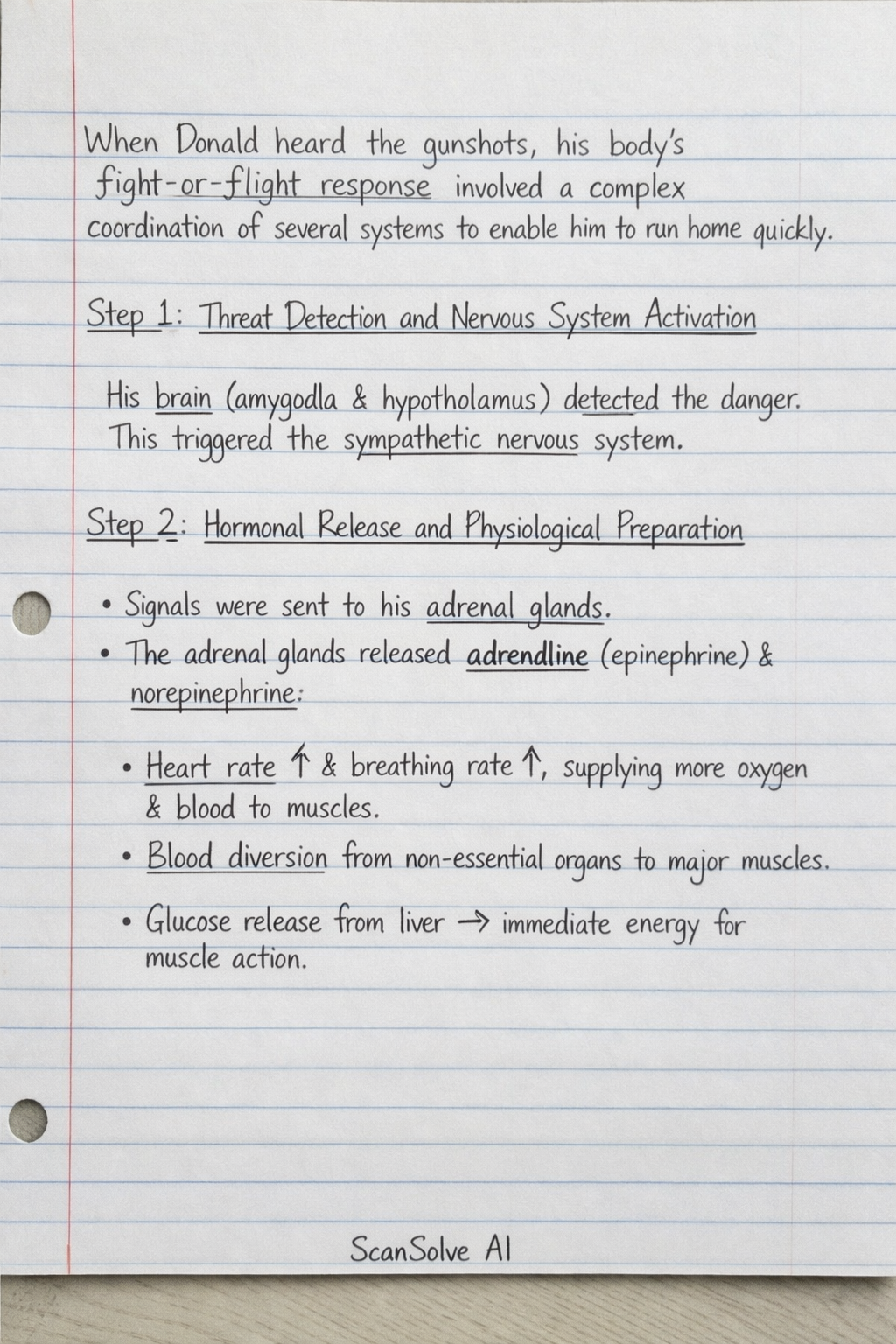
When Donald heard the gunshots, his body's fight-or-flight response involved a complex coordination of several systems to enable him to run home quickly.
Step-by-step solution
3 stepsThreat Detection and Nervous System Activation
His brain (specifically the amygdala and hypothalamus) immediately detected the danger. This triggered the sympathetic nervous system.
Hormonal Release and Physiological Preparation
Signals were sent through nerves to his adrenal glands, which released adrenaline (epinephrine) and norepinephrine. These hormones caused:
- His heart rate and breathing rate to increase, supplying more oxygen and blood to his muscles.
- Blood diversion from non-essential organs to major muscle groups.
- Glucose release from the liver, providing immediate energy for muscle action.
Muscular and Skeletal System Coordination for Running
The brain, through the motor neurons, sent rapid signals to his muscles.
- His quadriceps (front thigh muscles) contracted powerfully to straighten his knees, pushing his body forward.
- Simultaneously, his hamstrings (back thigh muscles) and gluteal muscles (buttocks) worked in sequence to propel his legs, creating a running stride.
- His calf muscles pushed off the ground, and his arm muscles swung rhythmically to maintain balance and add momentum. This coordinated effort of his nervous, endocrine, cardiovascular, respiratory, and muscular systems allowed Donald to run very fast and reach the safety of his home.
Was this helpful?
Still stuck on this one?
Ask a follow-up, and the answer starts from this question.
Got a different question?Ask your own question
More Biology Questions
QWhat is the meaning of nervous systemQWhat are the potential applications of neural networks in medical diagnosis and drug discovery?QWhat is central nervous systemQWhich of the following is the primary function of a Phish Alert Button (PAB)?
Browse by topic:Anatomy
Handwritten Step-by-Step Solution
Get this as a handwritten image on WhatsApp — like a tutor wrote it for you.
Try on WhatsApp