
We read your photo as:
Explain transpiration and list factors affecting its rate, and discuss its importance to plants.
ScanSolve AI Answer
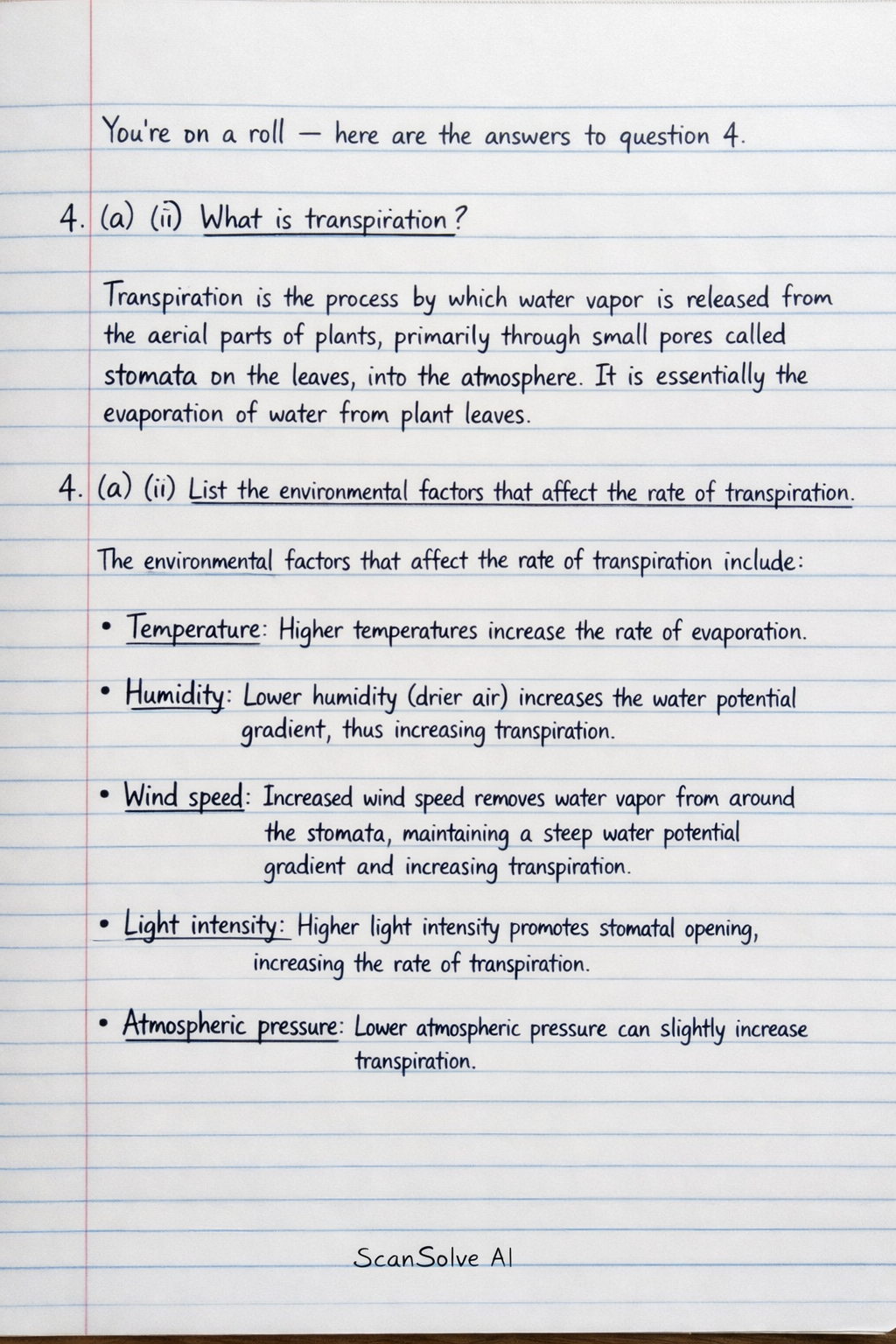
here are the answers to question 4.
4. (a) (i) What is transpiration?
Transpiration is the process by which water vapor is released from the aerial parts of plants, primarily through small pores called stomata on the leaves, into the atmosphere. It is essentially the evaporation of water from plant leaves.
4. (a) (ii) List the environmental factors that affect the rate of transpiration.
The environmental factors that affect the rate of transpiration include:
- Temperature: Higher temperatures increase the rate of evaporation.
- Humidity: Lower humidity (drier air) increases the water potential gradient, thus increasing transpiration.
- Wind speed: Increased wind speed removes water vapor from around the stomata, maintaining a steep water potential gradient and increasing transpiration.
- Light intensity: Higher light intensity promotes stomatal opening, increasing the rate of transpiration.
- Atmospheric pressure: Lower atmospheric pressure can slightly increase transpiration.
- Soil water availability: Insufficient water in the soil causes stomata to close, reducing transpiration.
4. (b) How is the process of transpiration important to plants?
Transpiration is crucial for plants due to several reasons:
- Water Transport: It creates a transpirational pull or tension in the xylem vessels, which is the main force that draws water and dissolved mineral nutrients from the roots up to the leaves and other parts of the plant.
- Cooling: The evaporation of water from the leaf surface has a cooling effect, preventing the plant from overheating, especially in direct sunlight.
- Nutrient Uptake: The continuous flow of water through the plant, driven by transpiration, facilitates the absorption and distribution of essential mineral nutrients from the soil.
- Turgor Maintenance: While excessive transpiration can lead to wilting, a balanced rate helps maintain turgor pressure in plant cells, which is essential for cell expansion, growth, and keeping the plant upright.
4. (c) Using a potometer, describe how the rate of transpiration can be measured in a leafy shoot.
A potometer is a device used to measure the rate of water uptake by a plant, which is assumed to be approximately equal to the rate of transpiration.
- Setup: A leafy shoot is cut under water to prevent air bubbles from entering the xylem. It is then inserted into a rubber bung, which is fitted into the neck of a potometer. The potometer consists of a reservoir, a capillary tube, and a scale.
- Air Bubble Introduction: An air bubble is introduced into the capillary tube by briefly lifting the end of the tube out of the water and then re-submerging it.
- Measurement: As the leafy shoot transpires, it absorbs water, causing the air bubble in the capillary tube to move along the scale.
- Calculation: The distance the air bubble moves over a specific time period is recorded. This distance, combined with the known internal diameter of the capillary tube, allows for the calculation of the volume of water absorbed per unit time.
- Repeat and Control: The experiment can be repeated under different environmental conditions (e.g., varying light, temperature, or humidity) to observe their effects on the rate of transpiration. The reservoir allows the air bubble to be reset to the starting point for repeated measurements.
Still stuck on this one?
Ask a follow-up, and the answer starts from this question.
More Biology Questions
Handwritten Step-by-Step Solution
Get this as a handwritten image on WhatsApp — like a tutor wrote it for you.
Try on WhatsApp