
We read your photo as:
What are two types of plant pests and how can they be controlled? Describe the life cycle of a bean plant and list three major plant nutrients and their sources and importance.
Biology
ScanSolve AI Answer
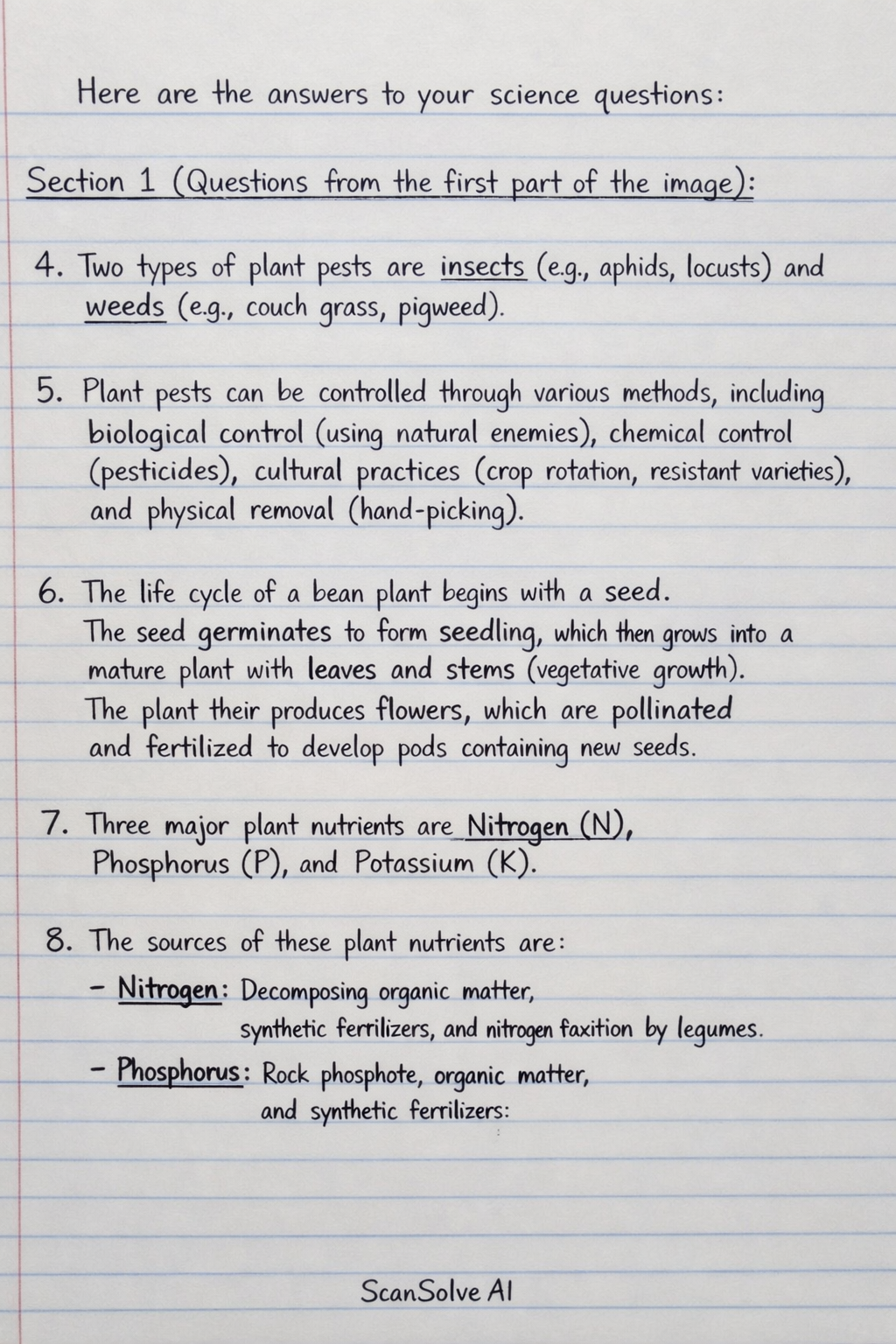
Here are the answers to your science questions:
Section 1 (Questions from the first part of the image):
- Two types of plant pests are insects (e.g., aphids, locusts) and weeds (e.g., couch grass, pigweed).
- Plant pests can be controlled through various methods, including biological control (using natural enemies), chemical control (pesticides), cultural practices (crop rotation, resistant varieties), and physical removal (hand-picking).
- The life cycle of a bean plant begins with a seed. The seed germinates to form a seedling, which then grows into a mature plant with leaves and stems (vegetative growth). The plant then produces flowers, which are pollinated and fertilized to develop pods containing new seeds.
- Three major plant nutrients are Nitrogen (N), Phosphorus (P), and Potassium (K).
- The sources of these plant nutrients are:
- Nitrogen: Decomposing organic matter, synthetic fertilizers, and nitrogen fixation by legumes.
- Phosphorus: Rock phosphate, organic matter, and synthetic fertilizers.
- Potassium: Mineral rocks, organic matter, and synthetic fertilizers.
- The importance of each plant nutrient:
- Nitrogen: Essential for leafy growth and the production of chlorophyll, which is vital for photosynthesis.
- Phosphorus: Crucial for root development, flowering, fruiting, and energy transfer within the plant.
- Potassium: Important for water regulation, disease resistance, and the overall quality of fruits and seeds.
- When plants lack each plant nutrient:
- Nitrogen deficiency: Leads to yellowing of older leaves (chlorosis) and stunted growth.
- Phosphorus deficiency: Causes purplish discoloration of leaves, poor root development, and delayed maturity.
- Potassium deficiency: Results in yellowing or browning of leaf margins, weak stems, and poor fruit development.
- Vertebrates are animals that possess a backbone or spinal column, which is part of their internal skeleton.
- Three groups of vertebrates are mammals, birds, and fish. Three groups of invertebrates are insects, molluscs, and annelids.
- Three examples of vertebrates are humans, dogs, and snakes. Three examples of invertebrates are earthworms, butterflies, and snails.
- Water bodies and the environment are important because they provide habitats for diverse species, regulate global climate, supply essential resources like food and drinking water, and support biodiversity. A healthy environment ensures the survival and well-being of all living organisms.
- The components of a food web are producers (e.g., plants), consumers (primary, secondary, tertiary, e.g., herbivores, carnivores, omnivores), and decomposers (e.g., bacteria, fungi).
Section 2 (Questions from the second part of the image):
- An ecosystem is a community of living organisms (biotic components) interacting with their non-living physical environment (abiotic components) in a specific area.
- To draw a diagram showing a food web:
- Start with producers (e.g., grass, trees, algae) at the bottom.
- Draw arrows from producers to primary consumers (herbivores) that eat them (e.g., grasshopper eats grass).
- Draw arrows from primary consumers to secondary consumers (carnivores/omnivores) that eat them (e.g., frog eats grasshopper).
- Continue drawing arrows to tertiary consumers and so on, showing multiple feeding relationships and how different food chains interconnect.
- Ensure arrows point in the direction of energy flow (from the organism being eaten to the organism that eats it).
- Example: Grass Grasshopper Frog Snake Eagle. Also, Grass Rabbit Fox. The fox might also eat the snake, creating a web.
- The importance of a food web is that it illustrates the complex and interconnected feeding relationships within an ecosystem, showing how energy and nutrients flow. It demonstrates the interdependence of species and helps us understand the stability and resilience of an ecosystem, as well as the potential impact of changes to one population on others.
- Pollination is the process by which pollen grains are transferred from the anther (male part) of a flower to the stigma (female part) of the same or another flower. This transfer can occur through agents like wind, water, or animals (e.g., insects, birds).
- A flower typically consists of the following main parts:
- Sepals: Leaf-like structures that protect the bud.
- Petals: Often brightly colored to attract pollinators.
- Stamen (male reproductive part): Composed of the anther (produces pollen) and the filament (supports the anther).
- Pistil/Carpel (female reproductive part): Composed of the stigma (receives pollen), the style (connects stigma to ovary), and the ovary (contains ovules, which develop into seeds).
- Pollination is important because it is an essential step in the sexual reproduction of flowering plants. It leads to fertilization, which results in the formation of seeds and fruits. This process ensures the continuation of plant species, contributes to genetic diversity, and provides food sources for humans and animals.
Was this helpful?
Still stuck on this one?
Ask a follow-up, and the answer starts from this question.
Got a different question?Ask your own question
More Biology Questions
QWhat are crop pests and how can they be identified, controlled, and prevented?QList microbial and weed plant pests, with examples.QThe diagram below illustrates a tomato fruit infested by a field pest. a) Identify the pest. b)…QPlease complete the table identifying common plant pests, their symptoms, sources, affected plant…QControl of crops Weeds pest and disease
Browse by topic:Nutrition
Handwritten Step-by-Step Solution
Get this as a handwritten image on WhatsApp — like a tutor wrote it for you.
Try on WhatsApp