
This biology question covers important biological concepts and processes. The step-by-step explanation below helps you understand the underlying mechanisms and reasoning.
ScanSolve AI Answer
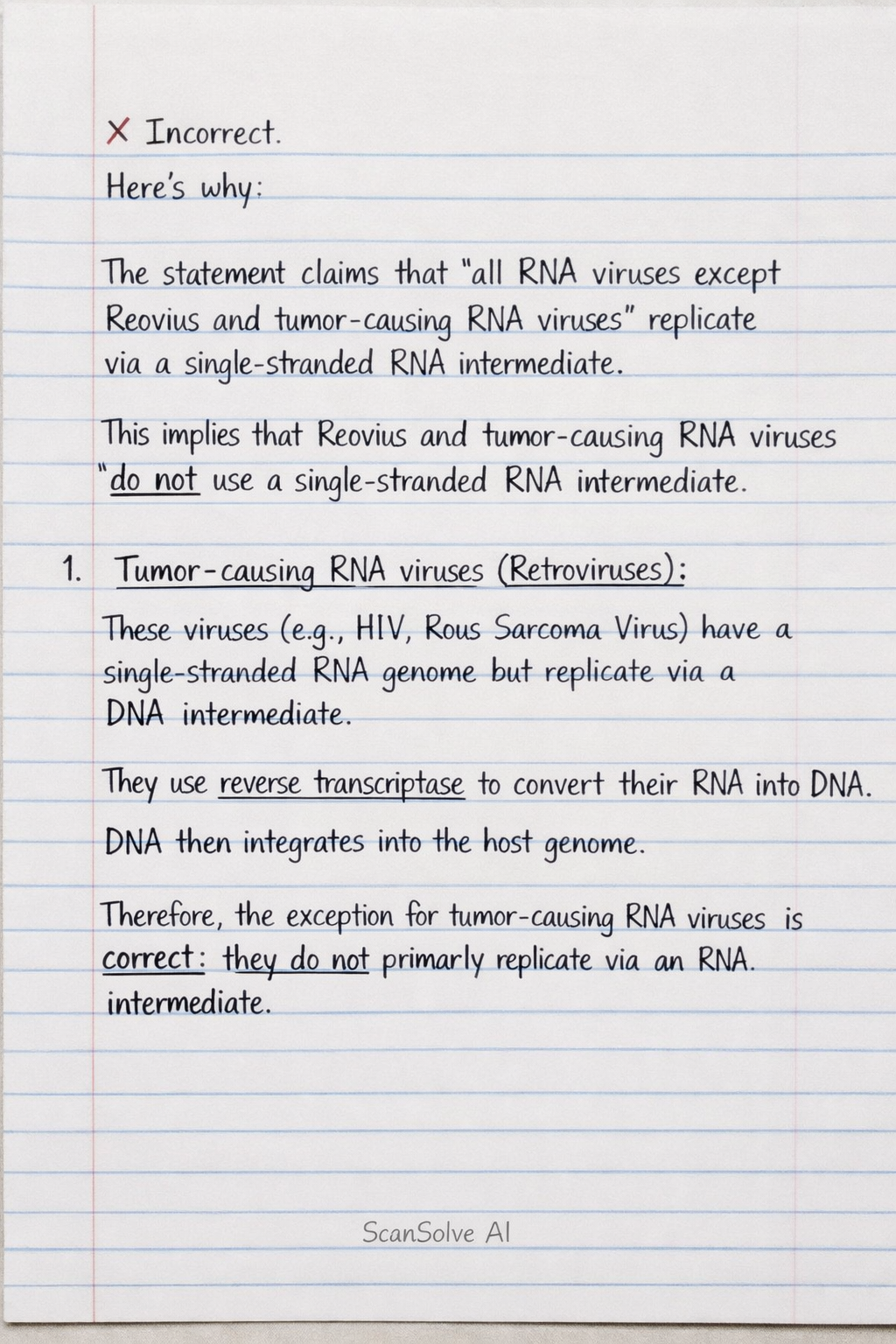
❌ Incorrect. Here's why: The statement claims that "all RNA viruses except Reovirus and tumor-causing RNA viruses" replicate via a single-stranded RNA intermediate. This implies that Reovirus and tumor-causing RNA viruses do not use a single-stranded RNA intermediate. 1. Tumor-causing RNA viruses (Retroviruses): These viruses (e.g., HIV, Rous Sarcoma Virus) have a single-stranded RNA genome but replicate via a DNA intermediate. They use reverse transcriptase to convert their RNA into DNA, which then integrates into the host genome. Therefore, the exception for tumor-causing RNA viruses is correct; they do not primarily replicate via an RNA intermediate. 2. Reovirus: Reoviruses are double-stranded RNA (dsRNA) viruses. During their replication cycle, they transcribe their dsRNA genome into positive-sense single-stranded RNA ((+)ssRNA). This (+)ssRNA serves as messenger RNA (mRNA) and also as a template for synthesizing the complementary negative-sense strand, which then pairs with the (+)ssRNA to form new dsRNA genomes. Therefore, (+)ssRNA is a single-stranded RNA intermediate in the replication of Reoviruses. Since Reoviruses do utilize a single-stranded RNA intermediate in their replication, the statement that they are an exception to this mode of replication is incorrect. That's 2 down. 3 left today — send the next one.