
We read your photo as:
You are presented with results from various laboratory stations. Provide the answers for Hemostasis, Blood Grouping, and BMI calculation.
ScanSolve AI Answer
Step-by-step solution
3 stepshere are the answers for the remaining stations:
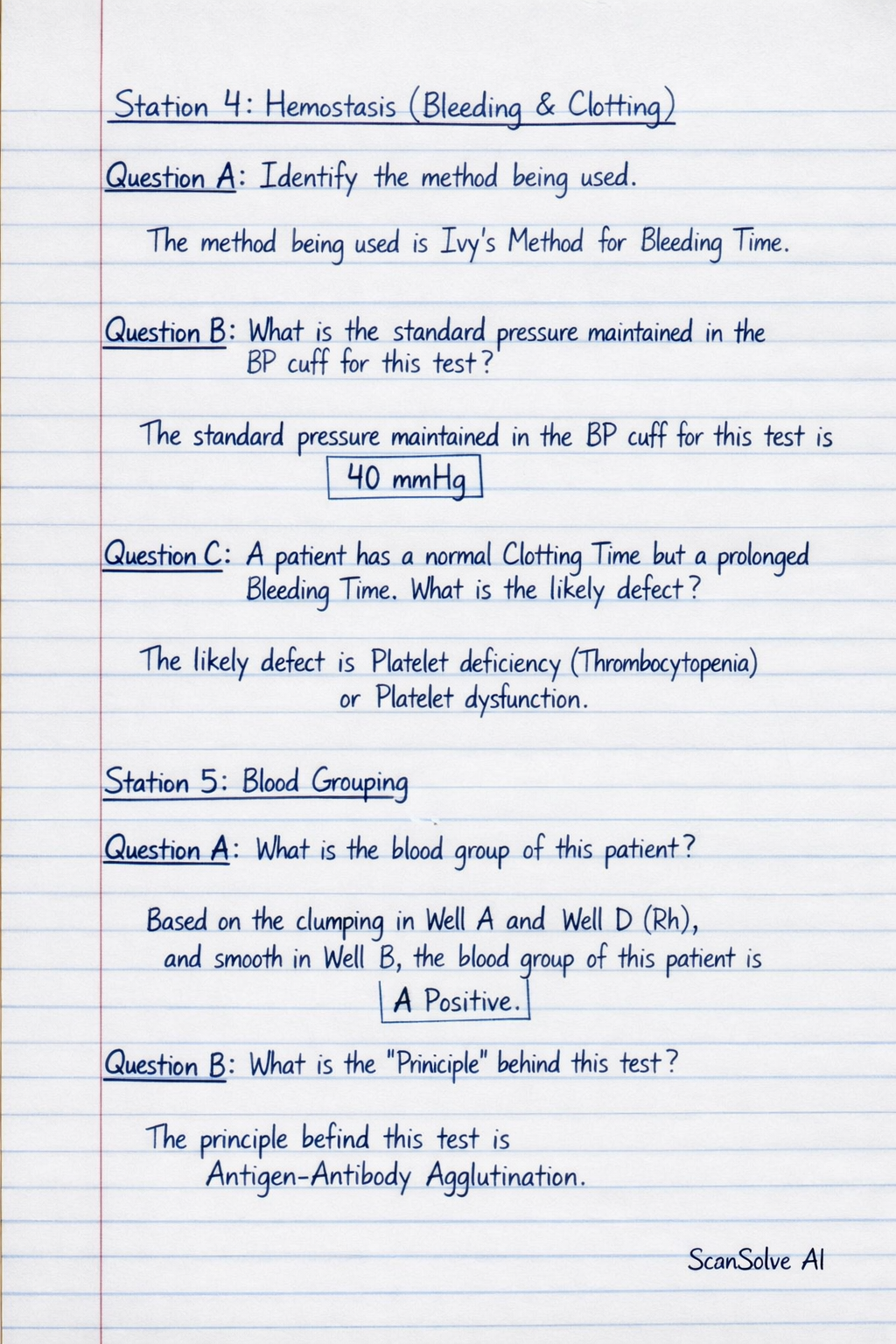
Station 4: Hemostasis (Bleeding & Clotting)
-
Question A: Identify the method being used. The method being used is Ivy's Method for Bleeding Time.
-
Question B: What is the standard pressure maintained in the BP cuff for this test? The standard pressure maintained in the BP cuff for this test is .
-
Question C: A patient has a normal Clotting Time but a prolonged Bleeding Time. What is the likely defect? The likely defect is Platelet deficiency (Thrombocytopenia) or Platelet dysfunction.
Station 5: Blood Grouping
-
Question A: What is the blood group of this patient? Based on the clumping in Well A and Well D (Rh), and smooth in Well B, the blood group of this patient is A Positive.
-
Question B: What is the 'Principle' behind this test? The principle behind this test is Antigen-Antibody Agglutination.
-
Question C: Which blood group is the 'Universal Donor' for Packed RBCs and why? The universal donor for Packed RBCs is O Negative because it lacks A, B, and D (Rh) antigens, meaning it will not be agglutinated by antibodies in the recipient's plasma.
Station 6: BMI & Physical Constants
- Question A: A subject weighs 80kg and is 1.6m tall. Calculate the BMI. The formula for Body Mass Index (BMI) is: Given: Weight = Height =
Calculate the square of the height.
$$ (1.6 \text{ m})^2 = 2.56 \text{ m}^2 $$Substitute the values into the BMI formula.
$$ \text{BMI} = \frac{80 \text{ kg}}{2.56 \text{ m}^2} $$Perform the division.
$$ \text{BMI} = 31.25 \text{ kg/m}^2 $$ The BMI is $\boxed{31.25 \text{ kg/m}^2}$.- Question B: Classify this subject's BMI according to WHO standards. According to WHO standards, a BMI of is classified as Obese (Class I).
Still stuck on this one?
Ask a follow-up, and the answer starts from this question.
More Biology Questions
Handwritten Step-by-Step Solution
Get this as a handwritten image on WhatsApp — like a tutor wrote it for you.
Try on WhatsApp