ScanSolve logoScanSolve
Toggle sidebar
  • Homework
  • Tutor
  • Humanizer
  • AI Detector
  • Questions
  • Blog
  • History
  • Mobile App

  • Homework
  • Tutor
  • Humanizer
  • AI Detector

  • Questions
  • Math homework helpMath
    Physics homework helpPhysics
    Chemistry homework helpChemistry
    Biology homework helpBiology
    Computer Science homework helpComputer Science
    History homework helpHistory
    More homework helpMore
  • Blog
  • History

  • Mobile App
ScanSolvePLUS
  • Unlimited answers
  • ScanSolve AI Pro
Start Free Trial →
Try on WhatsApp
Business/Management: Define the following: Oxidation, Nutrition, Metabolism, Malnutrition, Balanced d... — Step-by-Step Solution | ScanSolve
Home > Business/Management Homework Help > Solution

Define the following: Oxidation, Nutrition, Metabolism, Malnutrition, Balanced diet. Differentiate between macro-nutrients and micro-nutrients. Outline five (5) importance of the food composition table. State six (6) dietary guidelines. Write out five (5) reasons for cooking food.

Asked on March 26, 2026|Business/Management

This business/management problem is solved step by step below, with detailed explanations to help you understand the method and arrive at the correct answer.

ScanSolve AI AnswerAnswered on March 26, 2026
1. Define the following: a)* Oxidation: A chemical reaction involving the loss of electrons or an increase in oxidation state by a molecule, atom, or ion. In food, it often leads to spoilage, such as rancidity in fats. b)* Nutrients: Substances found in food that are essential for growth, metabolism, and other body functions. They include carbohydrates, proteins, fats, vitamins, minerals, and water. c) Metabolism: The set of life-sustaining chemical reactions in organisms. It involves two main processes: anabolism (building up substances) and catabolism* (breaking down substances) to produce energy. d)* Malnutrition: A condition that results from eating a diet in which nutrients are either not enough or are too much, such that the diet causes health problems. It can involve undernutrition or overnutrition. e)* Balanced diet: A diet that provides all the necessary nutrients in appropriate amounts to maintain health, support growth, and provide energy without excess or deficiency. 2. a)* Five (5) structures of a food composition table: Food item name Energy content (calories/joules) Macronutrient content (protein, fat, carbohydrates) Micronutrient content (vitamins, minerals) Water content b)* Five (5) ways of disposing kitchen waste: Composting organic waste Recycling suitable materials (e.g., plastic, glass, metal) Disposing of non-recyclable waste in designated bins Using garbage disposals for certain food scraps Donating edible surplus food c)* Six (6) reasons for the importance of entertainment: Reduces stress and promotes relaxation Provides enjoyment and pleasure Encourages social interaction and bonding Offers a break from routine Stimulates creativity and imagination Can be educational or culturally enriching d)* Four (4) common styles of serving food: Family style:* Food is placed in serving dishes on the table for guests to help themselves. Buffet style:* Food is arranged on a separate table, and guests serve themselves. Plated/American style:* Food is portioned and arranged on individual plates in the kitchen before being served to guests. Russian style:* Food is presented on platters to guests by servers, who then serve individual portions onto the guests' plates. e)* Five (5) types of traditional dishes in five different regions of Cameroon: Central Region: Ndolè* (bitter leaf soup with peanuts and meat/fish) Littoral Region: Eru* (wild spinach soup with water fufu) North Region: Koki* (steamed black-eyed pea cake) West Region: Achu* (cocoyam fufu with yellow soup) South West Region: Water fufu and Eru* (fermented cassava paste with wild spinach soup) 3. a)* Four (4) factors that cause nutrient loss: Heat:* High temperatures during cooking can destroy heat-sensitive vitamins (e.g., Vitamin C, B vitamins). Water:* Water-soluble vitamins can leach into cooking water and be discarded. Light:* Exposure to light can degrade certain vitamins (e.g., riboflavin). Oxygen:* Oxidation can destroy vitamins (e.g., Vitamin C) and lead to rancidity in fats. b)* Six (6) tips for preserving nutrients: Cook vegetables quickly and for minimal time. Use minimal water when cooking, or steam/microwave. Store foods properly to minimize exposure to light and air. Cut vegetables just before cooking to reduce surface area exposure. Eat fresh produce as soon as possible. Use cooking liquids in sauces or gravies to retain leached nutrients. c)* Five (5) reasons for using food additives: To preserve food and extend shelf life (e.g., antioxidants, antimicrobials). To enhance flavor and aroma (e.g., flavor enhancers). To improve appearance (e.g., colorants). To maintain or improve nutritional value (e.g., fortifying with vitamins). To improve texture and consistency (e.g., emulsifiers, thickeners). d)* Five (5) types of spices and five (5) types of herbs: Spices:* Black pepper Cumin Cinnamon Nutmeg Cloves Herbs:* Parsley Basil Thyme Rosemary Mint 4. a)* Macronutrients are nutrients required in large quantities (grams) by the body, providing energy and building blocks for tissues. Examples include carbohydrates, proteins, and fats. Micronutrients are nutrients required in smaller quantities (milligrams or micrograms), essential for various bodily functions but not providing energy directly. Examples include vitamins and minerals. b)* Five (5) importance of the food composition table: Helps in planning balanced diets. Assists in nutritional research and education. Aids in food labeling and regulation. Supports clinical dietetics for patients with specific needs. Facilitates food product development and quality control. c)* Six (6) dietary guidelines: Eat a variety of foods from all food groups. Limit intake of saturated fats, trans fats, cholesterol, and sodium. Choose foods with less added sugars. Consume adequate fruits, vegetables, and whole grains. Control portion sizes to maintain a healthy weight. Drink plenty of water. d)* Five (5) reasons for cooking food: To make food safe by killing harmful microorganisms. To improve digestibility and nutrient availability. To enhance flavor, aroma, and appearance. To tenderize tough foods, making them easier to chew. To preserve food for longer periods. 5. a)* Seven (7) requirements for food labeling: Product name Net weight or volume Ingredient list (in descending order by weight) Nutritional information (e.g., calories, macronutrients, micronutrients) Allergen information Manufacturer's name and address Date marking (e.g., best before, use by) b)* Five (5) importance of digestion: Breaks down complex food into simpler molecules. Enables absorption of nutrients into the bloodstream. Provides energy for bodily functions. Eliminates undigested waste products. Supports growth, repair, and maintenance of tissues. c)* Five (5) main digestive organs: Esophagus Stomach Small intestine Large intestine Liver d)* Eight (8) personal hygiene rules to be observed when preparing food: Wash hands thoroughly with soap and water before and after handling food. Wear clean clothes or an apron. Tie back long hair or wear a hairnet. Cover cuts or wounds with waterproof bandages. Avoid touching face, hair, or nose while preparing food. Do not sneeze or cough over food. Keep fingernails short and clean. Avoid wearing jewelry that could fall into food. 6. a)* Five (5) mechanical raising agents: Whisking (e.g., egg whites for meringue) Sieving (e.g., flour to incorporate air) Creaming (e.g., butter and sugar) Folding (e.g., light ingredients into heavier ones) Beating (e.g., whole eggs for sponge cake) b)* Five (5) uses of eggs in cookery: Binding:* Holds ingredients together (e.g., meatballs, burgers). Thickening:* Used in custards, sauces, and quiches. Emulsifying:* Helps combine oil and water (e.g., mayonnaise). Leavening:* Incorporates air for lightness (e.g., soufflés, sponge cakes). Coating:* Used to adhere breadcrumbs or batter to food (e.g., fried chicken). c)* Five (5) items which may be found in a First Aid box (kit): Adhesive bandages (various sizes) Antiseptic wipes or solution Sterile gauze pads and adhesive tape Pain relievers (e.g., paracetamol) Scissors and tweezers d)* Five (5) information that should be found or be contained in an invitation card: Purpose of the event (e.g., wedding, birthday) Date and time of the event Location/venue of the event Host's name RSVP information (contact details and deadline) e)* The place set for a person is called a cover. Four (4) different occasions in which an invitation card could be served: Weddings Birthday parties Graduation ceremonies Anniversary celebrations

Related Business/Management Questions

  • to explain "What to do" for each of the SWOT analysis findings for Sarah's business.
  • a) Five circumstances under which an insurance company would not compensate the insured in the event of loss are:
  • The prompting strategy that involves providing an AI model with a single example of a task before asking it to perform a...
  • 1.1.5 To ensure Grade R learners are fully engaged in Physical Education lessons, teachers should prioritize effective p...
  • a) A research design is the overall strategy or blueprint for conducting a research study. It outlines the methods and p...
  • 23. a) The livestock management practice illustrated is dehorning.
See all Business/Management questions

This step-by-step solution was generated by ScanSolve AI. Need help with more business/management problems? Browse Business/Management solutions or ask your own question.

Home›Business/Management Homework Help›Define the following: Oxidation, Nutrition, Metabolism, Maln…
Q

Define the following: Oxidation, Nutrition, Metabolism, Malnutrition, Balanced diet. Differentiate between macro-nutrients and micro-nutrients. Outline five (5) importance of the food composition table. State six (6) dietary guidelines. Write out five (5) reasons for cooking food.

March 26, 2026|Business/Management
Define the following: Oxidation, Nutrition, Metabolism, Malnutrition, Balanced diet. Differentiate between macro-nutrients and micro-nutrients. Outline five (5) importance of the food composition table. State six (6) dietary guidelines. Write out five (5) reasons for cooking food.

Define the following: Oxidation, Nutrition, Metabolism, Malnutrition, Balanced diet. Differentiate between macro-nutrients and micro-nutrients. Outline five (5) importance of the food composition table. State six (6) dietary guidelines. Write out five (5) reasons for cooking food.

ScanSolve AI

ScanSolve AI Answer

Answered on March 26, 2026

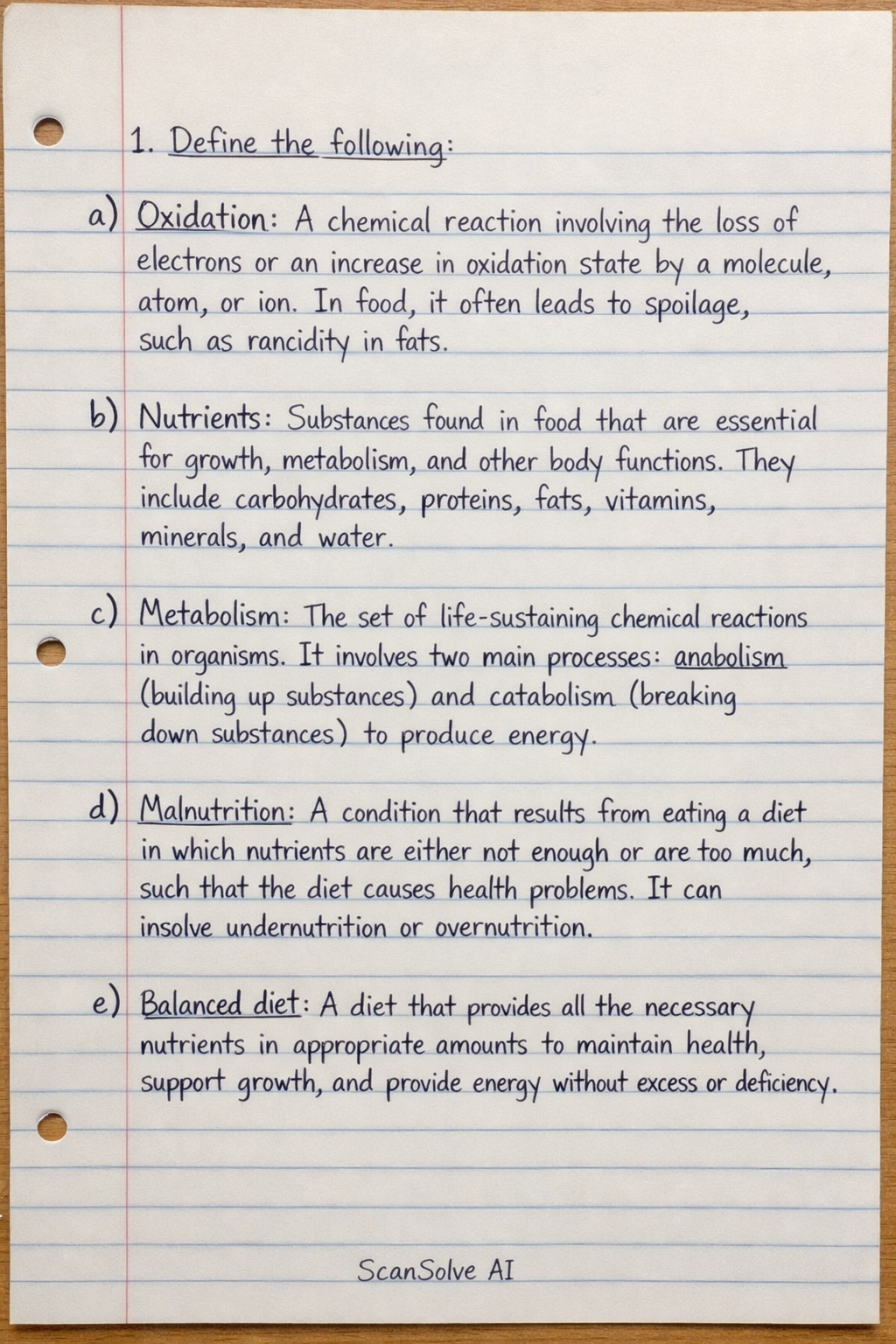
1. Define the following:

  • a) Oxidation: A chemical reaction involving the loss of electrons or an increase in oxidation state by a molecule, atom, or ion. In food, it often leads to spoilage, such as rancidity in fats.
  • b) Nutrients: Substances found in food that are essential for growth, metabolism, and other body functions. They include carbohydrates, proteins, fats, vitamins, minerals, and water.
  • c) Metabolism: The set of life-sustaining chemical reactions in organisms. It involves two main processes: anabolism (building up substances) and catabolism (breaking down substances) to produce energy.
  • d) Malnutrition: A condition that results from eating a diet in which nutrients are either not enough or are too much, such that the diet causes health problems. It can involve undernutrition or overnutrition.
  • e) Balanced diet: A diet that provides all the necessary nutrients in appropriate amounts to maintain health, support growth, and provide energy without excess or deficiency.

2.

  • a) Five (5) structures of a food composition table:
    • Food item name
    • Energy content (calories/joules)
    • Macronutrient content (protein, fat, carbohydrates)
    • Micronutrient content (vitamins, minerals)
    • Water content
  • b) Five (5) ways of disposing kitchen waste:
    • Composting organic waste
    • Recycling suitable materials (e.g., plastic, glass, metal)
    • Disposing of non-recyclable waste in designated bins
    • Using garbage disposals for certain food scraps
    • Donating edible surplus food
  • c) Six (6) reasons for the importance of entertainment:
    • Reduces stress and promotes relaxation
    • Provides enjoyment and pleasure
    • Encourages social interaction and bonding
    • Offers a break from routine
    • Stimulates creativity and imagination
    • Can be educational or culturally enriching
  • d) Four (4) common styles of serving food:
    • Family style: Food is placed in serving dishes on the table for guests to help themselves.
    • Buffet style: Food is arranged on a separate table, and guests serve themselves.
    • Plated/American style: Food is portioned and arranged on individual plates in the kitchen before being served to guests.
    • Russian style: Food is presented on platters to guests by servers, who then serve individual portions onto the guests' plates.
  • e) Five (5) types of traditional dishes in five different regions of Cameroon:
    • Central Region: Ndolè (bitter leaf soup with peanuts and meat/fish)
    • Littoral Region: Eru (wild spinach soup with water fufu)
    • North Region: Koki (steamed black-eyed pea cake)
    • West Region: Achu (cocoyam fufu with yellow soup)
    • South West Region: Water fufu and Eru (fermented cassava paste with wild spinach soup)

3.

  • a) Four (4) factors that cause nutrient loss:
    • Heat: High temperatures during cooking can destroy heat-sensitive vitamins (e.g., Vitamin C, B vitamins).
    • Water: Water-soluble vitamins can leach into cooking water and be discarded.
    • Light: Exposure to light can degrade certain vitamins (e.g., riboflavin).
    • Oxygen: Oxidation can destroy vitamins (e.g., Vitamin C) and lead to rancidity in fats.
  • b) Six (6) tips for preserving nutrients:
    • Cook vegetables quickly and for minimal time.
    • Use minimal water when cooking, or steam/microwave.
    • Store foods properly to minimize exposure to light and air.
    • Cut vegetables just before cooking to reduce surface area exposure.
    • Eat fresh produce as soon as possible.
    • Use cooking liquids in sauces or gravies to retain leached nutrients.
  • c) Five (5) reasons for using food additives:
    • To preserve food and extend shelf life (e.g., antioxidants, antimicrobials).
    • To enhance flavor and aroma (e.g., flavor enhancers).
    • To improve appearance (e.g., colorants).
    • To maintain or improve nutritional value (e.g., fortifying with vitamins).
    • To improve texture and consistency (e.g., emulsifiers, thickeners).
  • d) Five (5) types of spices and five (5) types of herbs:
    • Spices:
      • Black pepper
      • Cumin
      • Cinnamon
      • Nutmeg
      • Cloves
    • Herbs:
      • Parsley
      • Basil
      • Thyme
      • Rosemary
      • Mint

4.

  • a) Macronutrients are nutrients required in large quantities (grams) by the body, providing energy and building blocks for tissues. Examples include carbohydrates, proteins, and fats. Micronutrients are nutrients required in smaller quantities (milligrams or micrograms), essential for various bodily functions but not providing energy directly. Examples include vitamins and minerals.
  • b) Five (5) importance of the food composition table:
    • Helps in planning balanced diets.
    • Assists in nutritional research and education.
    • Aids in food labeling and regulation.
    • Supports clinical dietetics for patients with specific needs.
    • Facilitates food product development and quality control.
  • c) Six (6) dietary guidelines:
    • Eat a variety of foods from all food groups.
    • Limit intake of saturated fats, trans fats, cholesterol, and sodium.
    • Choose foods with less added sugars.
    • Consume adequate fruits, vegetables, and whole grains.
    • Control portion sizes to maintain a healthy weight.
    • Drink plenty of water.
  • d) Five (5) reasons for cooking food:
    • To make food safe by killing harmful microorganisms.
    • To improve digestibility and nutrient availability.
    • To enhance flavor, aroma, and appearance.
    • To tenderize tough foods, making them easier to chew.
    • To preserve food for longer periods.

5.

  • a) Seven (7) requirements for food labeling:
    • Product name
    • Net weight or volume
    • Ingredient list (in descending order by weight)
    • Nutritional information (e.g., calories, macronutrients, micronutrients)
    • Allergen information
    • Manufacturer's name and address
    • Date marking (e.g., best before, use by)
  • b) Five (5) importance of digestion:
    • Breaks down complex food into simpler molecules.
    • Enables absorption of nutrients into the bloodstream.
    • Provides energy for bodily functions.
    • Eliminates undigested waste products.
    • Supports growth, repair, and maintenance of tissues.
  • c) Five (5) main digestive organs:
    • Esophagus
    • Stomach
    • Small intestine
    • Large intestine
    • Liver
  • d) Eight (8) personal hygiene rules to be observed when preparing food:
    • Wash hands thoroughly with soap and water before and after handling food.
    • Wear clean clothes or an apron.
    • Tie back long hair or wear a hairnet.
    • Cover cuts or wounds with waterproof bandages.
    • Avoid touching face, hair, or nose while preparing food.
    • Do not sneeze or cough over food.
    • Keep fingernails short and clean.
    • Avoid wearing jewelry that could fall into food.

6.

  • a) Five (5) mechanical raising agents:
    • Whisking (e.g., egg whites for meringue)
    • Sieving (e.g., flour to incorporate air)
    • Creaming (e.g., butter and sugar)
    • Folding (e.g., light ingredients into heavier ones)
    • Beating (e.g., whole eggs for sponge cake)
  • b) Five (5) uses of eggs in cookery:
    • Binding: Holds ingredients together (e.g., meatballs, burgers).
    • Thickening: Used in custards, sauces, and quiches.
    • Emulsifying: Helps combine oil and water (e.g., mayonnaise).
    • Leavening: Incorporates air for lightness (e.g., soufflés, sponge cakes).
    • Coating: Used to adhere breadcrumbs or batter to food (e.g., fried chicken).
  • c) Five (5) items which may be found in a First Aid box (kit):
    • Adhesive bandages (various sizes)
    • Antiseptic wipes or solution
    • Sterile gauze pads and adhesive tape
    • Pain relievers (e.g., paracetamol)
    • Scissors and tweezers
  • d) Five (5) information that should be found or be contained in an invitation card:
    • Purpose of the event (e.g., wedding, birthday)
    • Date and time of the event
    • Location/venue of the event
    • Host's name
    • RSVP information (contact details and deadline)
  • e) The place set for a person is called a cover. Four (4) different occasions in which an invitation card could be served:
    • Weddings
    • Birthday parties
    • Graduation ceremonies
    • Anniversary celebrations

Need help with your own homework?

Get instant step-by-step solutions to any question. Free to start.

Ask Your Question
Handwritten step-by-step solution

Handwritten Step-by-Step Solution

Get this solution as a handwritten image on WhatsApp — just like a tutor wrote it for you.

Try on WhatsApp

More Business/Management Questions

to explain "What to do" for each of the SWOT analysis findings for Sarah's business.a) Five circumstances under which an insurance company would not compensate the insured in the event…The prompting strategy that involves providing an AI model with a single example of a task before as…1.1.5 To ensure Grade R learners are fully engaged in Physical Education lessons, teachers should pr…a) A research design is the overall strategy or blueprint for conducting a research study. It outlin…23. a) The livestock management practice illustrated is dehorning.
See all Business/Managementquestions →