
We read your photo as:
Record organization refers to the systematic arrangement and classification of records to ensure their efficient storage, retrieval, and management throughout their lifecycle.
ScanSolve AI Answer
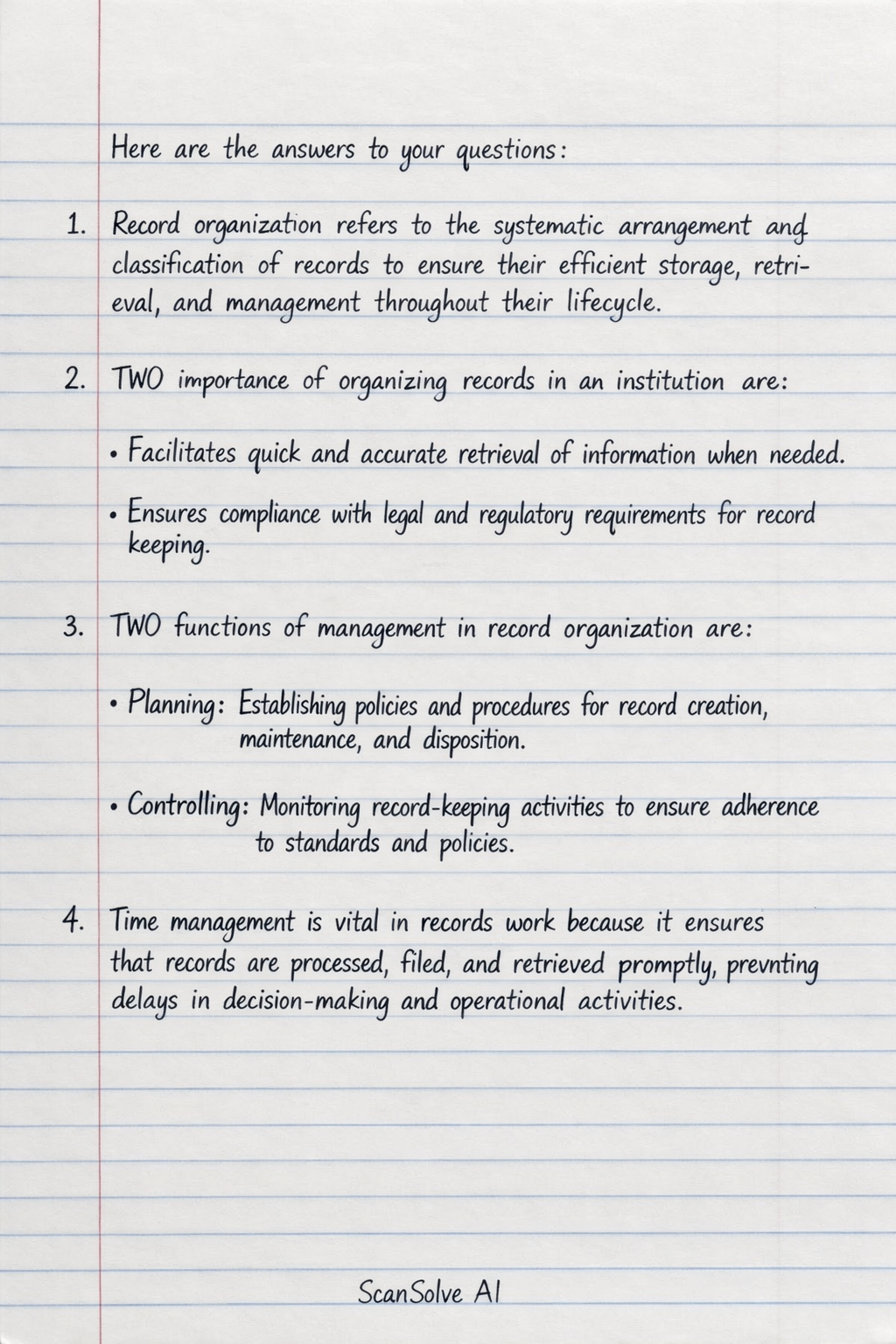
Here are the answers to your questions:
-
Record organization refers to the systematic arrangement and classification of records to ensure their efficient storage, retrieval, and management throughout their lifecycle.
-
TWO importance of organizing records in an institution are:
- Facilitates quick and accurate retrieval of information when needed.
- Ensures compliance with legal and regulatory requirements for record keeping.
-
TWO functions of management in record organization are:
- Planning: Establishing policies and procedures for record creation, maintenance, and disposition.
- Controlling: Monitoring record-keeping activities to ensure adherence to standards and policies.
-
Time management is vital in records work because it ensures that records are processed, filed, and retrieved promptly, preventing delays in decision-making and operational activities.
-
TWO challenges in record documentation are:
- Lack of standardized procedures leading to inconsistencies in record creation.
- Volume of records, making it difficult to process and document all information effectively.
-
A movement register is a log or record used to track the movement of files or documents within an organization, indicating who has a file, when it was taken, and when it is expected back.
-
TWO features of a movement register are:
- It includes details of the file or document, such as its title or reference number.
- It records the name of the person who borrowed the file and the date of borrowing and return.
-
TWO advantages of effective file follow-up are:
- Ensures timely action on matters requiring attention, preventing delays.
- Helps in locating missing files and maintaining control over document circulation.
-
Record retrieval is the process of locating and accessing specific records from a storage system when they are needed. Its purpose is to provide timely and accurate information for decision-making, operations, and legal requirements.
-
TWO methods used in documenting records are:
- Indexing: Creating a list of keywords or terms associated with a record for easy searching.
- Classification: Grouping records into categories based on their subject matter or function.
-
TWO examples of information resources used in record keeping are:
- Filing cabinets and physical folders for paper records.
- Electronic document management systems (EDMS) for digital records.
-
Vital records are essential for the continued operation of an organization and cannot be replaced, such as legal documents or financial records. Non-essential records are those whose loss would not critically impair operations and can be easily replaced or are of temporary value.
-
Metadata is data about data, providing descriptive information about a record, such as its author, creation date, and format. Its relevance in record categorization is that it enables efficient organization and retrieval by providing structured information that can be used to classify, search, and manage records effectively.
-
THREE factors to consider in record categorization are:
- Subject matter: Grouping records based on their content or topic.
- Function: Categorizing records according to the business activity or process they relate to.
- Retention requirements: Classifying records based on how long they need to be kept.
-
TWO methods of conducting file follow-up are:
- Manual review: Physically checking file locations and movement registers.
- Automated reminders: Using software to send alerts for overdue files or pending actions.
-
TWO challenges in identifying records action officers are:
- Frequent staff turnover or changes in roles, making it difficult to track who is responsible for specific records.
- Lack of clear delegation of authority or defined responsibilities for record management tasks.
Still stuck on this one?
Ask a follow-up, and the answer starts from this question.
More Business/Management Questions
Handwritten Step-by-Step Solution
Get this as a handwritten image on WhatsApp — like a tutor wrote it for you.
Try on WhatsApp