
We read your photo as:
Under which inventory cost flow assumption is the cost of the most recent purchases matched first with sales revenue?
ScanSolve AI Answer
Step-by-step solution
6 stepsHere are the answers to your questions:
-
Under which inventory cost flow assumption is the cost of the most recent purchases matched first with sales revenue?
- LIFO (Last-In, First-Out)
-
Under which inventory cost flow assumption is the cost of the most recent purchases likely to remain in inventory?
- FIFO (First-In, First-Out)
-
Under which inventory cost flow assumption is the oldest cost of inventory items likely to remain on the balance sheet?
- LIFO (Last-In, First-Out)
-
The amount inventory will appear on the balance sheet as a current asset at an amount that often reflects the Cost of the merchandise on hand.
-
The inventory system that does NOT update the inventory account automatically at the time of each purchase or sales is the Periodic method/system.
-
If a company is experiencing continuous cost increases for the merchandise that it purchases, which cost flow assumption will result in the least amount of profit and the least amount of income tax expense?
- LIFO (Last-In, First-Out)
-
A company in the computer industry is experiencing continuously lower costs. Which cost flow assumption will result in less income tax expense for the company?
- FIFO (First-In, First-Out)
-
A company purchased items for inventory during 2025 at continuously higher costs. Its last two purchases of 2025 were 20 units on December 28 at a cost of $14 per unit and 30 units on December 30 at a cost of $15 per unit. The company made its last sale for the year when it sold 10 units. Which inventory cost flow assumption will cause the $15 per unit to be expensed as part of the year 2025's cost of goods sold?
- LIFO Periodic
-
For cost of the goods available for sale (amounts of 150 units) and the cost of goods available for sale is $1,770.
Calculate total units available for sale.
$$ 20 + 40 + 40 + 50 = 150 \text{ units} $$Calculate total cost of goods available for sale.
$$ (20 \times \$10) + (40 \times \$11) + (40 \times \$12) + (50 \times \$13) $$ $$ \$200 + \$440 + \$480 + \$650 = \$1,770 $$10. Assuming the LIFO periodic cost flow assumption, what will be the company's cost of goods sold for the 120 items sold in 2025?
Identify the units sold from the most recent purchases under LIFO.
- 50 units from October 10 at 50 \times $13 = $650$
- 40 units from June 25 at 40 \times $12 = $480$
- Remaining units needed: units
- 30 units from January 25 at 30 \times $11 = $330$
Sum the costs.
$$ \text{COGS} = \$650 + \$480 + \$330 = \$1,460 $$ The correct option is **$1,460**.11. Assuming the FIFO periodic cost flow assumption, what will be the company's cost of goods sold for the 120 items sold in 2025?
Identify the units sold from the earliest purchases under FIFO.
- 20 units from January 1 at 20 \times $10 = $200$
- 40 units from January 25 at 40 \times $11 = $440$
- 40 units from June 25 at 40 \times $12 = $480$
- Remaining units needed: units
- 20 units from October 10 at 20 \times $13 = $260$
Sum the costs.
$$ \text{COGS} = \$200 + \$440 + \$480 + \$260 = \$1,380 $$
The correct option is **$1,380**.
Still stuck on this one?
Ask a follow-up, and the answer starts from this question.
More Business/Management Questions
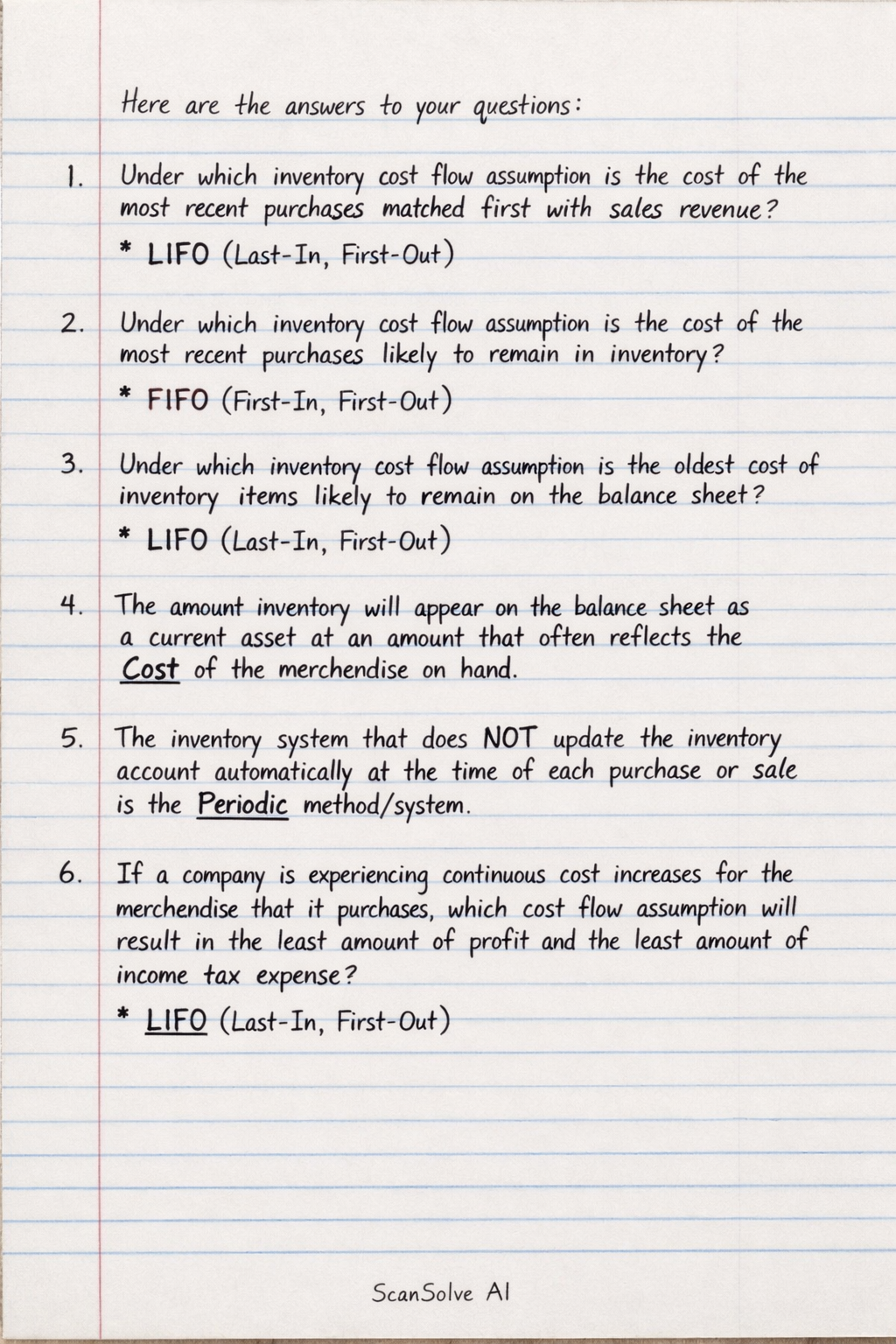
Handwritten Step-by-Step Solution
Get this as a handwritten image on WhatsApp — like a tutor wrote it for you.
Try on WhatsApp