
We read your photo as:
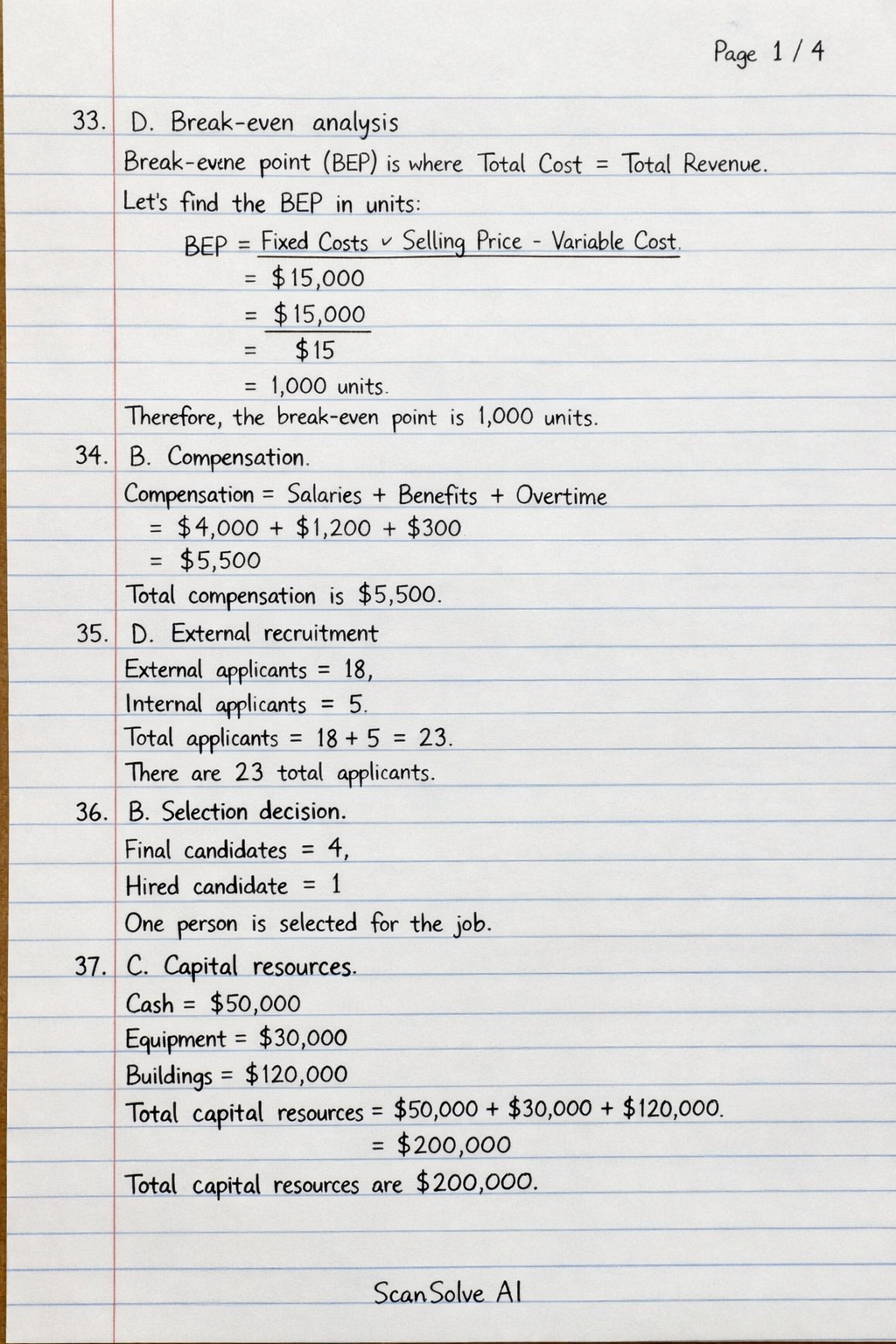
D. Break-even analysis
Business/Management
ScanSolve AI Answer
-
D. Break-even analysis
- Break-even analysis is a key component of financial projection as it determines the point at which total costs and total revenues are equal, indicating the sales volume needed to cover all expenses.
-
B. Compensation
- Compensation is the overall term for all forms of financial and non-financial rewards provided to employees for their work, encompassing salaries, wages, benefits, and other incentives.
-
D. External recruitment
- External recruitment is the process of identifying and attracting job seekers from outside the organization to fill vacant positions.
-
B. Selection decision
- The selection decision is the most critical step as it involves the final choice of which candidate to hire, based on all information gathered during the selection process.
-
C. Capital resources
- Capital resources are man-made assets used in the production of goods and services, including cash, buildings, machinery, and equipment.
-
B. Natural resources
- Natural resources are materials or substances that occur in nature and can be used for economic production, such as timber, cocoa, and minerals.
-
D. Entrepreneurial resource
- The ability of an entrepreneur to coordinate and combine all factors of production (land, labor, capital) is itself considered an entrepreneurial resource or enterprise.
-
B. Enables production of goods and services
- Enterprise resources (natural, human, capital, entrepreneurial) are fundamental inputs that enable the production of goods and services, which is their primary importance.
-
C. Net present value (NPV)
- Net Present Value (NPV) is an investment appraisal method that explicitly considers the time value of money by discounting future cash flows to their present value.
-
C. Payback period
- The payback period is an investment appraisal method that calculates the length of time required for an investment to recover its initial cost from its cash inflows.
-
B. Average profit Initial capital 100
- The formula for the Accounting Rate of Return (ARR) is typically calculated as the average annual profit divided by the initial capital invested, expressed as a percentage.
-
B. One-Stop Shop (Centre de Formalités de Création d'Entreprises - CFCE)
- In Cameroon, the Centre de Formalités de Création d'Entreprises (CFCE), often referred to as a One-Stop Shop, is the government office responsible for facilitating business registration.
-
C. Certificate of incorporation
- A Certificate of Incorporation is a legal document issued by the government that grants a company legal permission to operate and signifies its legal existence.
-
B. Name search and reservation
- The first step in registering a business name is typically to conduct a name search to ensure its availability and then reserve it to prevent others from using it.
-
C. Recording financial transactions
- Bookkeeping is primarily concerned with the systematic recording of financial transactions in an organized manner.
-
B. Journal
- The Journal (or book of original entry) is where financial transactions are first recorded in chronological order before being posted to the ledger.
-
D. Just-in-time
- The Just-in-Time (JIT) production system is a strategy where goods are produced or acquired only when they are needed, minimizing inventory and waste.
-
A. Batch production
- Batch production is a manufacturing method where products are made in groups or "batches," with each batch moving through the production process together.
Was this helpful?
Still stuck on this one?
Ask a follow-up, and the answer starts from this question.
Got a different question?Ask your own question
More Business/Management Questions
QDefine the term break-even.QPrepare a contribution break-even chart, calculate break-even rooms, and analyze the effects of…QThe breakeven point is reached when:Q4.1 Define the term break-even in the given context. 4.4.2 Name the type of cost that R6 000…QCalculate the break-even point in units and value for Scenario A, given fixed costs of 20,000 DH, a…
Handwritten Step-by-Step Solution
Get this as a handwritten image on WhatsApp — like a tutor wrote it for you.
Try on WhatsApp