
We read your photo as:
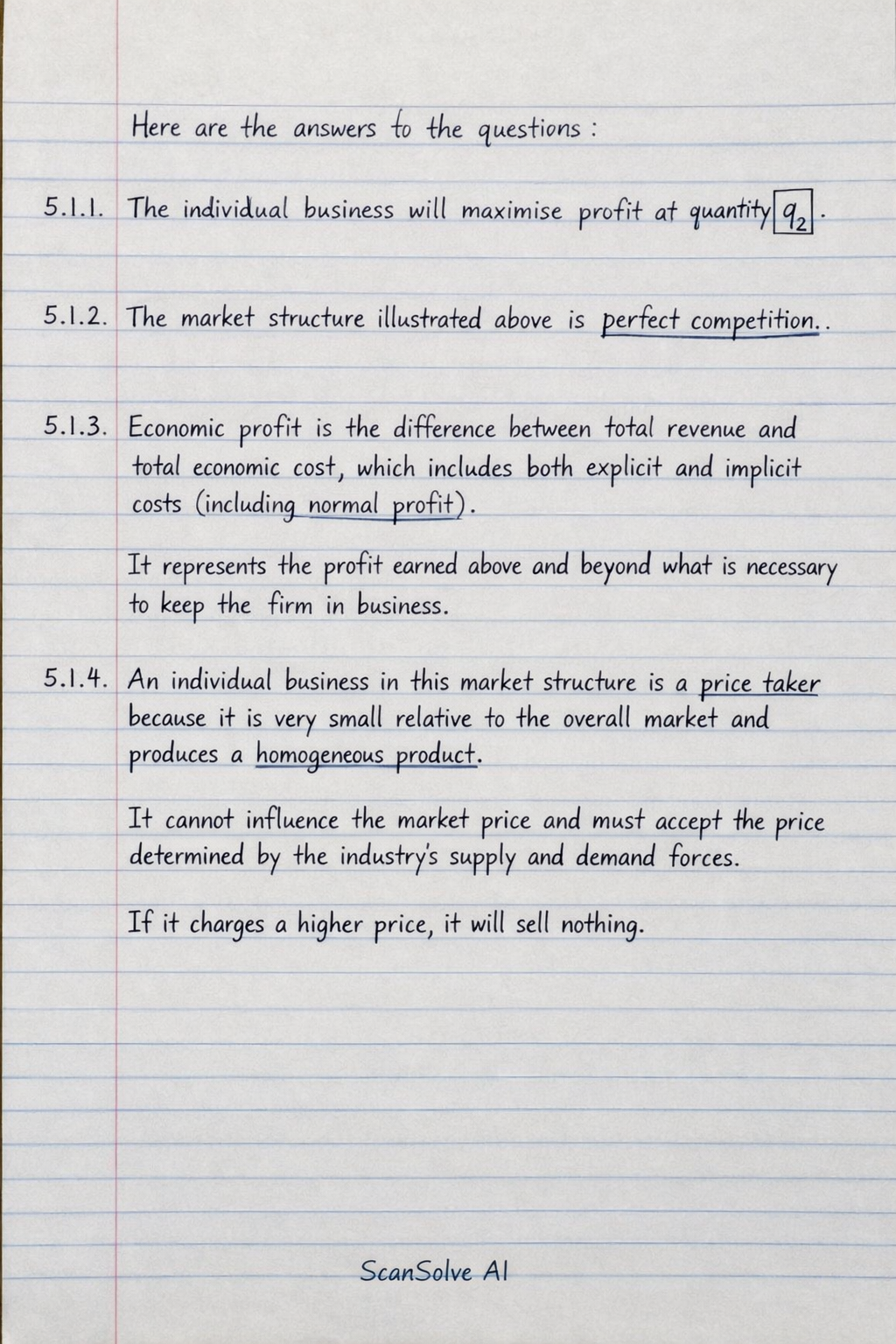
5.1.1. The individual business will maximise profit at quantity q₂.
ScanSolve AI Answer
Here are the answers to the questions:
5.1.1. The individual business will maximise profit at quantity .
5.1.2. The market structure illustrated above is perfect competition.
5.1.3. Economic profit is the difference between total revenue and total economic cost, which includes both explicit and implicit costs (including normal profit). It represents the profit earned above and beyond what is necessary to keep the firm in business.
5.1.4. An individual business in this market structure is a price taker because it is very small relative to the overall market and produces a homogeneous product. It cannot influence the market price and must accept the price determined by the industry's supply and demand forces. If it charges a higher price, it will sell nothing.
5.1.5. The entry of new firms into the industry in the long run would:
- Increase the overall industry supply, shifting the industry supply curve to the right.
- This increased supply would lead to a decrease in the market equilibrium price.
- For the individual business, this means its demand curve (D=AR=MR) would shift downwards, reducing its revenue and profit.
- This process continues until all economic profits are eliminated, and firms earn only normal profit in the long run.
5.2.1. The curve that represents the supply curve in the graph above is the MC curve (above the AVC curve).
5.2.2. The firm should produce 40 units in order to make a normal profit. (This occurs at point 'b' where AR=MR=D2 is tangent to the AC curve).
5.2.3. Marginal revenue is the additional revenue generated by selling one more unit of a good or service.
5.2.4. The producer would be reluctant to produce 30 units or less because at 30 units (point 'a'), the market price (AR=MR=D1 = 15) is equal to the minimum average variable cost (AVC). This means the firm is only covering its variable costs and is incurring a loss equal to its total fixed costs. If the price falls below 15 (i.e., below the minimum AVC), the firm would not even be able to cover its variable costs, and it would minimize its losses by shutting down operations entirely in the short run.
Still stuck on this one?
Ask a follow-up, and the answer starts from this question.
More Business/Management Questions
Handwritten Step-by-Step Solution
Get this as a handwritten image on WhatsApp — like a tutor wrote it for you.
Try on WhatsApp