
We read your photo as:
What are 5 typologies of communication filters?
ScanSolve AI Answer
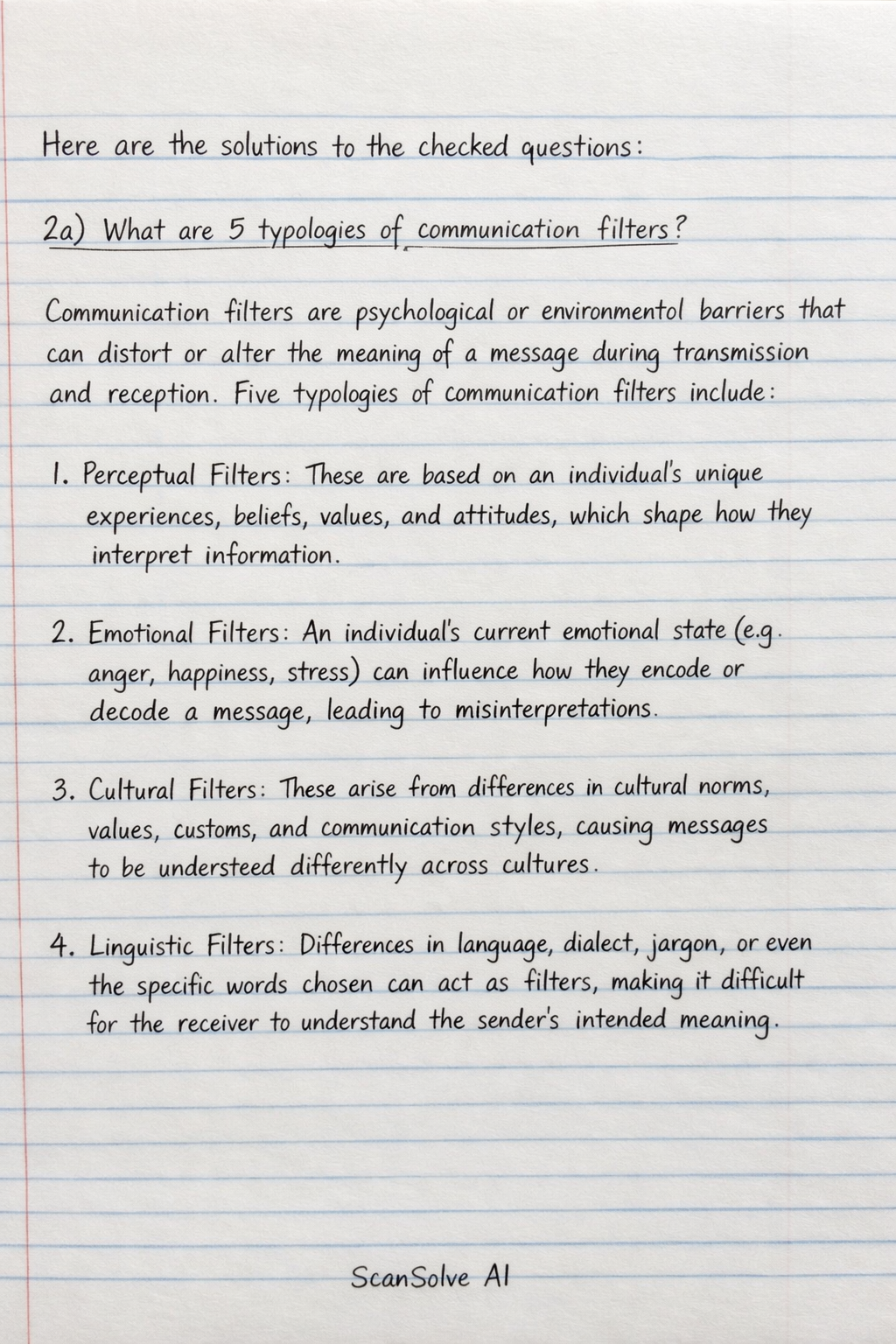
Here are the solutions to the checked questions:
2a) What are 5 typologies of communication filters?
Communication filters are psychological or environmental barriers that can distort or alter the meaning of a message during transmission and reception. Five typologies of communication filters include:
- Perceptual Filters: These are based on an individual's unique experiences, beliefs, values, and attitudes, which shape how they interpret information.
- Emotional Filters: An individual's current emotional state (e.g., anger, happiness, stress) can influence how they encode or decode a message, leading to misinterpretations.
- Cultural Filters: These arise from differences in cultural norms, values, customs, and communication styles, causing messages to be understood differently across cultures.
- Linguistic Filters: Differences in language, dialect, jargon, or even the specific words chosen can act as filters, making it difficult for the receiver to understand the sender's intended meaning.
- Psychological Filters: These include biases, stereotypes, prejudices, and preconceived notions that individuals hold, which can selectively block or distort incoming information.
2b) What are the varieties of human communication?
Human communication can be categorized into several varieties based on the number of participants, context, and medium. The main varieties include:
- Intrapersonal Communication: Communication that occurs within an individual, such as thinking, reflecting, or self-talk.
- Interpersonal Communication: Communication between two or a small group of people, typically face-to-face, involving direct interaction and immediate feedback.
- Group Communication: Communication that takes place within a larger group (e.g., a team meeting, a classroom), where individuals interact to achieve a common goal.
- Public Communication: A form of communication where one person addresses a large audience, often in a formal setting, with limited direct interaction from the audience.
- Mass Communication: Communication transmitted through various media (e.g., television, radio, newspapers, internet) to a large, dispersed, and often anonymous audience.
3a) What are the procedures in listening as a communication process?
Effective listening is an active process involving several key procedures:
- Receiving: This is the initial stage where the listener physically hears and attends to the verbal and non-verbal cues of the message.
- Understanding: The listener interprets the meaning of the message by processing the information, connecting it to existing knowledge, and grasping the sender's intent.
- Remembering: This involves retaining the information received and understood, either for short-term recall or for longer-term storage.
- Evaluating: The listener critically assesses the message, judging its credibility, relevance, and completeness, and forming an opinion.
- Responding: This final stage involves providing verbal or non-verbal feedback to the sender, indicating comprehension, agreement, disagreement, or further questions.
3b) Graphically explain a typical communication process.
A typical communication process can be explained through a linear or transactional model, involving several interconnected components:
- The process begins with a Sender (or source) who has an idea or information to convey.
- The sender then Encodes this idea into a message, translating thoughts into symbols (words, gestures, images).
- The Message is the actual content being transmitted.
- The message travels through a Channel, which is the medium of transmission (e.g., airwaves for speech, written text, email).
- The message reaches the Receiver, the person or entity for whom the message is intended.
- The receiver Decodes the message, interpreting the symbols to understand the sender's original idea.
- Throughout this process, Noise (any interference, physical or psychological) can disrupt the clarity of the message.
- Finally, the receiver provides Feedback to the sender, which can be verbal or non-verbal, indicating how the message was received and understood. This feedback allows the sender to adjust future messages.
4b) What are cultural traits, and how do they affect intercultural communications?
Cultural traits are the shared characteristics, behaviors, beliefs, values, customs, and practices that define a particular cultural group. These traits are learned, passed down through generations, and influence how individuals perceive the world and interact with others.
Cultural traits significantly affect intercultural communication by shaping how messages are encoded, transmitted, and decoded across different cultural backgrounds:
- Language and Non-verbal Cues: Different cultures have distinct languages, dialects, and non-verbal communication (e.g., gestures, eye contact, personal space). Misinterpretations can arise when these cues are not understood in their cultural context.
- Values and Beliefs: What is considered polite, appropriate, or important varies greatly. For example, directness in communication might be valued in one culture but seen as rude in another.
- Communication Styles: Some cultures are high-context (relying heavily on implicit cues and shared understanding), while others are low-context (emphasizing explicit verbal messages). This difference can lead to misunderstandings if not recognized.
- Perceptions of Time and Space: Cultural traits influence how individuals perceive time (e.g., monochronic vs. polychronic) and personal space, impacting interactions and expectations.
- Stereotypes and Prejudices: Preconceived notions based on cultural traits can create barriers, leading to biased interpretations of messages and hindering effective communication.
Still stuck on this one?
Ask a follow-up, and the answer starts from this question.
More Business/Management Questions
Handwritten Step-by-Step Solution
Get this as a handwritten image on WhatsApp — like a tutor wrote it for you.
Try on WhatsApp