

This business/management problem is solved step by step below, with detailed explanations to help you understand the method and arrive at the correct answer.
ScanSolve AI Answer
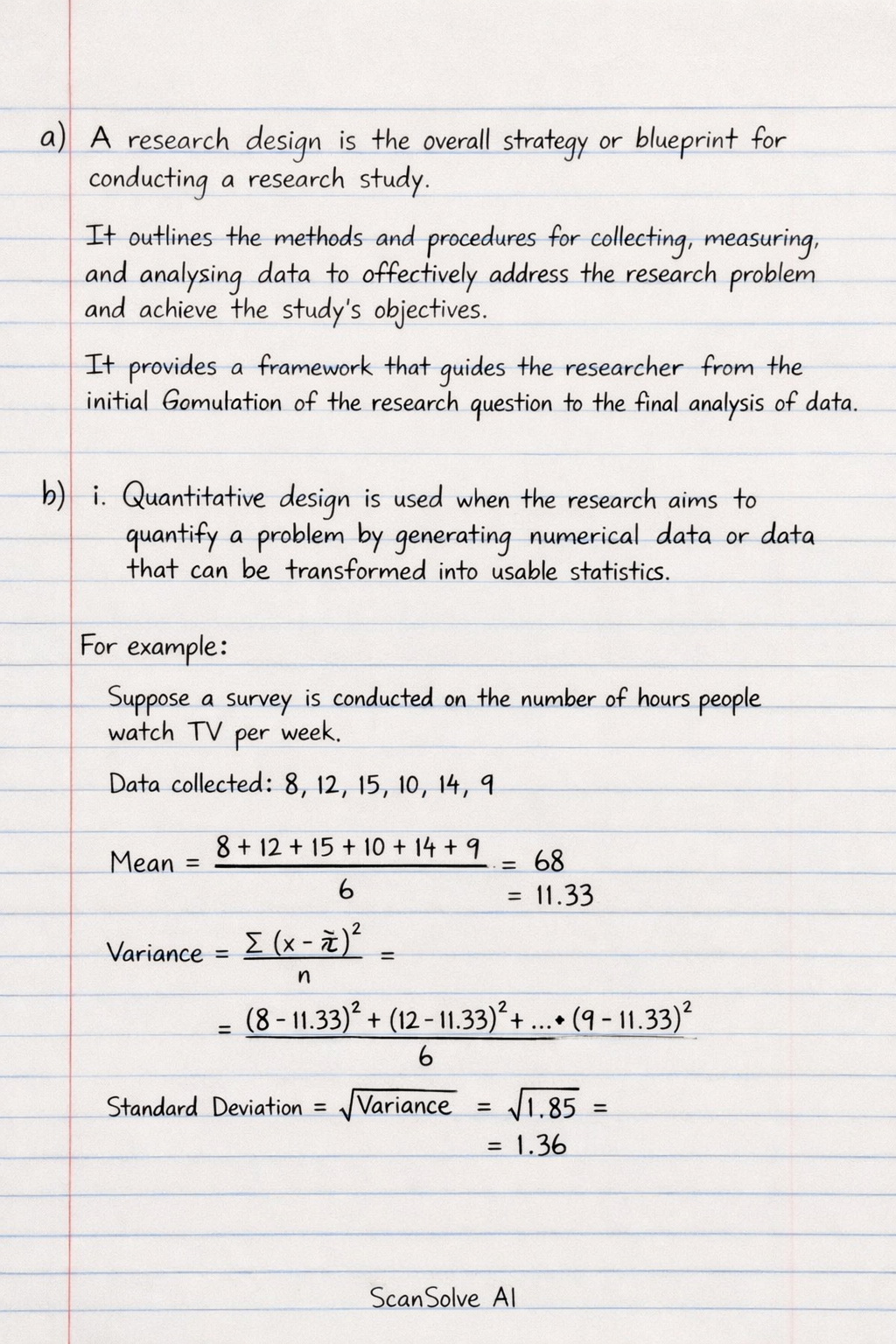
a) A research design is the overall strategy or blueprint for conducting a research study. It outlines the methods and procedures for collecting, measuring, and analyzing data to effectively address the research problem and achieve the study's objectives. It provides a framework that guides the researcher from the initial formulation of the research question to the final analysis of data. b) i. Quantitative design* is used when the research aims to quantify a problem by generating numerical data or data that can be transformed into usable statistics. • Circumstances: It is appropriate when the researcher wants to test hypotheses, establish cause-and-effect relationships, describe characteristics of a population, or generalize findings to a larger population. For example, a researcher might use a quantitative design to measure the impact of a new teaching method on student test scores across multiple schools, or to survey a large sample of students to determine their satisfaction levels with online learning. This design is suitable for studies requiring statistical analysis and objective measurement. ii. Qualitative design* is used when the research aims to explore a phenomenon, understand experiences, perspectives, and meanings, or gain in-depth insights into a particular context. • Circumstances: It is appropriate when the researcher wants to explore complex issues, understand underlying reasons, opinions, and motivations, or develop theories from rich, descriptive data. For example, a researcher might use a qualitative design to conduct in-depth interviews with teachers about their experiences implementing a new curriculum, or to observe classroom interactions to understand the dynamics of student engagement. This design is suitable for studies seeking nuanced understanding and subjective interpretations. c) A researcher using a single research design can encounter several challenges: • Limited Scope and Perspective: A single design may not capture the full complexity of an educational phenomenon. For instance, a purely quantitative study on student performance might show what is happening but fail to explain why it is happening, missing crucial contextual factors or individual experiences. • Incomplete Understanding: Educational issues often have both measurable aspects and subjective experiences. Relying on one design means only one type of data is collected, leading to an incomplete understanding of the problem. A quantitative study might miss the emotional impact of a policy, while a qualitative study might not provide generalizable prevalence rates. • Methodological Constraints: Each design has inherent limitations. Quantitative designs can sometimes oversimplify complex human behaviors and contexts, while qualitative designs may struggle with generalizability and objectivity due to smaller sample sizes and subjective interpretation. Using only one design means accepting these limitations without the benefit of complementary methods. • Difficulty in Answering Diverse Research Questions: Many research problems require answers to both "what" (quantifiable) and "why" or "how" (exploratory) questions. A single design is typically strong in one area but weak in the other, making it difficult to fully address multifaceted research questions. • Lack of Triangulation: Using a single design prevents triangulation, which involves using multiple methods or data sources to confirm findings. This can reduce the confidence in the validity and reliability of the research outcomes, as there is no cross-verification of data.