
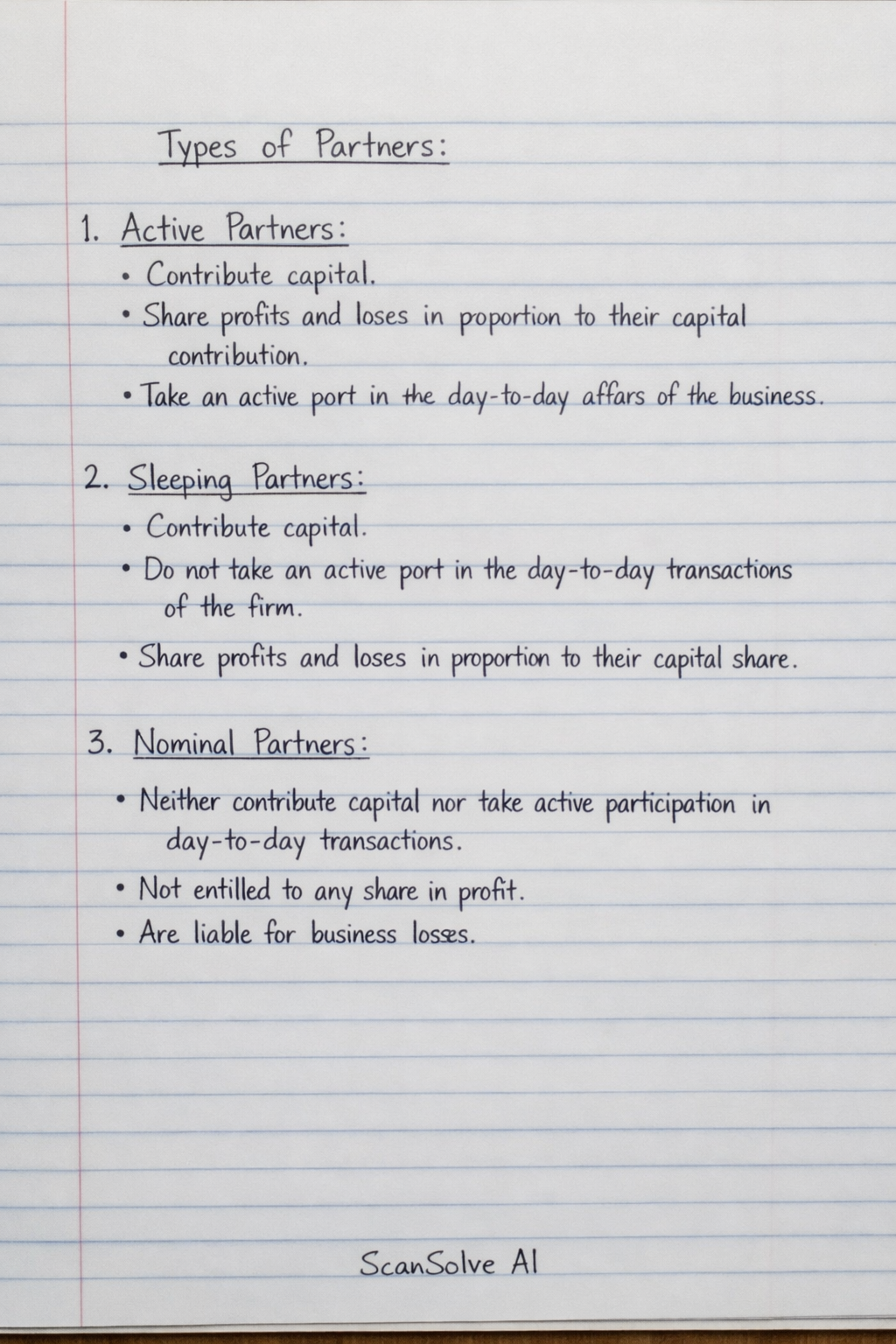
We read your photo as:
What is a partnership deed and what does it contain? Discuss the procedure to be followed whenever differences arise among the partners.
Business/Management
ScanSolve AI Answer
Answer
This page from your Business Studies textbook details the different types of partners in a partnership firm and explains the concept of a partnership deed.
Types of Partners:
-
Active Partners:
- Contribute capital.
- Share profits and losses in proportion to their capital contribution.
- Take an active part in the day-to-day affairs of the business.
-
Sleeping Partners:
- Contribute capital.
- Do not take an active part in the day-to-day transactions of the firm.
- Share profits and losses in proportion to their capital share.
-
Nominal Partners:
- Neither contribute capital nor take active participation in day-to-day transactions.
- Not entitled to any share in profit.
- Are liable for business losses.
-
Minor Partners:
- Are individuals who have not attained the age of 18 years.
- Cannot become a partner initially, but can be admitted by mutual agreement of all partners.
- Eligible for profits but not for defaults or losses.
- Cannot be admitted when a new partnership is started.
- In addition to these, the text mentions secret partners, limited partners, and partial partners. Partners are eligible only for profits.
Partnership Deed:
- Definition: A partnership deed is a written document, duly stamped and signed by all partners, that outlines all the terms and conditions of the partnership firm. It is essential as it differs from firm to firm.
- Contents: A partnership deed generally includes:
- The name of the firm.
- Names and addresses of partners.
- Addresses of the firm.
- Nature of business.
- Address of branches (if any).
- Date of commencement of business.
- Shares of capital contributed by each partner.
- Ratio of sharing profits and losses.
- Duties of each partner.
- Division of work among partners.
- Conditions for the admission of a new partner.
- Calculation of goodwill in case of death or retirement of a partner.
- Procedure to be followed at the time of closing the business.
- Procedure to be followed whenever differences arise among partners.
3 हो गए, आज 2 बाकी। तुम आगे बढ़ रहे हो।
Was this helpful?
Still stuck on this one?
Ask a follow-up, and the answer starts from this question.
Got a different question?Ask your own question
Handwritten Step-by-Step Solution
Get this as a handwritten image on WhatsApp — like a tutor wrote it for you.
Try on WhatsApp