
We read your photo as:
A retail chain continuously replenishes stock at all branches, but separately introduces a new point-of-sale system across the organisation. Which statement best distinguishes the two activities?
ScanSolve AI Answer
Answer
Stock replenishment is an operation, while system implementation is a project
Step-by-step solution
6 stepshere are the solutions to Questions 12 and 13:
Part 12· 3 steps
A retail chain continuously replenishes stock at all branches, but separately introduces a new point-of-sale system across the organisation. Which statement best distinguishes the two activities?
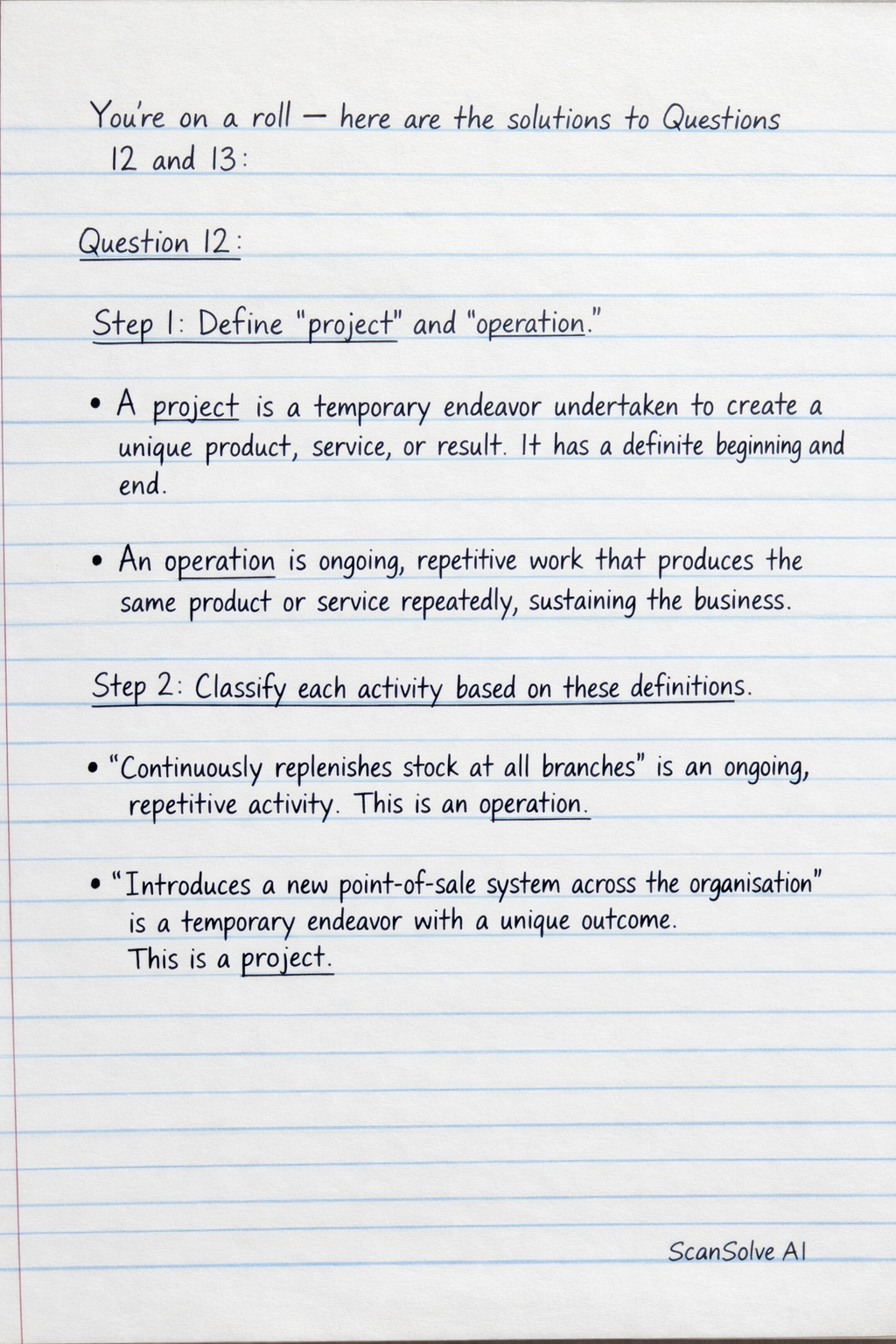
Define "project" and "operation."
- A project is a temporary endeavor undertaken to create a unique product, service, or result. It has a definite beginning and end.
- An operation is ongoing, repetitive work that produces the same product or service repeatedly, sustaining the business.
Classify each activity based on these definitions.
- "Continuously replenishes stock at all branches" is an ongoing, repetitive activity. This is an operation.
- "Introduces a new point-of-sale system across the organisation" is a temporary endeavor with a unique outcome. This is a project.
Evaluate the given options.
- a. Both are projects because they use organisational resources. (Incorrect, stock replenishment is an operation).
- b. Stock replenishment is a project, while system implementation is an operation. (Incorrect, the classifications are reversed).
- c. Stock replenishment is an operation, while system implementation is a project. (Correct, this accurately distinguishes the two activities).
- d. Both are operations because they support business strategy. (Incorrect, system implementation is a project).
The correct option is c. Stock replenishment is an operation, while system implementation is a project.
Part 13· 3 steps
A university introduces a campus-energy project because of rising electricity costs, sustainability targets and pressure from students and regulators. These factors are best described as:
Identify the factors listed.
The factors are rising electricity costs, sustainability targets, and pressure from students and regulators.
Understand what these factors represent in project management.
These factors are the underlying reasons or impetus for initiating the project. They represent the problems, opportunities, or mandates that drive the need for a project.
Evaluate the given options.
- a. Project objectives: These are the specific goals the project aims to achieve (e.g., "reduce energy consumption by 15%"). The factors listed are the reasons for setting such objectives, not the objectives themselves.
- b. Project scope: This defines the boundaries of the project and what work will be performed. The factors are not part of the work definition.
- c. Project drivers: These are the internal or external conditions, needs, or pressures that necessitate the initiation of a project. Rising costs, sustainability targets, and stakeholder pressure are all classic examples of factors that drive a project.
- d. Project deliverables: These are the tangible outputs or results produced by the project (e.g., a new solar panel installation). The factors are not deliverables.
The correct option is c. Project drivers.
Try one yourself
A new problem that tests the same skill.
Still stuck on this one?
Ask a follow-up, and the answer starts from this question.
More Business/Management Questions
Handwritten Step-by-Step Solution
Get this as a handwritten image on WhatsApp — like a tutor wrote it for you.
Try on WhatsApp