
We read your photo as:
A) Use a table to classify the following enterprises into Unincorporated, Incorporated and Public sector business units: b) State and explain three roles played by cooperative societies in Cameroon.
ScanSolve AI Answer
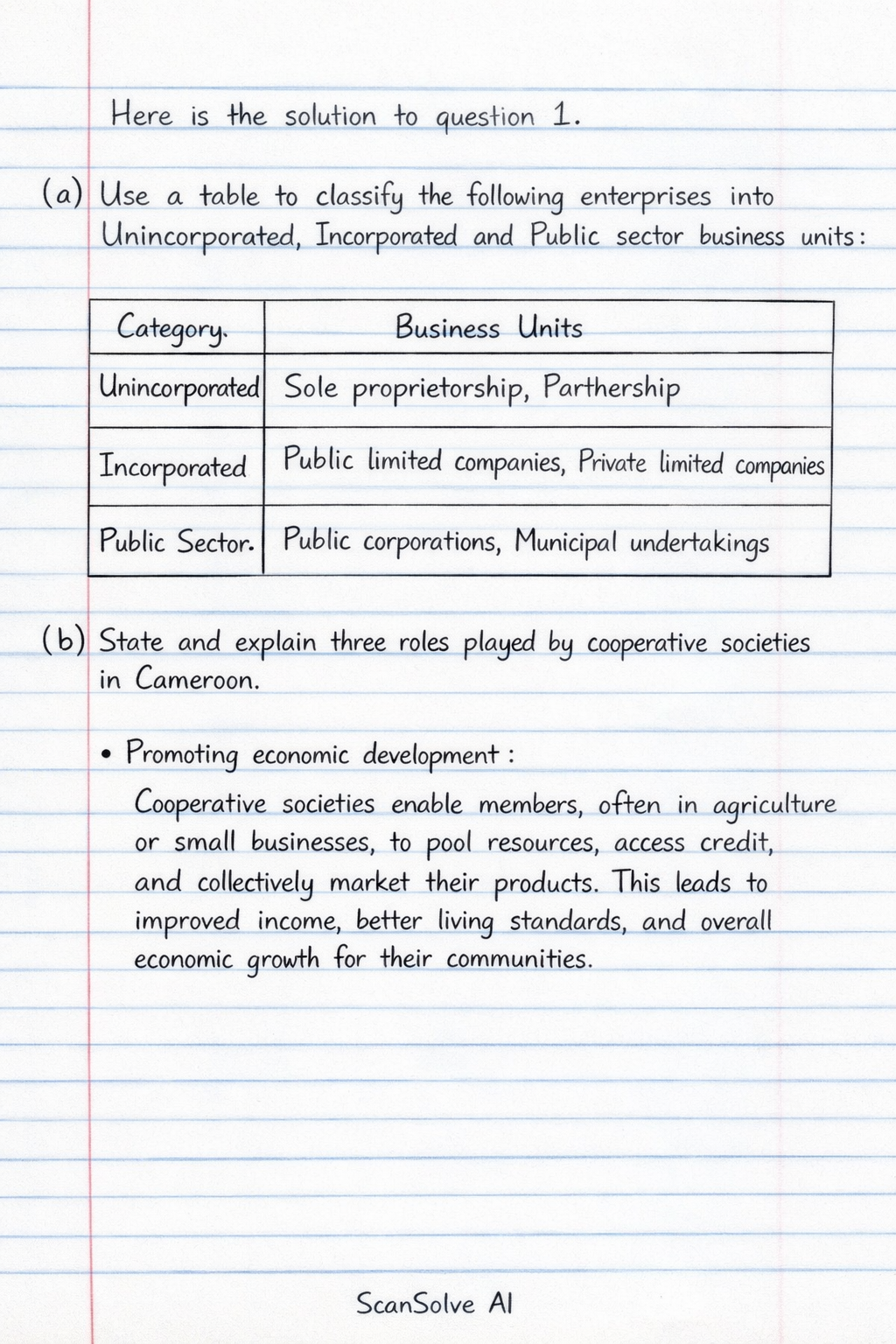
Here is the solution to question 1.
1. a) Use a table to classify the following enterprises into Unincorporated, Incorporated and Public sector business units:
| Category | Business Units |
|---|---|
| Unincorporated | Sole proprietorship, Partnership |
| Incorporated | Public limited companies, Private limited companies |
| Public Sector | Public corporations, Municipal undertakings |
b) State and explain three roles played by cooperative societies in Cameroon.
-
Promoting economic development: Cooperative societies enable members, often in agriculture or small businesses, to pool resources, access credit, and collectively market their products. This leads to improved income, better living standards, and overall economic growth for their communities.
-
Providing social services: Many cooperatives extend beyond economic activities to offer essential social services to their members, such as access to education, healthcare facilities, or affordable housing. This helps to address gaps in public services and improve members' quality of life.
-
Empowering marginalized groups: Cooperatives often provide a platform for women, youth, and rural communities to participate actively in economic activities and decision-making processes. This fosters social inclusion, reduces poverty, and gives a voice to groups that might otherwise be excluded.
c) State and explain four reasons for Privatisation in Cameroon.
-
Increase efficiency and productivity: Privatisation is often pursued to enhance the operational efficiency and productivity of state-owned enterprises. Private companies, driven by profit motives and market competition, are generally believed to be more agile and innovative than government-run entities.
-
Generate revenue for the government: Selling off state-owned assets to private investors provides a significant source of one-time revenue for the government. These funds can be used to reduce national debt, finance public infrastructure projects, or address other budgetary needs.
-
Reduce government burden and subsidies: Many state-owned enterprises operate at a loss and require substantial government subsidies to remain viable. Privatisation eliminates this financial drain on public funds, freeing up resources for other essential public services.
-
Promote competition and innovation: By transferring monopolies or dominant state-owned enterprises to the private sector, privatisation can introduce competition into various industries. This competition can lead to lower prices, better quality goods and services, and greater innovation for consumers.
Still stuck on this one?
Ask a follow-up, and the answer starts from this question.
More Business/Management Questions
Handwritten Step-by-Step Solution
Get this as a handwritten image on WhatsApp — like a tutor wrote it for you.
Try on WhatsApp