
We read your photo as:
A) With examples, explain Ethics and Ethical Behaviour b) Examine four (4) Ethical Behaviour that contributes to individual development and societal progress
ScanSolve AI Answer
Here are the solutions to questions 4 and 5:
a) With examples, explain Ethics and Ethical Behaviour
- Ethics: This refers to the moral principles that govern a person's or group's behavior. It is a branch of philosophy that explores moral questions, defining what is considered good or bad, right or wrong. Ethics provides a framework for making moral decisions.
- Ethical Behaviour: This describes actions that align with accepted moral principles and standards. It involves acting in a way that is considered morally correct, responsible, and fair.
- Example: A journalist reporting facts accurately and without bias, even if it goes against their personal views.
- Example: A business owner paying fair wages and providing safe working conditions for employees.
b) Examine four (4) Ethical Behaviour that contributes to individual development and societal progress
-
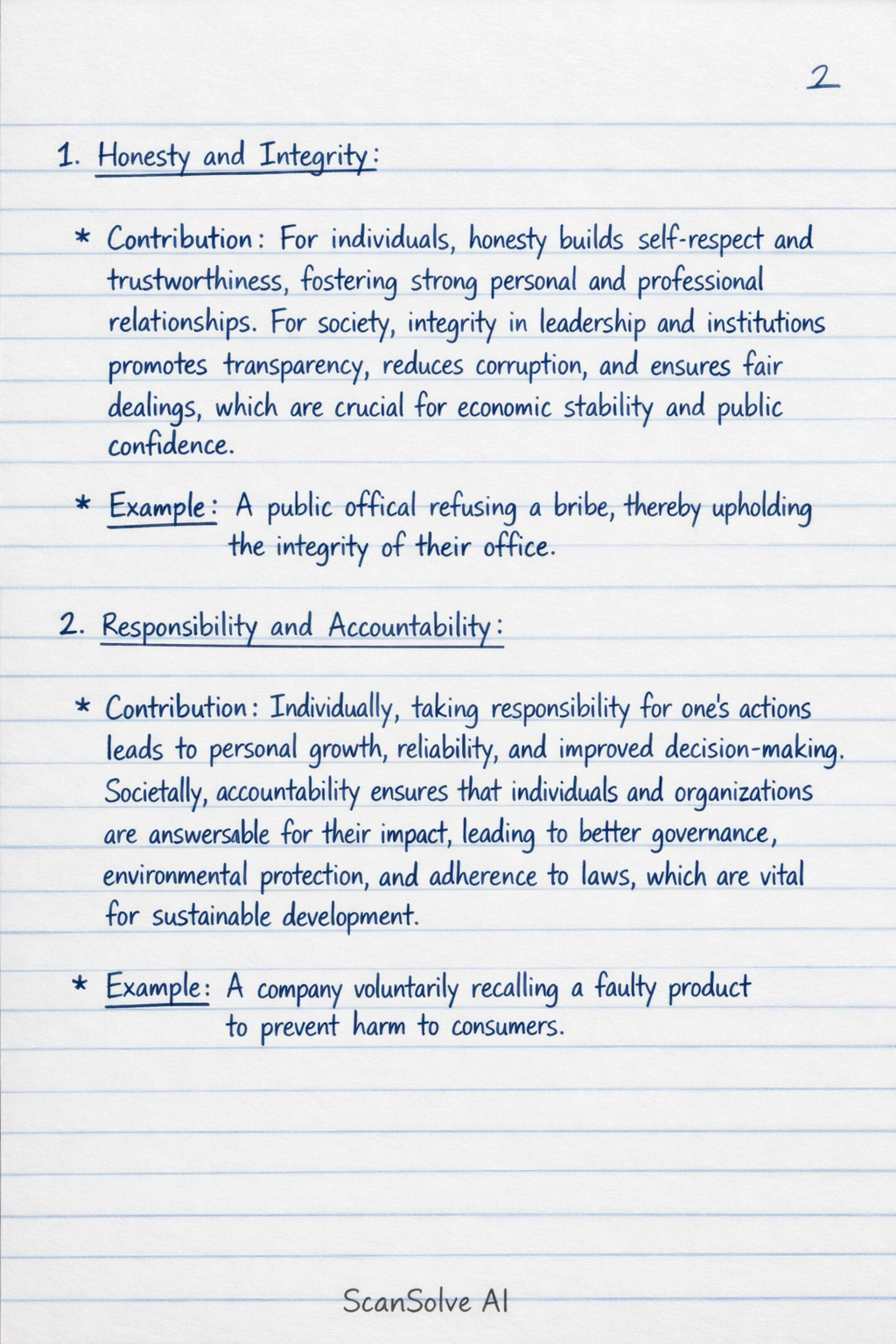
Honesty and Integrity:
- Contribution: For individuals, honesty builds self-respect and trustworthiness, fostering strong personal and professional relationships. For society, integrity in leadership and institutions promotes transparency, reduces corruption, and ensures fair dealings, which are crucial for economic stability and public confidence.
- Example: A public official refusing a bribe, thereby upholding the integrity of their office.
-
Responsibility and Accountability:
- Contribution: Individually, taking responsibility for one's actions leads to personal growth, reliability, and improved decision-making. Societally, accountability ensures that individuals and organizations are answerable for their impact, leading to better governance, environmental protection, and adherence to laws, which are vital for sustainable development.
- Example: A company voluntarily recalling a faulty product to prevent harm to consumers.
-
Respect and Empathy:
- Contribution: On an individual level, respect for others fosters positive interactions, reduces conflict, and promotes understanding of diverse perspectives. For society, empathy and respect encourage inclusivity, reduce discrimination, and build social cohesion, creating a harmonious environment where all citizens feel valued and can contribute.
- Example: Listening actively to someone with a different opinion and acknowledging their viewpoint.
-
Fairness and Justice:
- Contribution: Individually, a commitment to fairness cultivates a strong moral compass and a desire for equitable treatment. Societally, upholding justice ensures that laws are applied equally, resources are distributed equitably, and human rights are protected. This reduces social unrest, promotes equality of opportunity, and strengthens the rule of law, which are foundations for progress.
- Example: An employer implementing non-discriminatory hiring practices.
c) Describe four (4) consequences of Unethical Behaviour that undermine the Development of Nation or a Society
-
Erosion of Trust and Social Cohesion:
- Consequence: Unethical actions like corruption, deceit, or broken promises by leaders or institutions lead to a profound loss of trust among citizens and between citizens and their government. This erodes the social fabric, making people less willing to cooperate, participate in civic life, or invest in collective endeavors.
- Undermining Development: A society without trust struggles to implement policies, maintain order, or achieve common goals, leading to stagnation and fragmentation.
-
Economic Stagnation and Capital Flight:
- Consequence: Unethical practices such as bribery, embezzlement, and fraud divert public funds, inflate project costs, and create an unpredictable business environment. This discourages both local and foreign investment, as investors fear their assets are not secure or that they cannot compete fairly.
- Undermining Development: Capital flight and a lack of investment stifle job creation, innovation, and infrastructure development, leading to slow economic growth, increased poverty, and reduced national competitiveness.
-
Weakening of Institutions and Rule of Law:
- Consequence: When unethical behavior becomes prevalent, especially within government, judiciary, or law enforcement, it compromises the integrity and effectiveness of these institutions. Laws may be selectively enforced, justice may be bought, and accountability becomes rare.
- Undermining Development: Weak institutions cannot effectively govern, protect rights, or provide essential services. This leads to political instability, a breakdown of order, and a lack of confidence in the state's ability to ensure a just and secure environment for its citizens.
-
Increased Inequality and Social Injustice:
- Consequence: Unethical practices often benefit a select few who exploit their positions or connections, leading to an unfair distribution of wealth, opportunities, and resources. This exacerbates existing inequalities and creates new forms of social injustice.
- Undermining Development: High levels of inequality can lead to widespread discontent, social unrest, and a less productive workforce, as a significant portion of the population is marginalized and unable to contribute fully to the nation's development.
a) Explain three (3) common features of Ancient African civilization
-
Centralized Political Systems: Many ancient African civilizations developed complex, hierarchical political structures, often led by powerful monarchs (kings, pharaohs, emperors). These systems were responsible for governing vast territories, organizing labor for large-scale projects, maintaining law and order, and defending the empire.
- Example: The pharaonic rule in Ancient Egypt or the Mansa (emperor) system in the Mali Empire.
-
Advanced Agricultural Practices: Ancient African societies developed sophisticated farming techniques that allowed for surplus food production. This included irrigation systems (e.g., along the Nile), crop rotation, and the domestication of various indigenous crops and livestock. These practices supported larger populations and enabled specialization of labor.
- Example: The extensive use of the Nile's annual flooding for irrigation in Egypt, or the cultivation of millet and sorghum in West African kingdoms.
-
Rich Oral Traditions and Artistic Expression: Oral traditions, encompassing storytelling, proverbs, epic poems, and historical narratives, were fundamental for transmitting knowledge, values, and history across generations. Alongside this, diverse forms of art, including sculpture (wood, bronze, terracotta), metalwork, pottery, music, and dance, flourished, often serving religious, ceremonial, or social functions.
- Example: The role of griots in West Africa as custodians of oral history, or the intricate bronze castings of the Benin Kingdom.
b) Analyze how these common features facilitated cultural exchange, Economic Development and the Emergence of complex societies across the African continent.
- Centralized Political Systems:
- Cultural Exchange: Strong central governments facilitated diplomatic relations, trade agreements, and the movement of people (merchants, scholars, artisans) across vast territories, leading to the exchange of ideas, technologies, and artistic styles.
- Economic Development: Centralized states could organize large-scale economic projects (e.g., mining, irrigation), protect trade routes, enforce laws, and collect taxes, creating stable environments conducive to trade, resource accumulation, and economic growth.
- Complex Societies: The need for administration, defense, and resource management led to the development of specialized roles (e.g., scribes, soldiers, priests), hierarchical social structures, and urban
Still stuck on this one?
Ask a follow-up, and the answer starts from this question.
More Business/Management Questions
Handwritten Step-by-Step Solution
Get this as a handwritten image on WhatsApp — like a tutor wrote it for you.
Try on WhatsApp