
We read your photo as:
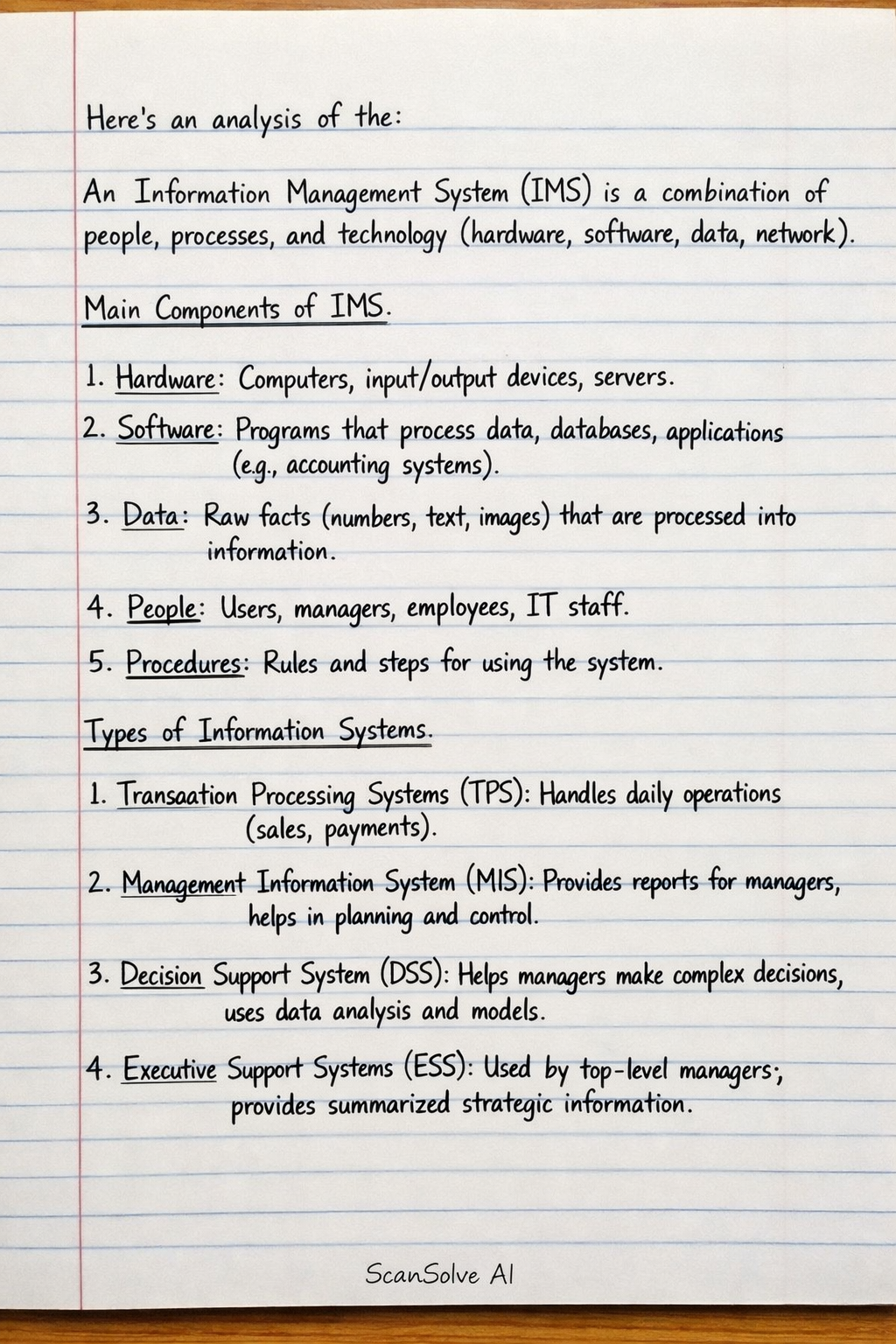
An Information Management System (IMS) is a combination of people, processes, and technology (hardware, software, data, network).
Business/Management
ScanSolve AI Answer
Here is the information from your notes:
An Information Management System (IMS) is a combination of people, processes, and technology (hardware, software, data, network).
- Main Components of IMS
- Hardware: Computers, input/output devices, servers.
- Software: Programs that process data, databases, applications (e.g., accounting systems).
- Data: Raw facts (numbers, text, images) that are processed into information.
- People: Users, managers, employees, IT staff.
- Procedures: Rules and steps for using the system.
- Types of Information Systems
- Transaction Processing Systems (TPS): Handles daily operations (sales, payments). Example: ATM systems.
- Management Information System (MIS): Provides reports for managers, helps in planning and control.
- Decision Support System (DSS): Helps managers make complex decisions, uses data analysis and models.
- Executive Support Systems (ESS): Used by top-level managers, provides summarized strategic information.
- Functions of IMS
- Data collection
- Data processing
- Storage
- Distribution
- Importance of IMS
- Improves decision making
- Saves time and costs
- Increases efficiency
- Enhances communication
- Helps in planning and control
- Advantages of IMS
- Fast access to information
- Better accuracy
- Improved productivity
- Easy data storage
- Disadvantages of IMS
- High cost of setup
- Security risks
- Requires training
- Dependence on technology
Was this helpful?
Still stuck on this one?
Ask a follow-up, and the answer starts from this question.
Got a different question?Ask your own question
More Business/Management Questions
QDefine management information systemQ(i) An information system is a set of interrelated components working together to collect, process…QManagement Information Systems (MIS) in Hotel Operations:QWhat is an information system? (ii) Define the following terms. (iii) Describe the term Multimedia.QWhat is computer based information system
Browse by topic:Management
Handwritten Step-by-Step Solution
Get this as a handwritten image on WhatsApp — like a tutor wrote it for you.
Try on WhatsApp