
Answer all according to the numbers on the picture
Business/Management
ScanSolve AI Answer
here are the answers for Question 2 and Question 3 from the picture.
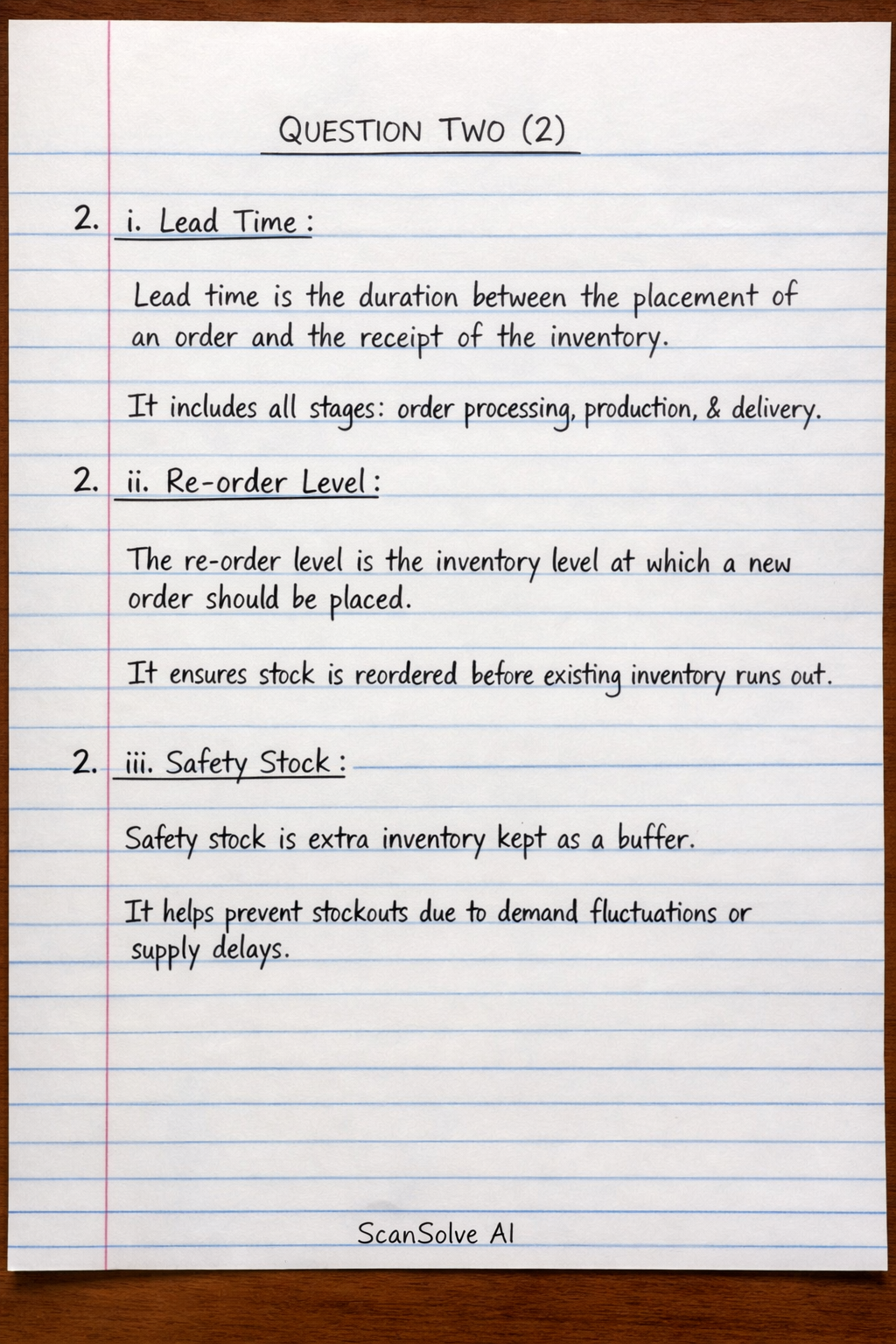
QUESTION TWO (2)
2. i. Lead Time
- Lead time refers to the duration between the moment an order for inventory is placed with a supplier and the moment the ordered goods are actually received and available for use or sale. It encompasses all stages, including order processing, production, and delivery.
2. ii. Re-order Level
- The re-order level is a specific point or quantity of inventory at which a new purchase order must be placed to replenish stock. Its purpose is to ensure that new stock arrives before the existing stock runs out, preventing disruptions in operations.
2. iii. Safety Stock
- Safety stock is an extra quantity of inventory held to reduce the risk of stockouts caused by uncertainties in demand or supply. It acts as a buffer against unexpected fluctuations in sales or delays in delivery from suppliers.
2. iv. Economic Order Quantity (EOQ)
- Economic Order Quantity (EOQ) is the optimal order quantity that a company should purchase to minimize its total inventory costs, which include holding costs, ordering costs, and shortage costs. It is calculated using a formula that balances these costs.
2. v. Stock-out
- A stock-out occurs when a company runs out of a particular item of inventory, meaning there is no stock available to meet customer demand or production needs. This can lead to lost sales, production delays, and damage to customer satisfaction.
QUESTION THREE (3)
3. State five (5) differences between Financial Accounting and Management Accounting.
Here are five key differences between Financial Accounting and Management Accounting:
-
Users of Information:
- Financial Accounting: Primarily serves external users such as investors, creditors, government agencies, and the public.
- Management Accounting: Primarily serves internal users such as managers, executives, and employees within the organization.
-
Purpose of Information:
- Financial Accounting: Provides a historical record of financial transactions to assess the overall financial performance and position of the company.
- Management Accounting: Provides information for planning, controlling, and decision-making within the organization, often focusing on future operations.
-
Reporting Standards:
- Financial Accounting: Must adhere to Generally Accepted Accounting Principles (GAAP) or International Financial Reporting Standards (IFRS).
- Management Accounting: Does not need to follow external standards; its design is flexible and tailored to the specific needs of management.
-
Focus and Time Horizon:
- Financial Accounting: Focuses on historical data and past events, typically covering specific periods (e.g., quarterly, annually).
- Management Accounting: Focuses on future-oriented data and estimates, used for forecasting, budgeting, and strategic planning.
-
Level of Detail:
- Financial Accounting: Presents aggregated information about the entire organization.
- Management Accounting: Provides detailed information about specific segments, products, departments, or activities within the organization.
Was this helpful?
Still stuck on this one?
Ask a follow-up, and the answer starts from this question.
Got a different question?Ask your own question
More Business/Management Questions
Handwritten Step-by-Step Solution
Get this as a handwritten image on WhatsApp — like a tutor wrote it for you.
Try on WhatsApp