
BECE 2026 MATHEMATICS HEAT QUESTIONS ✅ SOLVE Q1. A student scored 45 marks in a test which is 60%. a) Find the total marks b) How many more marks are needed to reach 80%? Q2. A sum of GH₵360 is shared among Kofi, Ama, and Yaw in the ratio 2 : 3 : 4. Find: a) Kofi’s share b) Ama’s share c) Yaw’s share Q3. A rectangular garden is 20 m long and 15 m wide. a) Find the perimeter b) Find the area c) Find the cost of fencing it at GH₵5 per metre Q4. Two angles on a straight line Find(x+10)°and (3x-20) ° a) Find x b) If one of the angles is part of a triangle, find the third angle if the other two are 50° and that angle. Q5. A shirt was sold for GH₵180 after a 10% discount. What was the original price? b) A shopkeeper bought goods for GH₵450 and sold them for GH₵540. Find the profit percentage. Q6. The marks of 12 students are: 42, 55, 50, 48, 55, 62, 38, 50, 55, 60, 45, 48 i. Find the mode ii. Find the range b) A bag contains 4 red, 3 blue and 3 green balls. One ball is drawn at random. Find the probability that it is: i. Blue ii. Not green Q7. a) A taxi company charges a fixed fee of GH₵10 plus GH₵1.20 per kilometer. How much will a passenger pay for a trip of 15 km? b) A rectangular field is 85 m long and 60 m wide. A farmer wants to put a fence around the field and also divide the field into 5 equal smaller plots by lines parallel to the shorter side. i. What is the perimeter of the field? ii. How many metres of fencing will be needed altogether?
ScanSolve AI Answer
Step-by-step solution
36 stepsQ1.
a)
Let the total marks be .
We are given that 45 marks represent 60% of the total marks.
Divide both sides by 0.60 to find .
The total marks are 75.
b)
Calculate 80% of the total marks.
Find the difference between 80% of the total marks and the student's current score.
The student needs 15 more marks to reach 80%.
Q2.
Find the total number of ratio parts.
Find the value of one ratio part.
a)
Calculate Kofi's share.
Kofi's share is GH₵80.
b)
Calculate Ama's share.
Ama's share is GH₵120.
c)
Calculate Yaw's share.
Yaw's share is GH₵160.
Q3.
Given: Length () = 20 m, Width () = 15 m.a)
Use the formula for the perimeter of a rectangle.
The perimeter is 70 m.
b)
Use the formula for the area of a rectangle.
The area is 300 m.
c)
Calculate the cost of fencing using the perimeter and the cost per metre.
The cost of fencing is GH₵350.
Q4.
Given: Two angles on a straight line are and .a)
Angles on a straight line sum to .
Combine like terms.
Add 10 to both sides.
Divide by 4.
The value of is 47.5.
b)
Calculate the values of the two angles using .
Assume "that angle" refers to the first angle, .
The sum of angles in a triangle is .
The third angle is 72.5.
Q5.
a)
Let the original price be .
A 10% discount means the selling price is 90% of the original price.
Divide by 0.90 to find .
The original price was GH₵200.
b)
Calculate the profit.
Calculate the profit percentage.
The profit percentage is 20%.
Q6.
Given marks: 42, 55, 50, 48, 55, 62, 38, 50, 55, 60, 45, 48.
i.Identify the frequency of each mark.
- 38: 1
- 42: 1
- 45: 1
- 48: 2
- 50: 2
- 55: 3
- 60: 1
- 62: 1 The mark that appears most frequently is 55. The mode is 55.
ii.
Identify the highest and lowest marks.
Highest mark = 62
Lowest mark = 38Calculate the range.
The range is 24.
b)
Given: 4 red, 3 blue, 3 green balls.Calculate the total number of balls.
i.
Calculate the probability of drawing a blue ball.
The probability of drawing a blue ball is .
ii.
Calculate the probability of drawing a ball that is not green.
The probability of drawing a ball that is not green is .
Q7.
a)
Identify the fixed fee and the cost per kilometer.
Fixed fee = GH₵10
Cost per km = GH₵1.20
Distance = 15 kmCalculate the total cost.
A passenger will pay GH₵28 for a trip of 15 km.
b)
Given: Length () = 85 m, Width () = 60 m.
i.Use the formula for the perimeter of a rectangle.
The perimeter of the field is 290 m.
ii.
The fencing around the field is its perimeter.
To divide the field into 5 equal smaller plots by lines parallel to the shorter side (60 m), 4 internal fences are needed.
Each internal fence will have the length of the shorter side.
Calculate the total length of internal fencing.
Calculate the total fencing needed.
A total of 530 m of
Still stuck on this one?
Ask a follow-up, and the answer starts from this question.
More Business/Management Questions
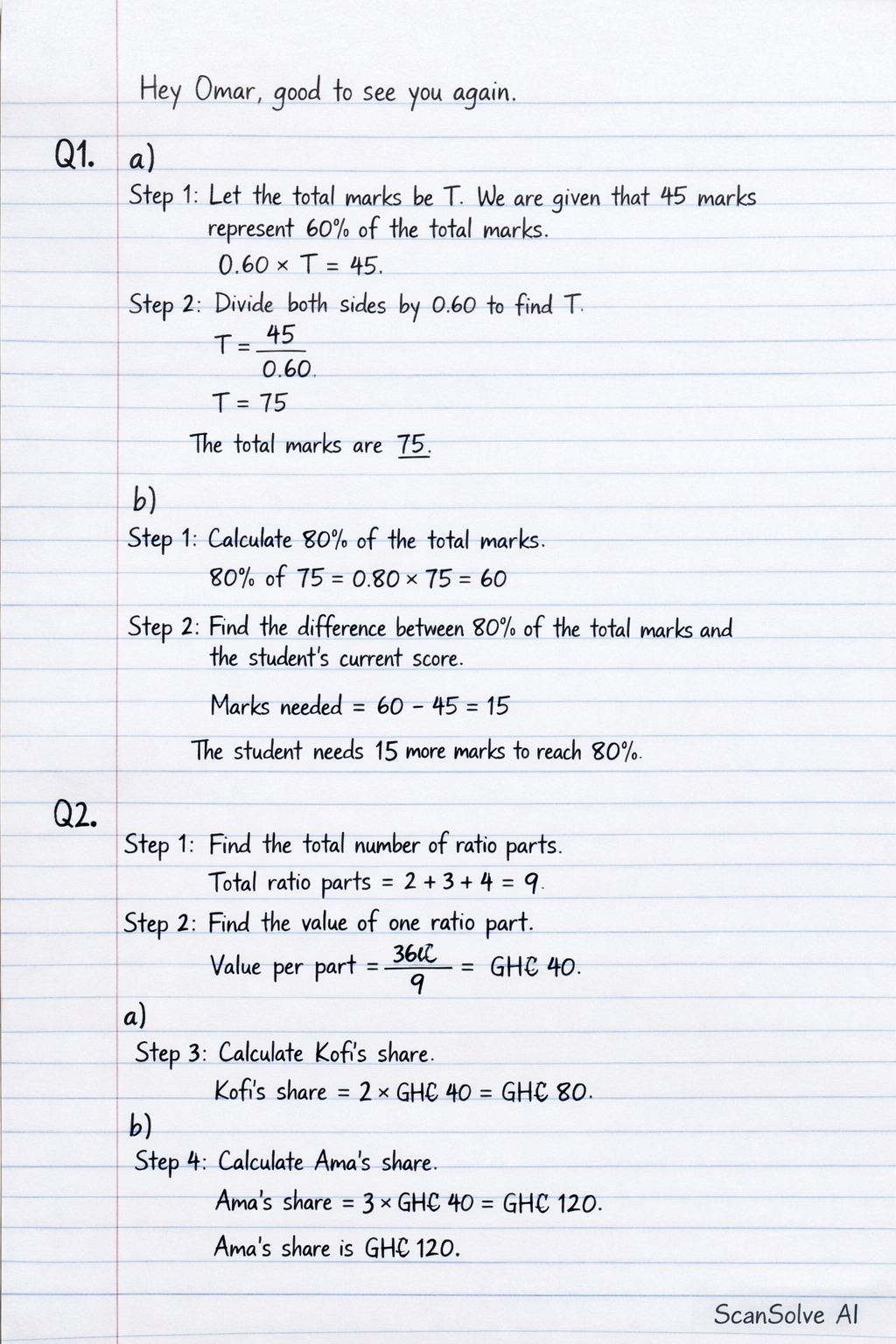
Handwritten Step-by-Step Solution
Get this as a handwritten image on WhatsApp — like a tutor wrote it for you.
Try on WhatsApp