

This business/management problem is solved step by step below, with detailed explanations to help you understand the method and arrive at the correct answer.
ScanSolve AI Answer
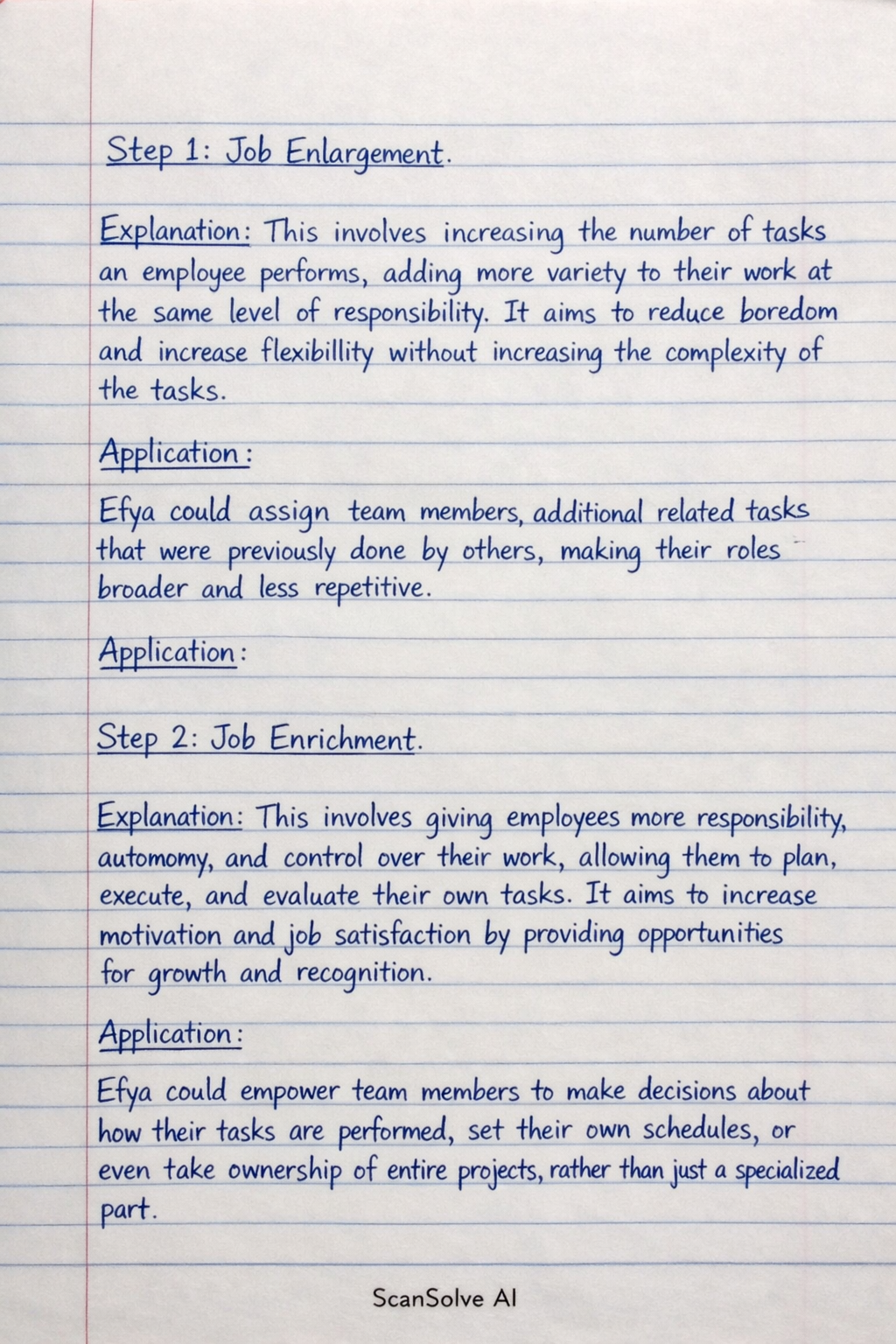
a) Briefly explain any two (2) alternatives to specialization you think Efya could have employed to achieve her goals. Step 1: Job Enlargement Explanation:* This involves increasing the number of tasks an employee performs, adding more variety to their work at the same level of responsibility. It aims to reduce boredom and increase flexibility without increasing the complexity of the tasks. Application:* Efya could assign team members additional related tasks that were previously done by others, making their roles broader and less repetitive. Step 2: Job Enrichment Explanation:* This involves giving employees more responsibility, autonomy, and control over their work, allowing them to plan, execute, and evaluate their own tasks. It aims to increase motivation and job satisfaction by providing opportunities for growth and recognition. Application:* Efya could empower team members to make decisions about how their tasks are performed, set their own schedules, or even take ownership of entire projects, rather than just a specialized part. b) As a student of organizational management, discuss the process that Efya should embark on to effectively implement her new approach within her department. Step 1: Prepare for Delegation Identify tasks suitable for delegation:* Efya should analyze departmental tasks and identify those that can be effectively delegated, considering their complexity, importance, and the skills required. Routine, less critical, or developmental tasks are often good candidates. Select the right individuals:* She needs to assess her team members' skills, experience, and willingness to take on new responsibilities. Matching tasks to individuals' strengths and developmental needs is crucial. Step 2: Assign Duties and Responsibilities Clearly define the task:* Efya must clearly communicate what needs to be done, the expected outcomes, deadlines, and any specific standards or procedures. Ambiguity can lead to errors and frustration. Explain the purpose: She should explain why* the task is important and how it contributes to the department's and organization's goals, providing context and increasing motivation. Step 3: Grant Authority Provide necessary authority:* Efya must give the delegate sufficient authority to complete the assigned task. This includes access to resources, information, and the power to make decisions within defined limits. Authority should match responsibility. Communicate authority to others:* She should inform other relevant team members or departments about the delegated authority to ensure cooperation and avoid confusion. Step 4: Establish Accountability Set up reporting mechanisms:* Efya needs to establish clear expectations for feedback and progress reports. This could involve regular check-ins, performance reviews, or specific reporting formats. Provide support and feedback:* She should offer guidance, resources, and constructive feedback throughout the process. This includes being available to answer questions, provide training, and help overcome obstacles, ensuring the delegate feels supported rather than abandoned. Evaluate performance:* Finally, Efya must evaluate the outcome of the delegated task and provide feedback on performance, recognizing successes and discussing areas for improvement. This reinforces accountability and supports continuous learning. c) Outline two (2) benefits that the firm stands to gain from adopting a delegation strategy. Step 1: Employee Development and Motivation Benefit:* Delegation provides opportunities for employees to learn new skills, take on greater responsibilities, and develop their capabilities. This fosters a sense of trust and empowerment, leading to increased job satisfaction, motivation, and commitment to the organization. Step 2: Improved Efficiency and Managerial Focus Benefit:* By delegating routine or less critical tasks, managers like Efya can free up their time to focus on more strategic planning, complex problem-solving, and high-level decision-making. This leads to more efficient use of managerial resources and can improve overall departmental productivity and responsiveness.