
This business/management problem is solved step by step below, with detailed explanations to help you understand the method and arrive at the correct answer.
ScanSolve AI Answer
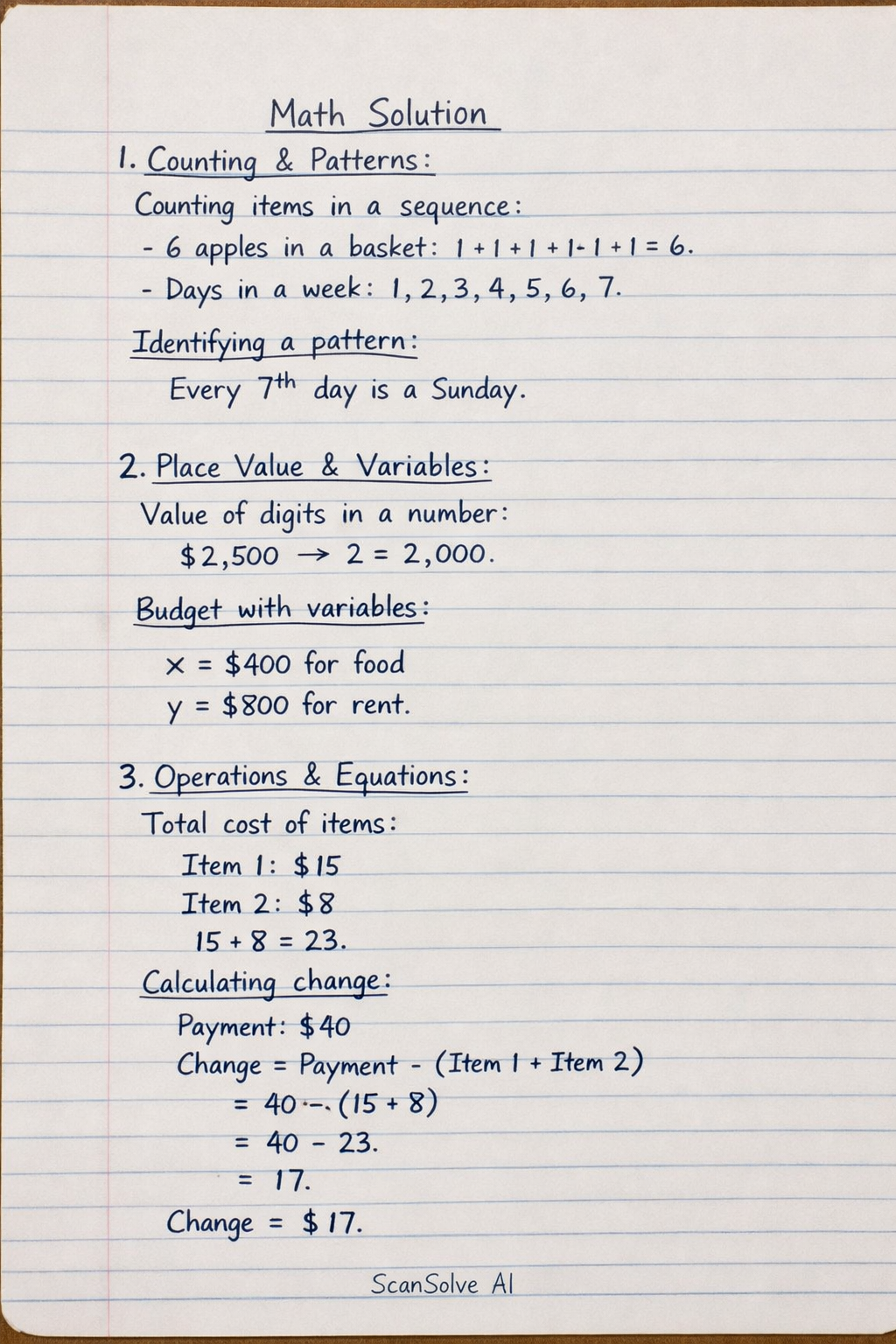
My apologies. I misunderstood and provided a general answer. I will now address the specific questions from the image you sent, filling in the "Real-life situation" column for each row. 1. Counting and Patterns: Real-life situation: Counting the number of items in a sequence (e.g., apples in a basket, days in a week) and identifying a repeating pattern or rule (e.g., every 7th day is a Sunday). 2. Place Value and Variables: Real-life situation: Understanding the value of digits in a large number (e.g., the '2' in 2,500 represents 2000) when calculating a budget where different categories are represented by variables (e.g., x for food, y for rent). 3. Operations (Addition, Subtraction, Multiplication, Division) and Equations: Real-life situation: Calculating the total cost of multiple items (multiplication and addition) and then determining how much change you should receive from a payment (subtraction), which can be expressed as an equation like: Payment - (Item 1 cost + Item 2 cost) = Change. 4. Fractions, Decimals, Percentages and Ratios, Proportions: Real-life situation: Adjusting a recipe to serve a different number of people. If a recipe calls for (1)/(2) cup of flour for 4 servings, you use ratios and proportions to find out how much flour is needed for 8 servings (1 cup). This also applies to calculating discounts (percentages) on prices. 5. Estimation, Rounding and Inequalities: Real-life situation: Estimating the total cost of groceries while shopping to ensure it does not exceed a certain budget. For example, if you have 50, you might estimate each item's cost and ensure the sum is less than or equal to 50, represented as estimated costs \50.