
CCTU produces large volumes of plastic bottles, food packaging and paper waste. Bins are not labelled, waste collectors mix all materials, and students have little incentive to separate waste. A student team proposes a mobile application that awards points for recycling, but many students have limited data access, and the campus has no confirmed recycling partner. Use systems thinking to identify causes or actors that must be considered before selecting a solution. Apply the main stages of design thinking to improve the student team’s proposal. [5 marks] Recommend circular-economy features that could be included in the final solution. [5 marks] Propose indicators for assessing the innovation. [5 marks]
ScanSolve AI Answer
Step-by-step solution
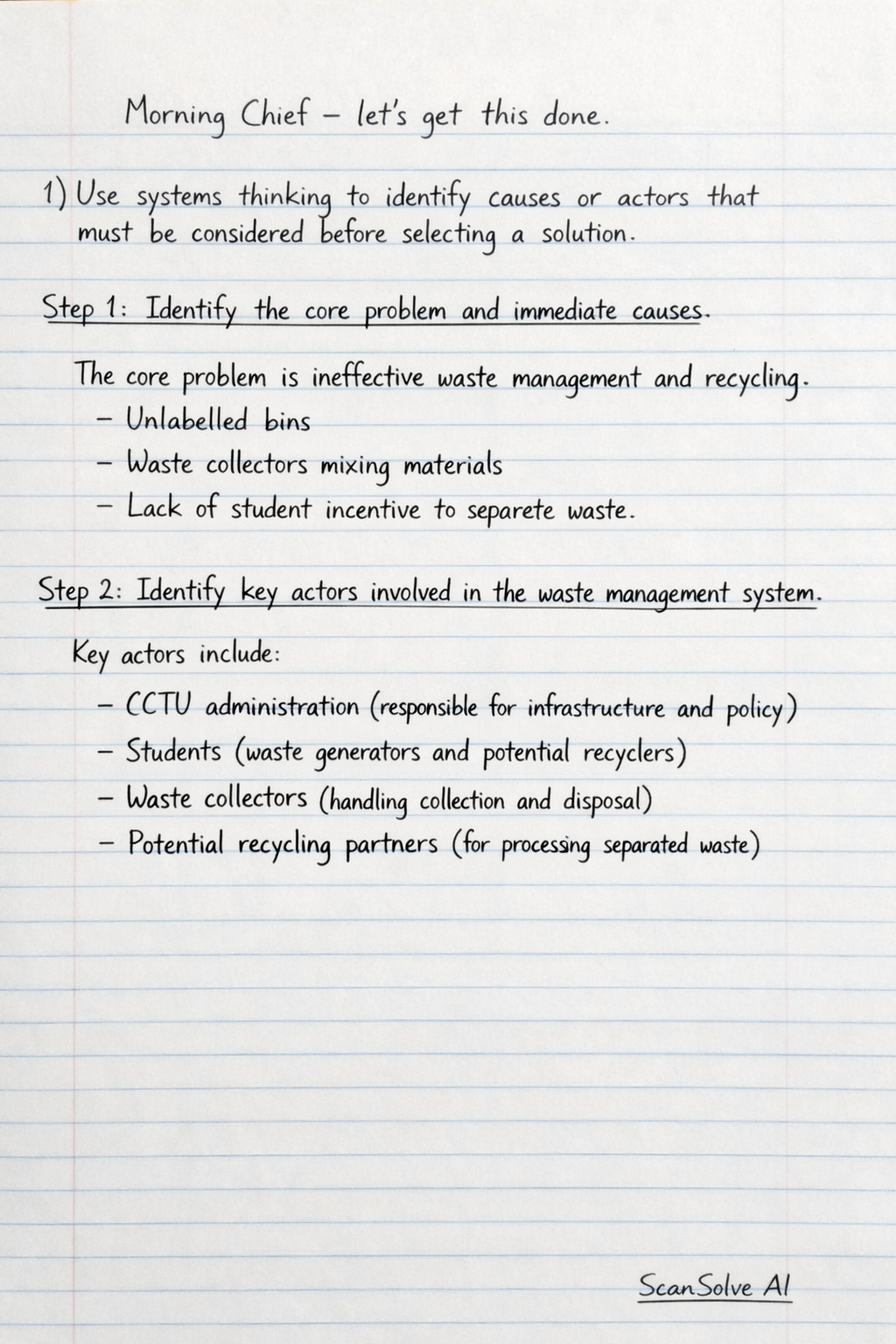
14 steps1) Use systems thinking to identify causes or actors that must be considered before selecting a solution.
Identify the core problem and immediate causes.
The core problem is ineffective waste management and recycling. Immediate causes include unlabelled bins, waste collectors mixing materials, and lack of student incentive to separate waste.
Identify key actors involved in the waste management system.
Key actors include CCTU administration (responsible for infrastructure and policy), students (waste generators and potential recyclers), waste collectors (handling collection and disposal), and potential recycling partners (for processing separated waste).
Identify systemic constraints and external factors.
Systemic constraints include limited data access for students (impacting app-based solutions) and the absence of a confirmed recycling partner (making actual recycling impossible). The large volumes of specific waste types (plastic bottles, food packaging, paper) also need consideration for targeted solutions.
2) Apply the main stages of design thinking to improve the student team’s proposal.
Empathize* with users and stakeholders.
Understand the needs and challenges of students (limited data, lack of motivation), waste collectors (ease of collection), and CCTU administration (cost, logistics, environmental goals). This involves observing waste habits and conducting interviews.
Define* the problem clearly.
Based on empathy, reframe the problem statement. For example: "How might we create an accessible and sustainable system that incentivizes CCTU students to effectively sort waste, considering data limitations and the need for a reliable recycling partner?"
Ideate* a wide range of solutions.
Brainstorm beyond just the mobile app. Consider solutions like physical incentives (e.g., vouchers for campus services), improved physical infrastructure (e.g., smart bins, sorting stations), educational campaigns, and direct partnerships with local businesses for waste collection/processing.
Prototype* selected ideas.
Develop low-fidelity versions of promising solutions. This could be a mock-up of a simplified app, a pilot program for clearly labelled bins in a specific area, or a small-scale collection point for specific materials.
Test* prototypes and iterate.
Implement the prototypes with a small group of students and waste collectors. Gather feedback on usability, effectiveness, and desirability. Use this feedback to refine the solution, addressing issues like data access or the need for a recycling partner, before wider implementation.
3) Recommend circular-economy features that could be included in the final solution.
Focus on Reduce and Reuse principles.
- Implement campaigns to reduce single-use plastic bottles and food packaging by promoting reusable alternatives (e.g., water refill stations, discounts for using personal containers).
- Establish collection points for reusable items (e.g., textbooks, clothing, electronics) for donation or exchange within the campus community.
Incorporate Recycle and Recover strategies.
- Develop a robust on-campus sorting and collection system for different waste streams (plastic, paper, organic) with clearly labelled bins and regular collection.
- Secure a confirmed recycling partner to ensure collected materials are actually processed and diverted from landfills.
- Explore options for composting food waste and organic materials on campus for use in gardens or landscaping.
Consider Value Creation from waste.
- Investigate opportunities to upcycle or repurpose collected materials into new products for campus use or sale (e.g., benches from recycled plastic, paper for art projects).
- Encourage campus vendors to adopt circular packaging solutions (e.g., compostable containers, returnable packaging systems).
4) Propose indicators for assessing the innovation.
Propose Environmental Impact indicators.
- Volume/Weight of Waste Recycled: Measure the total amount (in kg or tonnes) of plastic, paper, and food waste successfully separated and sent for recycling/composting.
- Waste Diversion Rate: Percentage of total waste generated that is diverted from landfills.
- Contamination Rate: Percentage of incorrectly sorted materials in recycling bins.
Propose Social/Behavioral indicators.
- Student Participation Rate: Number of students actively using the app (if implemented) or consistently using labelled bins.
- Awareness Levels: Results from surveys assessing student knowledge of proper waste sorting and recycling benefits.
- User Satisfaction: Feedback from students and waste collectors on the ease of use and effectiveness of the new system.
Propose Economic/Operational indicators.
- Cost Savings: Reduction in waste disposal fees for CCTU due to decreased landfill waste.
- Revenue from Recycled Materials: Any income generated from selling sorted recyclable materials to partners.
- Operational Efficiency: Time taken for waste collection and sorting, and the reliability of the recycling partnership.
Still stuck on this one?
Ask a follow-up, and the answer starts from this question.
More Business/Management Questions
Handwritten Step-by-Step Solution
Get this as a handwritten image on WhatsApp — like a tutor wrote it for you.
Try on WhatsApp