
We read your photo as:
Compare and contrast a sole proprietorship and a private limited company, detailing differences in liability and capital acquisition. Explain why a clear organizational structure is vital for scaling
Business/Management
ScanSolve AI Answer
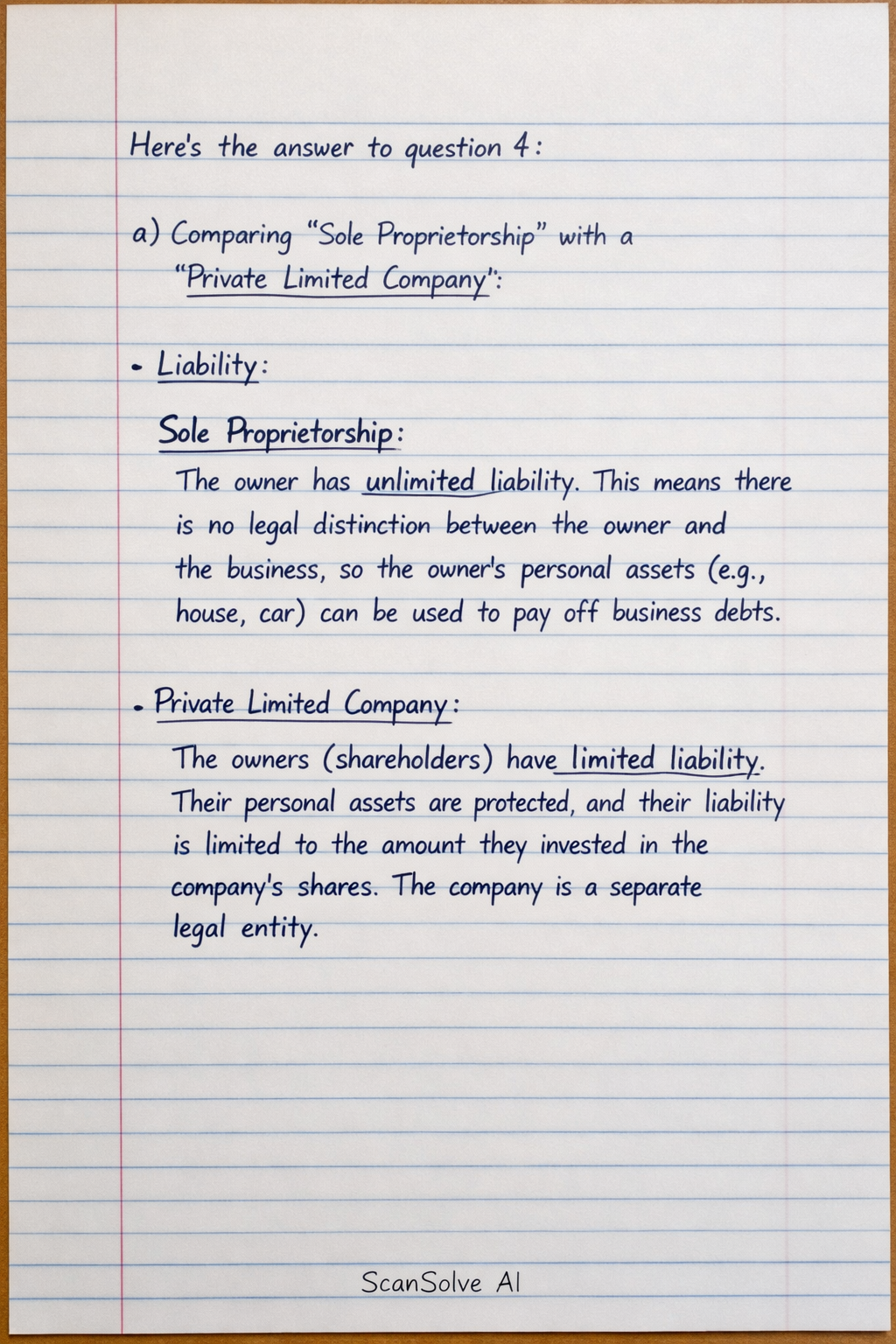
Here's the answer to question 4:
a) Comparing "Sole Proprietorship" with a "Private Limited Company":
-
Liability:
- Sole Proprietorship: The owner has unlimited liability. This means there is no legal distinction between the owner and the business, so the owner's personal assets (e.g., house, car) can be used to pay off business debts.
- Private Limited Company: The owners (shareholders) have limited liability. Their personal assets are protected, and their liability is limited to the amount they invested in the company's shares. The company is a separate legal entity.
-
Capital Acquisition:
- Sole Proprietorship: Capital is primarily raised from the owner's personal savings, loans from friends/family, or small bank loans. It can be difficult to raise large amounts of capital as the business's borrowing capacity is tied to the owner's personal creditworthiness.
- Private Limited Company: Capital can be raised by issuing shares to a limited number of private investors (not to the general public). It can also secure larger bank loans due to its separate legal status and potentially greater perceived stability. This structure generally offers more avenues for capital acquisition than a sole proprietorship.
b) A clear organizational structure is essential for a business aiming to scale its operations for several reasons:
- Clarity of Roles and Responsibilities: As a business grows, a clear structure defines who is responsible for what, reducing confusion, duplication of effort, and gaps in tasks. This ensures that new employees understand their place and contribution to the larger organization.
- Efficient Communication and Decision-Making: A well-defined structure establishes clear lines of authority and communication channels. This facilitates faster and more effective decision-making, as employees know who to report to and who to consult, preventing bottlenecks as the company expands.
- Scalability and Growth Management: An organizational structure provides a framework for adding new departments, teams, or positions without disrupting existing operations. It allows the business to grow systematically, ensuring that resources are allocated effectively and that the company can adapt to increased complexity and demand.
Was this helpful?
Still stuck on this one?
Ask a follow-up, and the answer starts from this question.
Got a different question?Ask your own question
More Business/Management Questions
QWill Sole trader/proprietor be suitable then a private company, motivate.QDiscuss a situation for a family funded business. Can be registered under sole proprietor…QDistinguish between primary/secondary and direct/indirect production. Explain four advantages of a…QWhat is the significance of including 'Limited' or 'Ltd' in a company name, and why are retained…QExplain 5 difference between public limited companies and parastatals
Handwritten Step-by-Step Solution
Get this as a handwritten image on WhatsApp — like a tutor wrote it for you.
Try on WhatsApp