
We read your photo as:
Cost-Volume-Profit (CVP) Analysis
ScanSolve AI Answer
Answer
Step-by-step solution
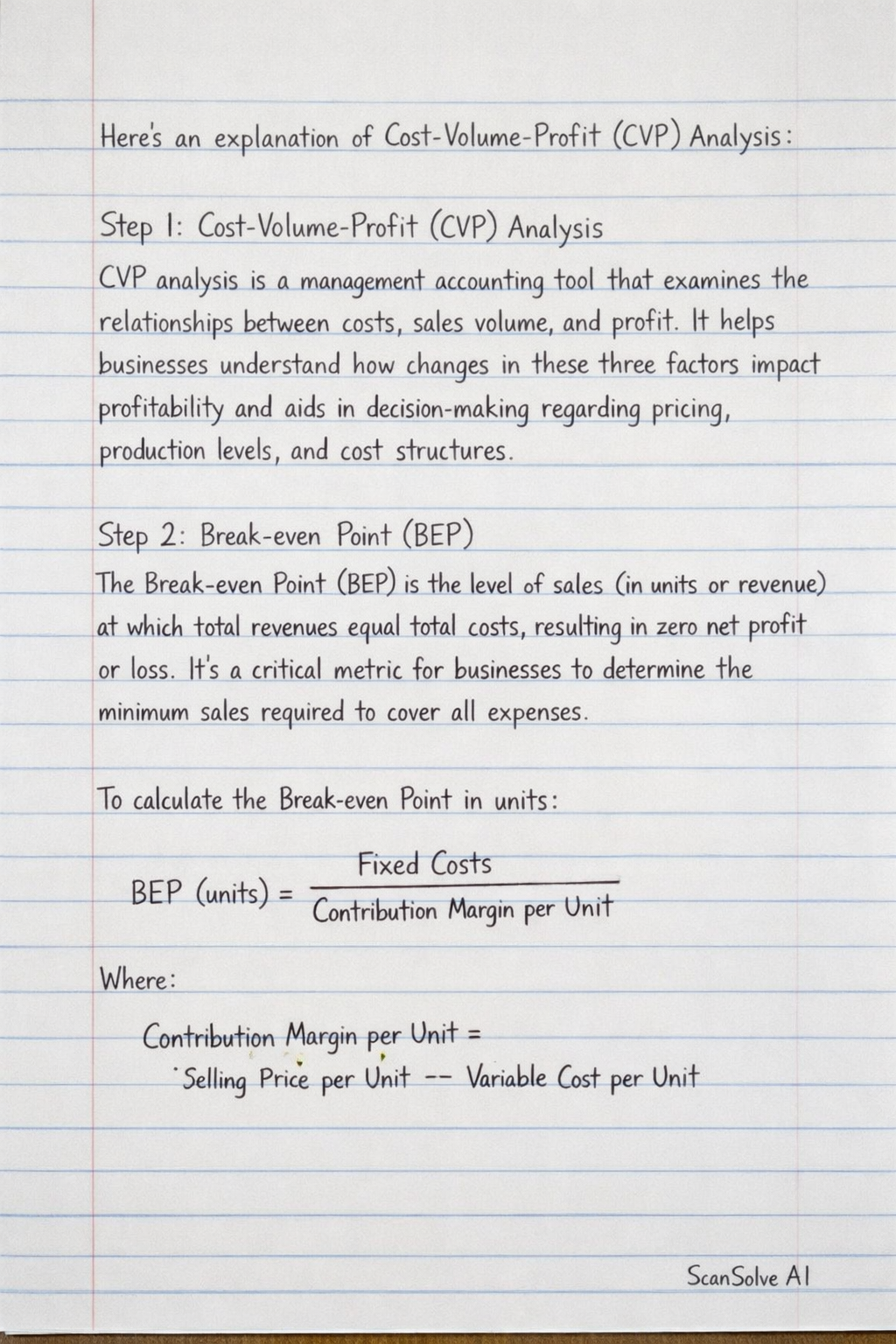
4 stepsHere's an explanation of Cost-Volume-Profit (CVP) Analysis:
Cost-Volume-Profit (CVP) Analysis
CVP analysis is a management accounting tool that examines the relationships between costs, sales volume, and profit. It helps businesses understand how changes in these three factors impact profitability and aids in decision-making regarding pricing, production levels, and cost structures.
Break-even Point (BEP)
The Break-even Point (BEP) is the level of sales (in units or revenue) at which total revenues equal total costs, resulting in zero net profit or loss. It's a critical metric for businesses to determine the minimum sales required to cover all expenses.
To calculate the Break-even Point in units:
Where:
Margin of Safety
The Margin of Safety is the difference between actual or expected sales and the break-even sales. It indicates how much sales can decline before the company starts incurring a loss, providing a measure of risk. A higher margin of safety suggests a lower risk of not breaking even.
To calculate the Margin of Safety:
This can be expressed in units, sales revenue, or as a percentage.
Example to determine units for a particular Profit / Sale
Let's assume a company has the following data:
- Fixed Costs =
\10,000$ - Selling Price per Unit =
\50$ - Variable Cost per Unit =
\30$ - Target Profit =
\5,000$
First, calculate the Contribution Margin per Unit:
Next, use the formula to find the number of units needed to achieve the target profit:
Substitute the values:
To achieve a target profit of
\5,000\boxed{750 units}$.- Fixed Costs =
Try one yourself
A new problem that tests the same skill.
Still stuck on this one?
Ask a follow-up, and the answer starts from this question.
More Business/Management Questions
Handwritten Step-by-Step Solution
Get this as a handwritten image on WhatsApp — like a tutor wrote it for you.
Try on WhatsApp