
We read your photo as:
Explain the Delphi technique and how it can be applied to solve business problems.
ScanSolve AI Answer
Step-by-step solution
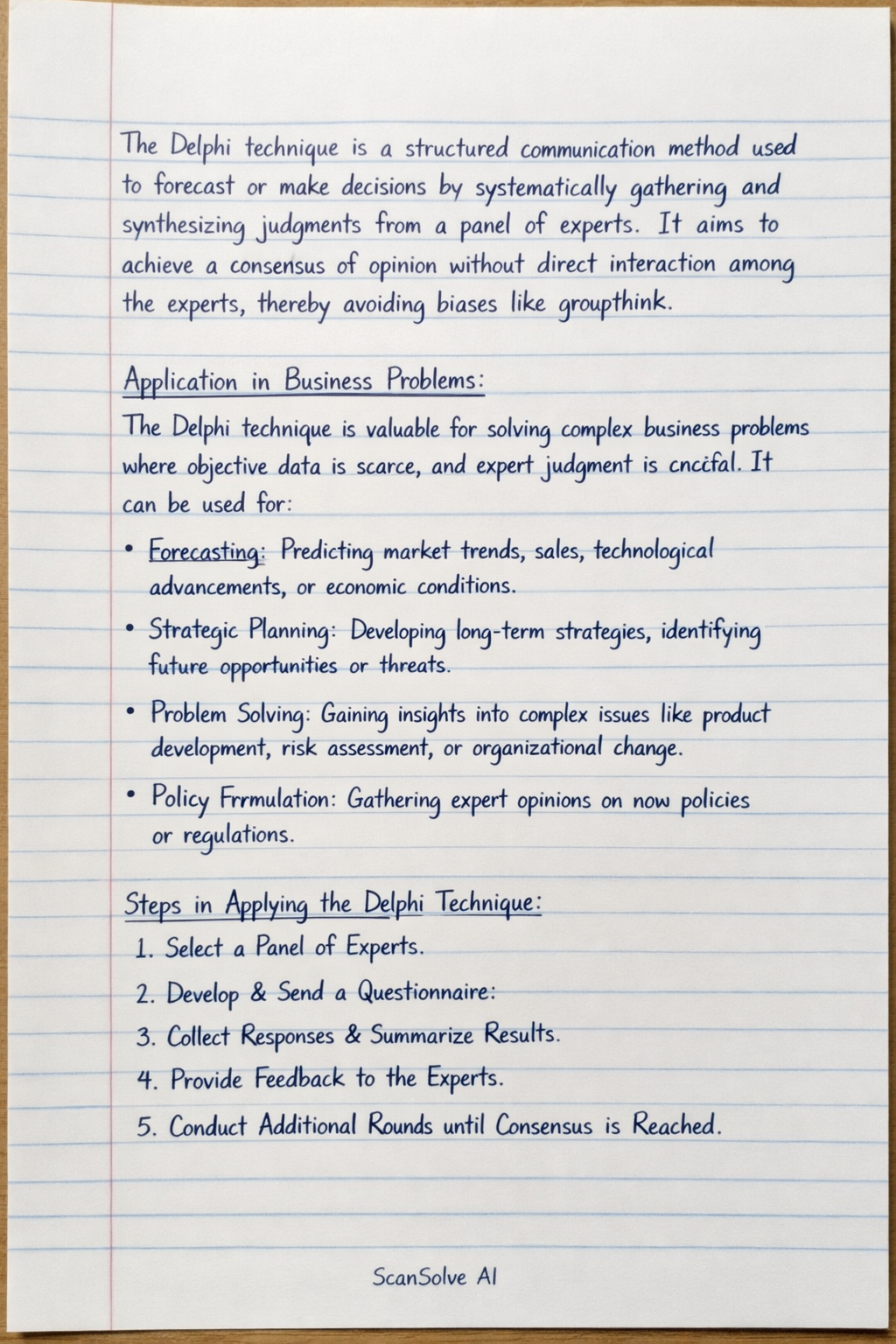
7 stepsThe Delphi technique is a structured communication method used to forecast or make decisions by systematically gathering and synthesizing judgments from a panel of experts. It aims to achieve a consensus of opinion without direct interaction among the experts, thereby avoiding biases like groupthink.
Here's how to apply the Delphi technique to solve business problems:
-
Application in Business Problems: The Delphi technique is valuable for solving complex business problems where objective data is scarce, and expert judgment is crucial. It can be used for:
- Forecasting: Predicting market trends, sales, technological advancements, or economic conditions.
- Strategic Planning: Developing long-term strategies, identifying future opportunities or threats.
- Problem Solving: Gaining insights into complex issues like product development, risk assessment, or organizational change.
- Policy Formulation: Gathering expert opinions on new policies or regulations.
-
Steps in Applying the Delphi Technique:
Define the Problem
Clearly articulate the business problem or question that needs to be addressed. This ensures all experts focus on the same issue.Select Experts
Identify and recruit a diverse panel of experts who have relevant knowledge and experience related to the problem. The number of experts can vary, but typically ranges from 10 to 50.First Round Questionnaire
Send an initial questionnaire to the experts, asking them to provide their opinions, forecasts, or solutions to the problem. Responses are collected anonymously.Analyze Responses
A facilitator collects, summarizes, and analyzes the anonymous responses from the first round. Common themes, divergent opinions, and statistical data (e.g., median, range) are identified.Second Round Questionnaire with Feedback
The summarized feedback from the first round is shared with the experts. They are then asked to reconsider their initial responses in light of the group's collective input. Experts whose opinions deviate significantly from the group's consensus may be asked to justify their reasoning.Iterate
Repeat steps 4 and 5 for several rounds. The goal is to narrow the range of opinions and move towards a consensus or a stable set of judgments. The number of rounds depends on the complexity of the problem and the level of consensus desired.Final Report
Once a satisfactory level of consensus is reached, or opinions stabilize, the aggregated results, conclusions, and any remaining dissenting views are compiled into a final report.- Sources for Information:
To gather more information on the Delphi technique and its application, you can consult:
- Academic Journals: Search databases like Google Scholar, JSTOR, or university libraries for articles on "Delphi method," "forecasting techniques," or "expert elicitation."
- Business Textbooks: Look for chapters on strategic management, operations research, or decision-making.
- Online Resources: Reputable business and management websites, research papers, and organizational consulting firm publications.
- Government Reports: Some government agencies use Delphi for policy planning and may publish reports.
The Delphi technique helps businesses make informed decisions by leveraging collective expert intelligence while minimizing biases.
- Sources for Information:
To gather more information on the Delphi technique and its application, you can consult:
Still stuck on this one?
Ask a follow-up, and the answer starts from this question.
More Business/Management Questions
Handwritten Step-by-Step Solution
Get this as a handwritten image on WhatsApp — like a tutor wrote it for you.
Try on WhatsApp