
We read your photo as:
Explain the different levels of management and define organizational structure and centralization. Also, list three marketing functions.
ScanSolve AI Answer
here are the answers to the remaining questions:
Question 2:
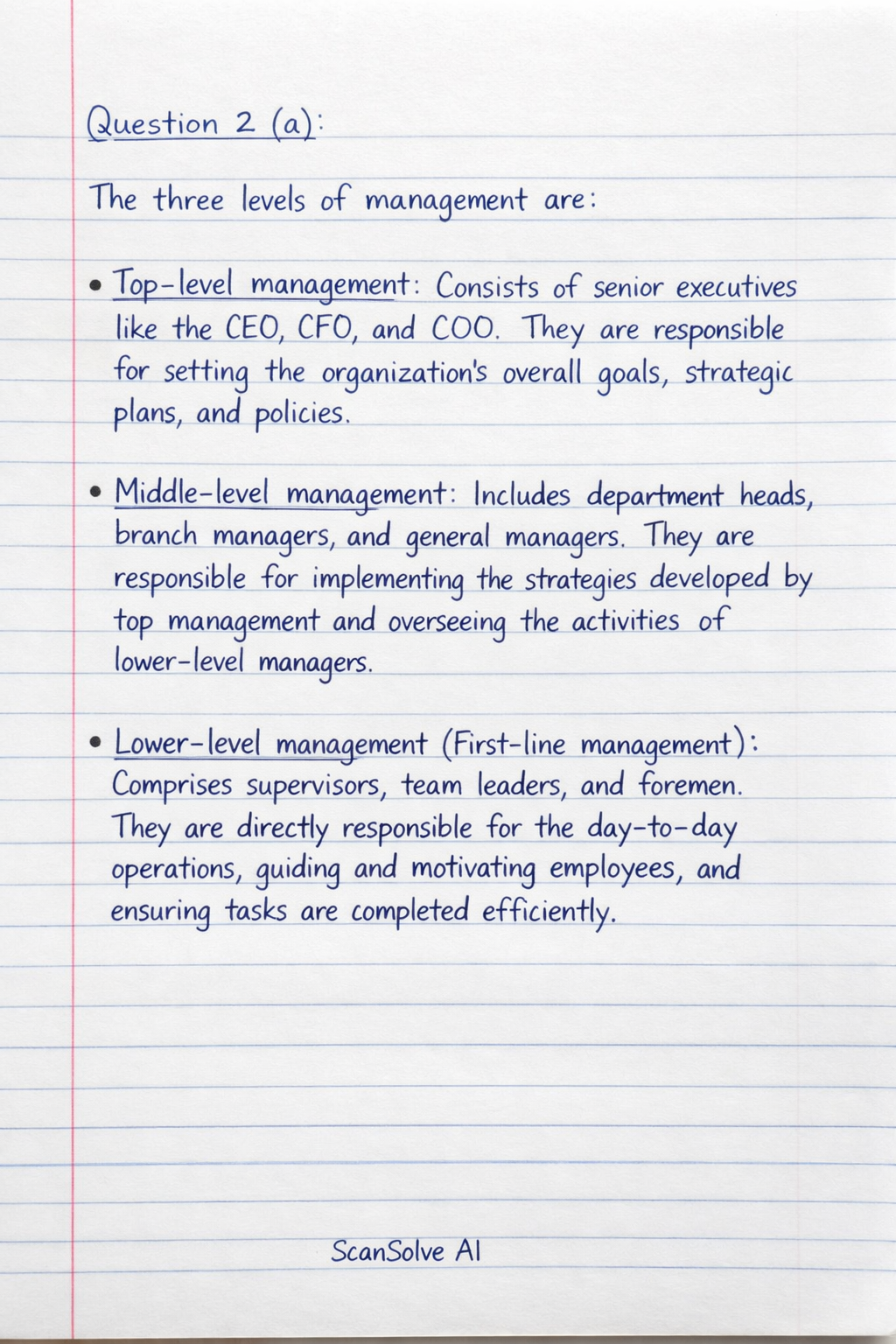
a) The three levels of management are:
- Top-level management: Consists of senior executives like the CEO, CFO, and COO. They are responsible for setting the organization's overall goals, strategic plans, and policies.
- Middle-level management: Includes department heads, branch managers, and general managers. They are responsible for implementing the strategies developed by top management and overseeing the activities of lower-level managers.
- Lower-level management (First-line management): Comprises supervisors, team leaders, and foremen. They are directly responsible for the day-to-day operations, guiding and motivating employees, and ensuring tasks are completed efficiently.
b)
(i) Organizational structure: This refers to the system that outlines how certain activities are directed in order to achieve the goals of an organization. These activities can include rules, roles, and responsibilities. It determines how information flows between levels within the company.
(ii) Centralization: This is a management approach where decision-making authority is concentrated at the top levels of an organization. A few individuals or a single department hold most of the power and control over operations and policies.
Question 3:
a) Three marketing functions performed by organizations are:
- Market Research: Gathering and analyzing information about customers, competitors, and market trends to identify opportunities and challenges.
- Product Development: Designing, creating, and improving goods or services to meet customer needs and market demands.
- Promotion: Communicating the value of products or services to target customers to persuade them to buy, using methods like advertising, public relations, and sales promotions.
b) The elements in the marketing mix, often referred to as the 4 Ps, are:
- Product: The good or service offered to meet customer needs, including its features, quality, design, branding, and packaging.
- Price: The amount customers pay for the product, considering pricing strategies, discounts, payment terms, and perceived value.
- Place (Distribution): How the product is made available to customers, including channels of distribution, logistics, inventory management, and location.
- Promotion: Activities used to communicate and persuade target customers about the product, such as advertising, personal selling, sales promotion, and public relations.
Question 4:
a) Inflation is the rate at which the general level of prices for goods and services is rising, and subsequently, the purchasing power of currency is falling. It means that a unit of currency effectively buys less than it did in prior periods.
b) The four causes of inflation are:
- Demand-pull inflation: Occurs when aggregate demand in an economy outpaces aggregate supply. Too much money is chasing too few goods, leading to price increases.
- Cost-push inflation: Arises when the cost of producing goods and services increases, forcing businesses to raise their prices to maintain profit margins. This can be due to higher wages, raw material costs, or energy prices.
- Built-in inflation (Wage-price spiral): Occurs when workers demand higher wages to compensate for rising prices, and businesses, in turn, raise prices to cover the increased labor costs. This creates a continuous cycle of wage and price increases.
- Monetary inflation: Caused by an excessive increase in the money supply by the central bank. When there is more money circulating in the economy without a corresponding increase in goods and services, the value of money decreases, leading to higher prices.
Question 5:
a) Specialization is the process by which individuals, firms, or countries focus on producing a limited range of goods or services in which they have a comparative advantage, rather than producing everything they need. This allows them to become highly efficient in those specific tasks.
b) Four advantages of specialization are:
- Increased Efficiency and Productivity: Workers become highly skilled and proficient in their specific tasks, leading to faster production and higher output per unit of input.
- Lower Production Costs: Specialization can lead to economies of scale, as firms can produce larger quantities more cheaply due to optimized processes and reduced waste.
- Improved Quality: Focusing on specific tasks allows for greater attention to detail and the development of expertise, often resulting in higher quality products or services.
- Innovation and Technological Advancement: Specialized knowledge can foster innovation as individuals or teams delve deeper into their specific areas, leading to new methods, tools, and technologies.
Question 6:
a) Three sources of external recruitment are:
- Job advertisements: Placing ads in newspapers, magazines, professional journals, or online job boards.
- Employment agencies/Recruitment firms: Using third-party agencies that specialize in finding suitable candidates for specific roles.
- Educational institutions: Recruiting directly from universities, colleges, or vocational schools through career fairs or campus placements.
b) Three advantages and three disadvantages of external recruitment:
Advantages:
- New perspectives and ideas: Brings in fresh talent with different experiences and approaches, fostering innovation.
- Wider talent pool: Allows access to a larger and more diverse group of candidates, potentially finding highly specialized skills not available internally.
- Reduced training costs (sometimes): External hires may already possess the necessary skills and experience, requiring less initial training compared to internal promotions. Disadvantages:
- Higher costs: Involves expenses for advertising, agency fees, and extensive screening processes.
- Longer hiring process: Can take more time to identify, interview, and onboard external candidates compared to internal promotions.
- Risk of poor fit: External candidates may not integrate well with the company culture or team dynamics, leading to potential turnover.
Question 7:
a) Leadership is the ability of an individual or an organization to guide, inspire, and influence a group of people or an entire organization towards the achievement of a common goal or vision. It involves setting direction, motivating others, and making decisions.
b)
(i) Democratic leadership: This style involves leaders who encourage participation from team members in decision-making. They value input from their subordinates, fostering a sense of ownership and collaboration, though the final decision often rests with the leader.
(ii) Autocratic leadership: In this style, the leader makes decisions independently with little or no input from team members. They maintain strict control and expect subordinates to follow instructions without question.
(iii) Laissez-faire leadership: This is a hands-off approach where leaders provide minimal guidance and allow team members to make most decisions and manage their own work. It relies heavily on the self-motivation and expertise of the team.
(iv) Transformational leadership: This style focuses on inspiring and motivating followers to achieve extraordinary outcomes and to develop their own leadership potential. Transformational leaders articulate a clear vision, act as role models, and encourage innovation and growth.
Question 8:
a) An insurance premium is the amount of money an individual or company must pay to an insurance company for coverage. It is typically a recurring payment, often paid monthly, quarterly, or annually, in exchange for the insurer's promise to pay for specified losses as outlined in the insurance policy.
b)
(i) Undue influence: Occurs when one party in a contract takes unfair advantage of a position of power or trust over another party, causing the weaker party to enter into a contract they would not have otherwise agreed to.
(ii) Duress: Involves the use of threats, violence, or unlawful pressure to force someone into entering a contract against their free will. The threat can be against the person, their property, or their loved ones.
(iii) Misrepresentation: Is a false statement of a material fact made by one party to another, which induces the other party to enter into a contract. The statement must be untrue and have influenced the decision to contract.
(iv) Mistake: Refers to an erroneous belief about a material fact of the contract by one or both parties. If the mistake is fundamental and shared by both parties (common mistake), or if one party's mistake is known to the other (unilateral mistake), it can render the contract void or voidable.
Still stuck on this one?
Ask a follow-up, and the answer starts from this question.
More Business/Management Questions
Handwritten Step-by-Step Solution
Get this as a handwritten image on WhatsApp — like a tutor wrote it for you.
Try on WhatsApp