

This business/management problem is solved step by step below, with detailed explanations to help you understand the method and arrive at the correct answer.
ScanSolve AI Answer
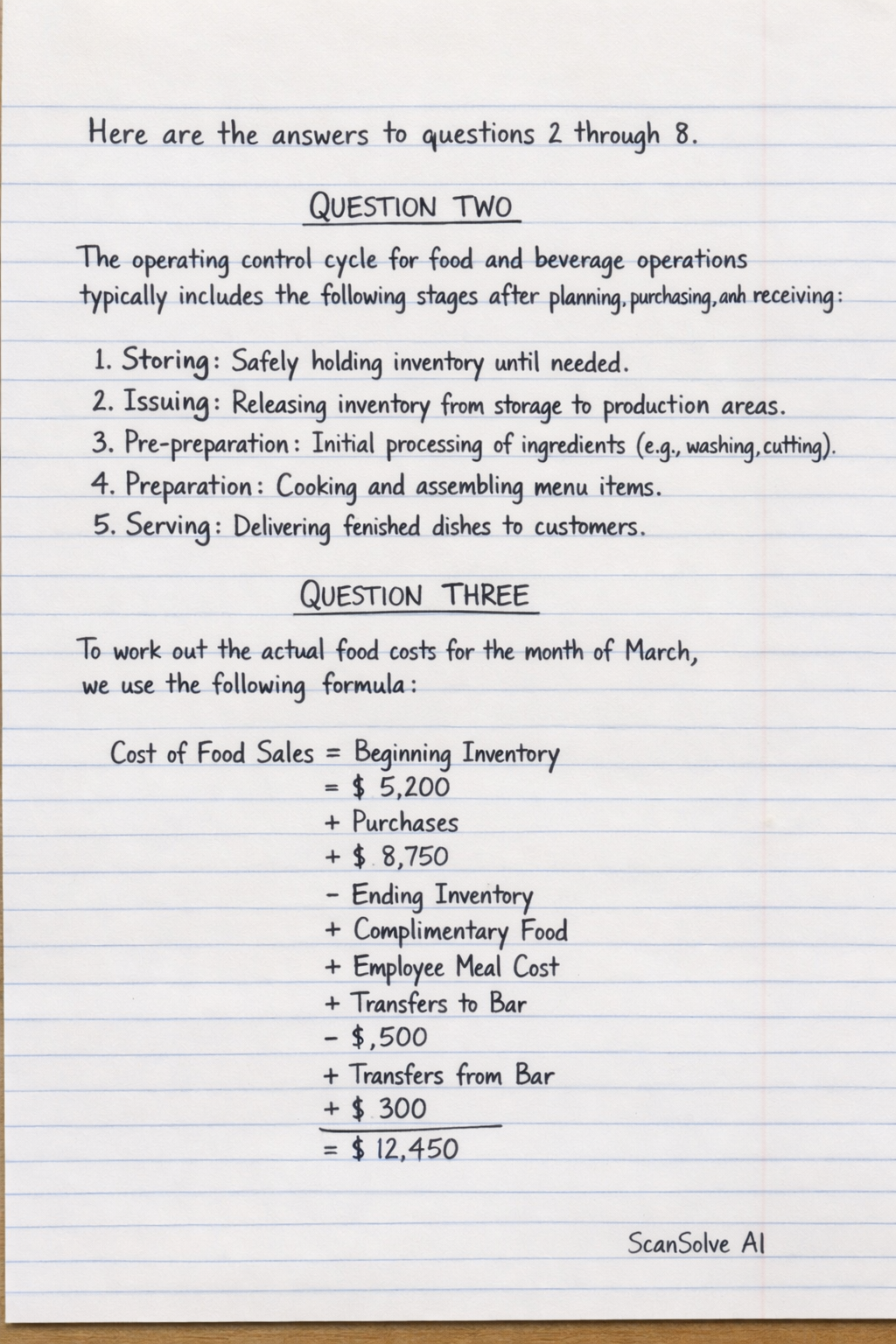
Here are the answers to questions 2 through 8. QUESTION TWO The operating control cycle for food and beverage operations typically includes the following stages after planning, purchasing, and receiving: 1. Storing: Safely holding inventory until needed. 2. Issuing: Releasing inventory from storage to production areas. 3. Pre-preparation: Initial processing of ingredients (e.g., washing, cutting). 4. Preparation: Cooking and assembling menu items. 5. Serving: Delivering finished dishes to customers. QUESTION THREE To work out the actual food costs for the month of March, we use the following formula: Cost of Food Sales = Beginning Inventory + Purchases - Ending Inventory + Complimentary Food + Employee Meal Cost - Transfers to Bar + Transfers from Bar Step 1: Identify the relevant data. Beginning Food Inventory: R70 000 Food Purchases: R450 000 Ending Food Inventory: R95 000 Complimentary Food: R1 500 Employee Meal Cost: R10 250 Transfer of food to bar: R2 500 Transfers of food from Bar: R3 750 Step 2: Substitute the values into the formula. Cost of Food Sales = R70\,000 + R450\,000 - R95\,000 + R1\,500 + R10\,250 - R2\,500 + R3\,750 Step 3: Calculate the total. Cost of Food Sales = R520\,000 - R95\,000 + R1\,500 + R10\,250 - R2\,500 + R3\,750 Cost of Food Sales = R425\,000 + R1\,500 + R10\,250 - R2\,500 + R3\,750 Cost of Food Sales = R426\,500 + R10\,250 - R2\,500 + R3\,750 Cost of Food Sales = R436\,750 - R2\,500 + R3\,750 Cost of Food Sales = R434\,250 + R3\,750 Cost of Food Sales = R438\,000 The actual food costs for the month of March are R438\,000. QUESTION FOUR To calculate the value of premade butternut using the FIFO method: Step 1: Identify the inventory available and the ending inventory count. Beginning Inventory (May 1): 45 bags @ R90 per bag Purchases during May: 55 bags @ R98 per bag Ending Inventory (May 31): 22 bags Step 2: Apply the FIFO (First-In, First-Out) principle, which assumes the oldest stock is used first. Therefore, the ending inventory consists of the most recently purchased items. Step 3: The 22 bags remaining in inventory are assumed to be from the latest purchase of 55 bags at R98 per bag. Value of Ending Inventory (FIFO) = 22 bags × R98/bag Value of Ending Inventory (FIFO) = R2\,156 The value of premade butternut left in inventory using the FIFO method is R2\,156. QUESTION FIVE Directs: These are food items purchased for immediate use, often highly perishable, and typically bypass long-term storage. They move directly from receiving to the production area. Examples*: Fresh fish, daily baked bread, fresh fruits and vegetables (e.g., lettuce, berries). Stores: These are food items purchased and placed into inventory for later use. They are generally non-perishable or semi-perishable and can be stored for a period. Examples*: Canned goods, dry pasta, flour, sugar, frozen meats, bottled beverages. QUESTION SIX Five ways to help ensure proper security concerns during storage are: 1. Limited Access: Restrict entry to storage areas to authorized personnel only, using locks or access control systems. 2. Surveillance: Install security cameras in and around storage facilities to monitor activity and deter theft. 3. Regular Inventory Audits: Conduct frequent, unannounced physical counts of inventory to compare with records and identify discrepancies. 4. Segregation of High-Value Items: Store expensive or easily pilfered items (e.g., liquor, specialty cheeses) in separate, more secure, locked cages or cabinets. 5. Clear Policies and Procedures: Establish and enforce strict policies for receiving, issuing, and transferring inventory, ensuring all staff are properly trained. QUESTION SEVEN POS (Point of Sale) systems significantly enhance management's control of production and service areas through: Production Control: Recipe Adherence and Portion Control: POS systems can be integrated with kitchen display systems (KDS) to show exact recipes and portion sizes, ensuring consistency and reducing ingredient waste. Real-time Inventory Management: Automatically updates inventory levels as sales occur, providing accurate data for ingredient usage, timely reordering, and preventing stockouts or overstocking. Production Forecasting: Provides detailed sales data and trends, enabling more accurate forecasting of demand for specific menu items, which optimizes production schedules and minimizes spoilage. Service Control: Revenue Accountability: Every transaction is recorded, minimizing opportunities for theft or "short ringing" by staff, ensuring all sales are accurately captured. Order Accuracy and Speed: Orders are directly transmitted to the kitchen, reducing errors in communication and speeding up service, leading to higher customer satisfaction. Performance Monitoring: Tracks individual server sales, voids, and discounts, allowing management to monitor staff performance, identify training needs, and detect potential irregularities. QUESTION EIGHT The food and beverage department in a hotel typically provides diverse services and operations. Five common examples are: 1. Restaurants: Full-service dining establishments offering various cuisines (e.g., a fine-dining restaurant, a casual bistro). 2. Bars/Lounges: Areas serving alcoholic and non-alcoholic beverages, often with light snacks or appetizers. 3. Room Service: Delivery of food and beverages directly to guest rooms. 4. Banquet and Catering: Services for events, conferences, weddings, and other functions held within the hotel or off-site. 5. Coffee Shops/Cafes: Casual outlets offering coffee, pastries, light meals, and grab-and-go options. Last free one today — make it count tomorrow, or type /upgrade for unlimited.