
We read your photo as:
Discuss the assumptions and relevance of the constant growth dividend valuation model in equity valuation, and calculate the expected dividend next year and the intrinsic value of the share.
ScanSolve AI Answer
This answer stops before the end.
It was cut off when it was first written. Ask ScanSolve this question again for the full working.
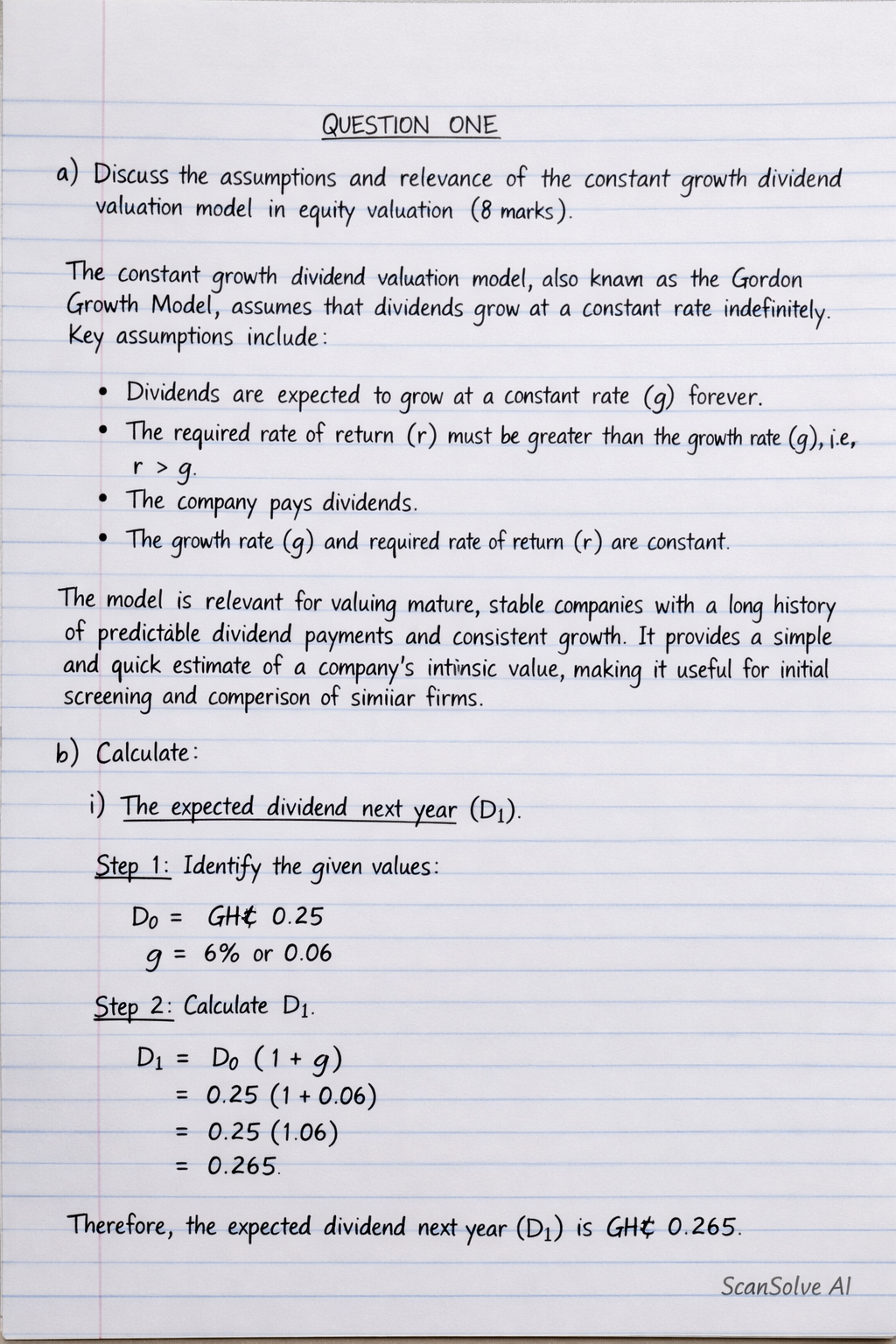
QUESTION ONE
a) Discuss the assumptions and relevance of the constant growth dividend valuation model in equity valuation (8 marks)
The constant growth dividend valuation model, also known as the Gordon Growth Model, assumes that dividends grow at a constant rate indefinitely. Key assumptions include:
- Dividends are expected to grow at a constant rate () forever.
- The required rate of return () must be greater than the growth rate (), i.e., .
- The company pays dividends.
- The growth rate () and required rate of return () are constant.
The model is relevant for valuing mature, stable companies with a long history of predictable dividend payments and consistent growth. It provides a simple and quick estimate of a company's intrinsic value, making it useful for initial screening and comparison of similar firms.
b) Calculate:
i) The expected dividend next year (D1)
Step 1: Identify the given values.
The dividend paid last year () is GH¢0.25.
The constant growth rate () is 6% or 0.06.
Step 2: Calculate the expected dividend next year ().
ii) The intrinsic value of the share using the constant growth model
Step 1: Identify the given values and the calculated .
The expected dividend next year () is GH¢0.265.
The required rate of return () is 14% or 0.14.
The constant growth rate () is 6% or 0.06.
Step 2: Calculate the intrinsic value () using the Gordon Growth Model formula.
iii) Interpret whether an investor should buy the share if its current market price is GH¢3.20.
Step 1: Compare the intrinsic value () with the current market price.
The intrinsic value () is GH¢3.3125.
The current market price is GH¢3.20.
Step 2: Make an investment decision.
Since the intrinsic value (GH¢3.3125) is greater than the current market price (GH¢3.20), the share is considered undervalued. Therefore, an investor should buy the share.
QUESTION TWO
a) Critically explain the concept of the multiple growth (supernormal growth) dividend model and why it is more realistic for growing companies (8 marks)
The multiple growth dividend model, also known as the supernormal growth model, assumes that a company's dividends will grow at a high, unsustainable rate (supernormal growth) for a finite period, followed by a stable, lower growth rate indefinitely. This model is more realistic for growing companies because it acknowledges that companies typically experience different growth phases throughout their life cycle. Initially, a company might have rapid growth due to new products, market expansion, or competitive advantages, which cannot be sustained forever. Eventually, as the company matures, its growth rate will slow down to a more stable, long-term rate, often aligning with the industry or economic growth rate.
b) Calculate the current intrinsic value of the company's shares using the multiple growth dividend model (12 marks)
Given:
Supernormal growth rate () = 15% for 3 years
Stable growth rate () = 7% indefinitely
Required rate of return () = 16%
Step 1: Calculate the dividends during the supernormal growth period (Years 1, 2, 3).
Step 2: Calculate the dividend for the first year of stable growth ().
Step 3: Calculate the terminal value () at the end of the supernormal growth period (Year 3).
Step 4: Calculate the present value (PV) of each dividend during the supernormal growth period.
Step 5: Calculate the present value of the terminal value ().
Step 6: Sum the present values to find the current intrinsic value ().
Still stuck on this one?
Ask a follow-up, and the answer starts from this question.
More Business/Management Questions
Handwritten Step-by-Step Solution
Get this as a handwritten image on WhatsApp — like a tutor wrote it for you.
Try on WhatsApp