
We read your photo as:
Distinguish between commerce and e-commerce. Explain the following types of e-commerce: (i) business to customer, (ii) government to business. State two advantages and three disadvantages of e-commerce.
ScanSolve AI Answer
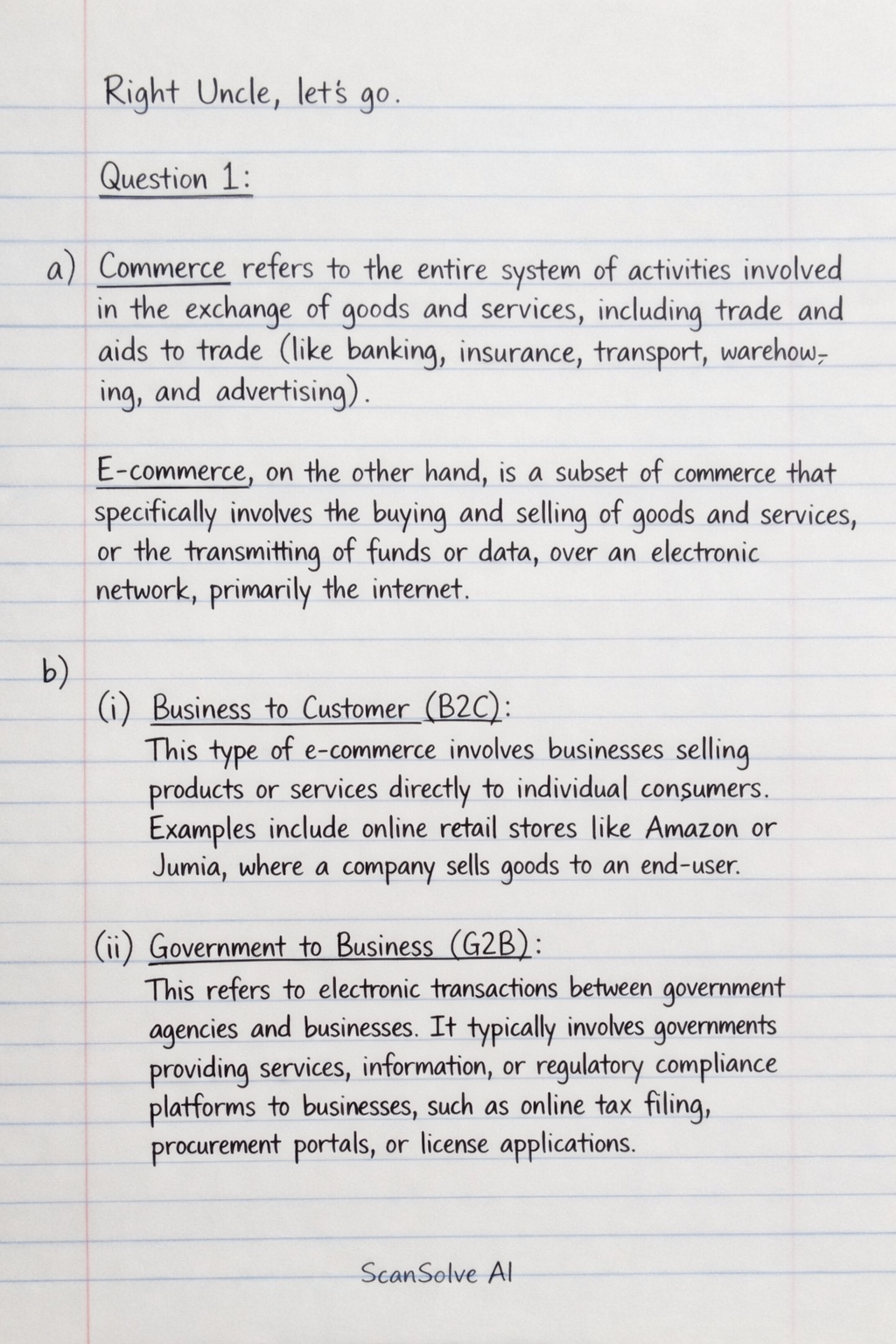
Question 1:
a) Commerce refers to the entire system of activities involved in the exchange of goods and services, including trade and aids to trade (like banking, insurance, transport, warehousing, and advertising). E-commerce, on the other hand, is a subset of commerce that specifically involves the buying and selling of goods and services, or the transmitting of funds or data, over an electronic network, primarily the internet.
b)
- (i) Business to Customer (B2C): This type of e-commerce involves businesses selling products or services directly to individual consumers. Examples include online retail stores like Amazon or Jumia, where a company sells goods to an end-user.
- (ii) Government to Business (G2B): This refers to electronic transactions between government agencies and businesses. It typically involves governments providing services, information, or regulatory compliance platforms to businesses, such as online tax filing, procurement portals, or license applications.
c)
- Two advantages of e-commerce:
- Wider Market Reach: Businesses can reach a global customer base without the need for physical stores in multiple locations.
- Reduced Operational Costs: E-commerce often involves lower overheads compared to traditional brick-and-mortar stores, as it can reduce expenses related to rent, staff, and utilities.
- Three disadvantages of e-commerce:
- Security Concerns: Customers may be hesitant to share personal and financial information online due to risks of data breaches and fraud.
- Lack of Personal Interaction: The absence of face-to-face interaction can make it difficult for customers to assess product quality or get immediate personalized assistance.
- Dependence on Technology: E-commerce operations are highly reliant on stable internet connectivity and functional websites, making them vulnerable to technical glitches or outages.
Question 2:
a) Division of labour is an economic concept where the production process is broken down into distinct, specialized tasks, and each worker or group of workers is assigned to perform only one or a few of these tasks. This specialization aims to increase efficiency and productivity.
b) Three features of capital:
- Man-made: Capital goods are not naturally occurring but are produced by humans (e.g., machinery, buildings, tools).
- Productive: Capital is used in the production of other goods and services, rather than being consumed directly.
- Has a Cost: The use of capital involves a cost, typically in the form of interest or depreciation.
c)
- (i) Extraction: These occupations involve obtaining raw materials directly from nature. They are part of the primary sector of the economy.
- Examples: Mining, Fishing, Logging, Farming.
- (ii) Manufacturing: These occupations involve processing raw materials or semi-finished goods into finished products. They are part of the secondary sector of the economy.
- Examples: Automobile production, Textile making, Food processing, Electronics assembly.
Question 3:
a)
- (i) The type of cooperative society formed by plantain farmers is a Producer Cooperative or Agricultural Cooperative.
- (ii) Four features of the cooperative society:
- Voluntary Membership: Individuals can freely join or leave the cooperative.
- Democratic Control: Members have equal voting rights, typically one member, one vote, regardless of the number of shares held.
- Service to Members: The primary objective is to serve the economic interests of its members, not to maximize profit for external shareholders.
- Limited Interest on Capital: Returns on capital invested by members are usually limited to a fixed, low rate.
b) Five advantages of a private company:
- Limited Liability: The personal assets of shareholders are protected from business debts and liabilities.
- Continuity of Existence: The company's existence is separate from its owners, meaning it continues even if owners change or pass away.
- Easier Capital Raising: It can raise capital by issuing shares to a limited number of private investors, which is easier than for a sole proprietorship.
- Privacy: Financial statements and other sensitive information do not need to be disclosed to the public, unlike public companies.
- Fewer Legal Formalities: Compared to public companies, private companies generally have fewer regulatory requirements and compliance obligations.
Question 4:
a) Five reasons hawkers continue to operate despite the existence of supermarkets:
- Convenience and Accessibility: Hawkers often operate in residential areas or busy streets, offering goods closer to customers' homes or workplaces.
- Lower Prices: Due to lower overheads (no rent, fewer staff), hawkers can often sell goods at slightly lower prices than supermarkets.
- Freshness of Produce: Many customers perceive hawkers' fresh produce (fruits, vegetables) as being fresher and of better quality.
- Credit Facilities: Hawkers often offer informal credit to regular customers, which is not available in supermarkets.
- Personalized Service: Customers can build personal relationships with hawkers, leading to trust and tailored recommendations.
b) Five features of a hypermarket:
- Large Retail Space: Hypermarkets occupy very large floor areas, combining a supermarket and a department store.
- Wide Range of Products: They offer an extensive variety of goods, including groceries, clothing, electronics, household items, and more, under one roof.
- Self-Service Model: Customers typically select items themselves from shelves and pay at centralized checkouts.
- Competitive Pricing: Due to bulk purchasing and high sales volume, hypermarkets often offer competitive prices.
- Out-of-Town Location: They are usually located on the outskirts of cities or in suburban areas, with ample parking facilities.
Question 5:
a) Five conditions that could lead to the dissolution of a contract:
- Performance: When both parties fulfill all their obligations as specified in the contract.
- Agreement: When both parties mutually agree to terminate the contract, even if it hasn't been fully performed.
- Breach of Contract: When one party fails to perform their obligations, giving the other party the right to terminate the contract and seek remedies.
- Frustration: When an unforeseen event makes it impossible or illegal to perform the contract, or fundamentally changes the nature of the performance.
- Operation of Law: When a contract is terminated by legal processes, such as bankruptcy, merger, or the expiry of a statutory period.
b)
- (i) Sale of Goods Act: This Act governs contracts for the sale of goods, outlining the rights and duties of both buyers and sellers. It covers aspects like implied conditions and warranties, transfer of ownership, and remedies for breach of contract.
- (ii) Foods and Drugs Act: This legislation regulates the manufacture, sale, advertisement, and importation of food, drugs, cosmetics, and medical devices. Its primary aim is to ensure the safety, quality, and proper labeling of these products to protect public health.
- (iii) Standard Organization Act: This Act establishes a national body (e.g., Standards Organisation of Nigeria - SON) responsible for setting, promoting, and enforcing industrial standards for goods and services. It aims to ensure quality, safety, and fair trade practices.
- (iv) Factory, Shops and Offices Act: This Act provides for the regulation of working conditions, health, safety, and welfare of workers in factories, shops, and offices. It sets standards for things like ventilation, lighting, sanitation, and machinery safety.
- (v) Hire Purchase Act: This Act governs agreements where goods are hired with an option to purchase, typically through installment payments. It protects the rights of both the hirer (customer) and the owner (seller), specifying conditions for repossession and termination.
Still stuck on this one?
Ask a follow-up, and the answer starts from this question.
More Business/Management Questions
Handwritten Step-by-Step Solution
Get this as a handwritten image on WhatsApp — like a tutor wrote it for you.
Try on WhatsApp