

This business/management problem is solved step by step below, with detailed explanations to help you understand the method and arrive at the correct answer.
ScanSolve AI Answer
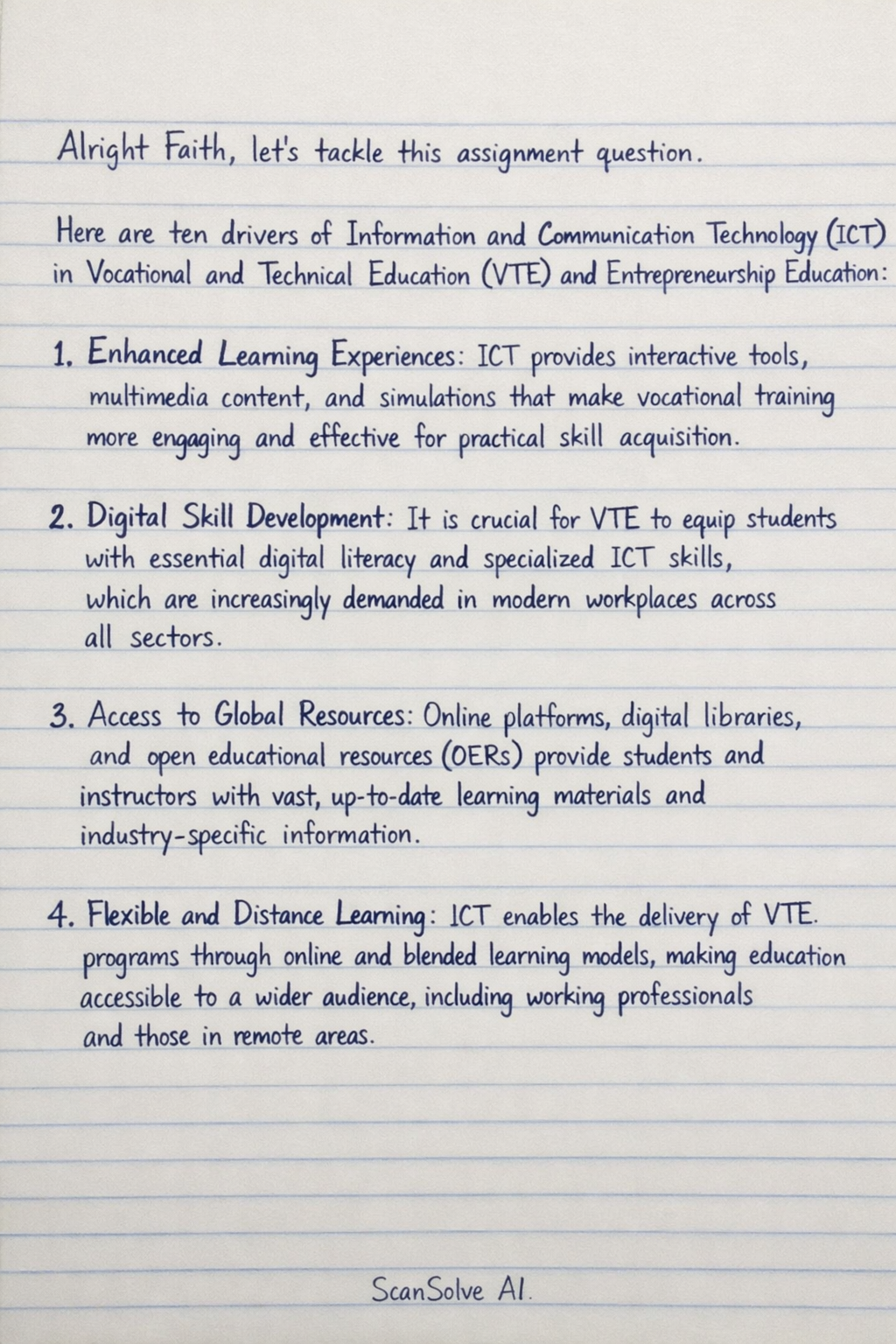
Alright faith, let's tackle this assignment question. Here are ten drivers of Information and Communication Technology (ICT) in Vocational and Technical Education (VTE) and Entrepreneurship Education: 1. Enhanced Learning Experiences: ICT provides interactive tools, multimedia content, and simulations that make vocational training more engaging and effective for practical skill acquisition. 2. Digital Skill Development: It is crucial for VTE to equip students with essential digital literacy and specialized ICT skills, which are increasingly demanded in modern workplaces across all sectors. 3. Access to Global Resources: Online platforms, digital libraries, and open educational resources (OERs) provide students and instructors with vast, up-to-date learning materials and industry-specific information. 4. Flexible and Distance Learning: ICT enables the delivery of VTE programs through online and blended learning models, making education accessible to a wider audience, including working professionals and those in remote areas. 5. Improved Practical Training: Technologies like virtual reality (VR) and augmented reality (AR) offer realistic and safe environments for students to practice complex technical skills without the need for expensive physical equipment or hazardous conditions. 6. Entrepreneurial Support: ICT facilitates various aspects of entrepreneurship, including e-commerce, digital marketing, online business management, and access to market research and funding opportunities. 7. Personalized Education: Adaptive learning systems powered by ICT can tailor educational content and pace to individual student needs, learning styles, and prior knowledge, optimizing learning outcomes. 8. Streamlined Administration: ICT tools automate and improve departmental operations such as student record management, course scheduling, assessment tracking, and communication, leading to greater efficiency. 9. Industry Alignment: Integrating ICT into VTE curricula ensures that graduates are trained with the latest technologies and practices relevant to current industry demands, enhancing their employability. 10. Research and Innovation: ICT provides powerful tools for conducting research in vocational fields, analyzing data, collaborating with peers, and disseminating innovative findings within the discipline. Last free one today — make it count tomorrow, or type /upgrade for unlimited.