
We read your photo as:
Expected sales 2,000 units @ 25, Variable Cost/Unit @ 15, Fixed Costs @ 10,000. i) Prepare a budgeted Income Statement ii) What is the break-even Sales Value? iii) Calculate the Margin of Safety iv) Explain the importance of budgeting in planning.
Business/Management
ScanSolve AI Answer
Answers
2 partsStep-by-step solution
8 stepsHere's the solution to question 8.b):
Given:
Expected Sales = 2,000 units
Selling Price per unit = Le 25
Variable Cost per unit = Le 15
Fixed Costs = Le 10,000
Part i· 3 steps
Prepare a budgeted Income Statement.
Calculate Total Sales Revenue.
Calculate Total Variable Costs.
Prepare the Budgeted Income Statement.
Part ii
What is the break-even Sales Value?
Calculate the Contribution Margin per unit.
Calculate the Contribution Margin Ratio.
Calculate the Break-even Sales Value.
Part iii
Calculate the Margin of Safety.
Identify Actual Sales Value and Break-even Sales Value.
Actual Sales Value (from part i) = Le 50,000
Break-even Sales Value (from part ii) = Le 25,000Calculate the Margin of Safety.
Part iv
Identify and explain the importance of budgeting in planning.
- Provides Direction and Coordination: Budgeting sets clear financial goals and targets for the organization, acting as a roadmap. It helps to coordinate the activities of various departments, ensuring that all efforts are aligned towards achieving the overall strategic objectives.
- Facilitates Performance Evaluation: Budgets serve as a benchmark against which actual financial performance can be measured. By comparing actual results to budgeted figures, management can identify variances, analyze their causes, and take corrective actions to improve efficiency and effectiveness.
Was this helpful?
Still stuck on this one?
Ask a follow-up, and the answer starts from this question.
Got a different question?Ask your own question
More Business/Management Questions
QA. Prepare a flexible budget at the activity levels of 800, 1,200 and 1,500 units respectfully. B…QA company has fixed costs of N2,000,000. Variable cost per unit is N20 and selling price per unit is…QCalculate the break-even point in units and value for Scenario A, given fixed costs of 20,000 DH, a…QWhat is the Break-Even Point (BEP) in sales and Margin of Safety given these financial figures?
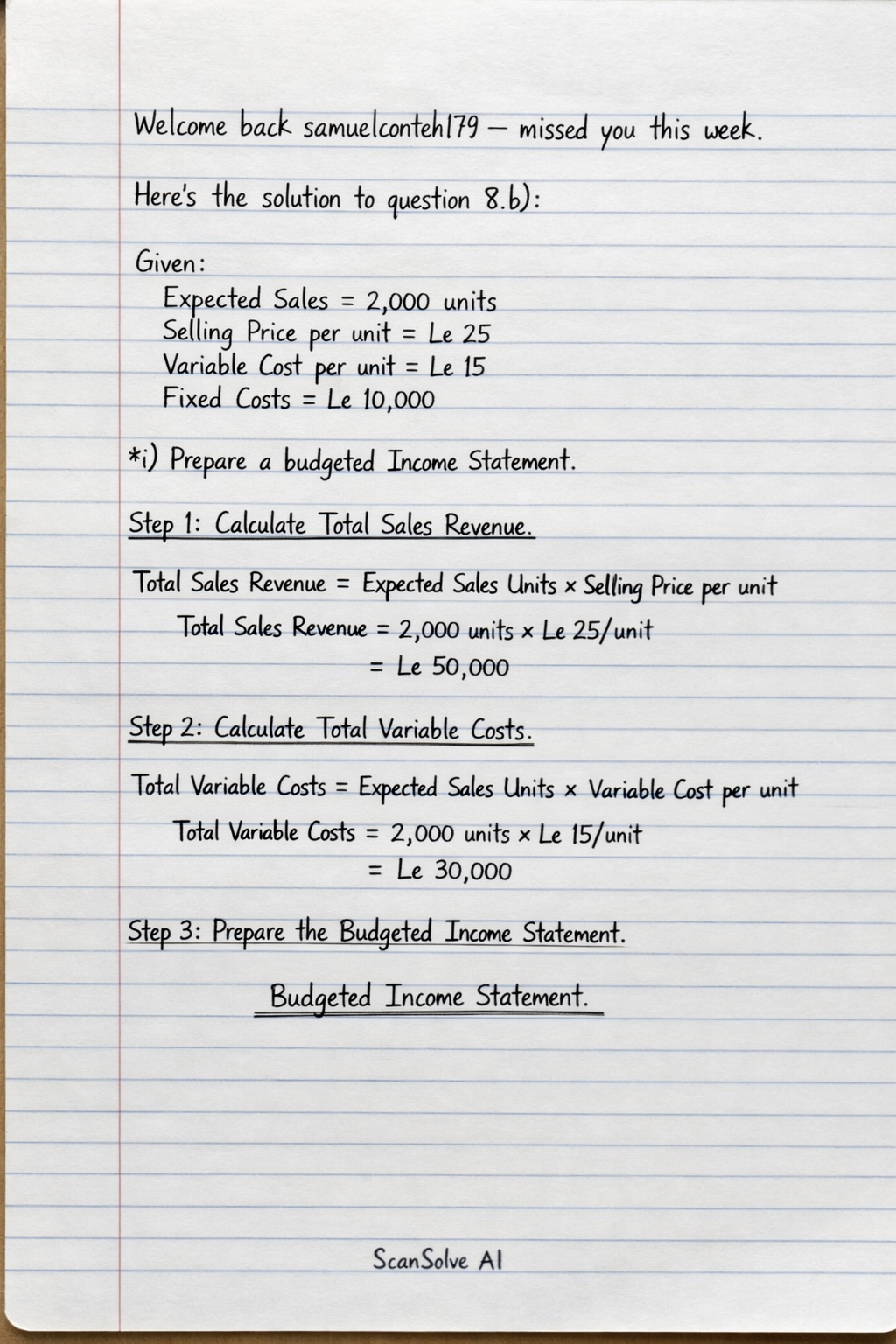
Handwritten Step-by-Step Solution
Get this as a handwritten image on WhatsApp — like a tutor wrote it for you.
Try on WhatsApp