
We read your photo as:
External customers all have different wants and have five basic needs. Which one of the following is NOT a basic need of an external customer?
ScanSolve AI Answer
Answer
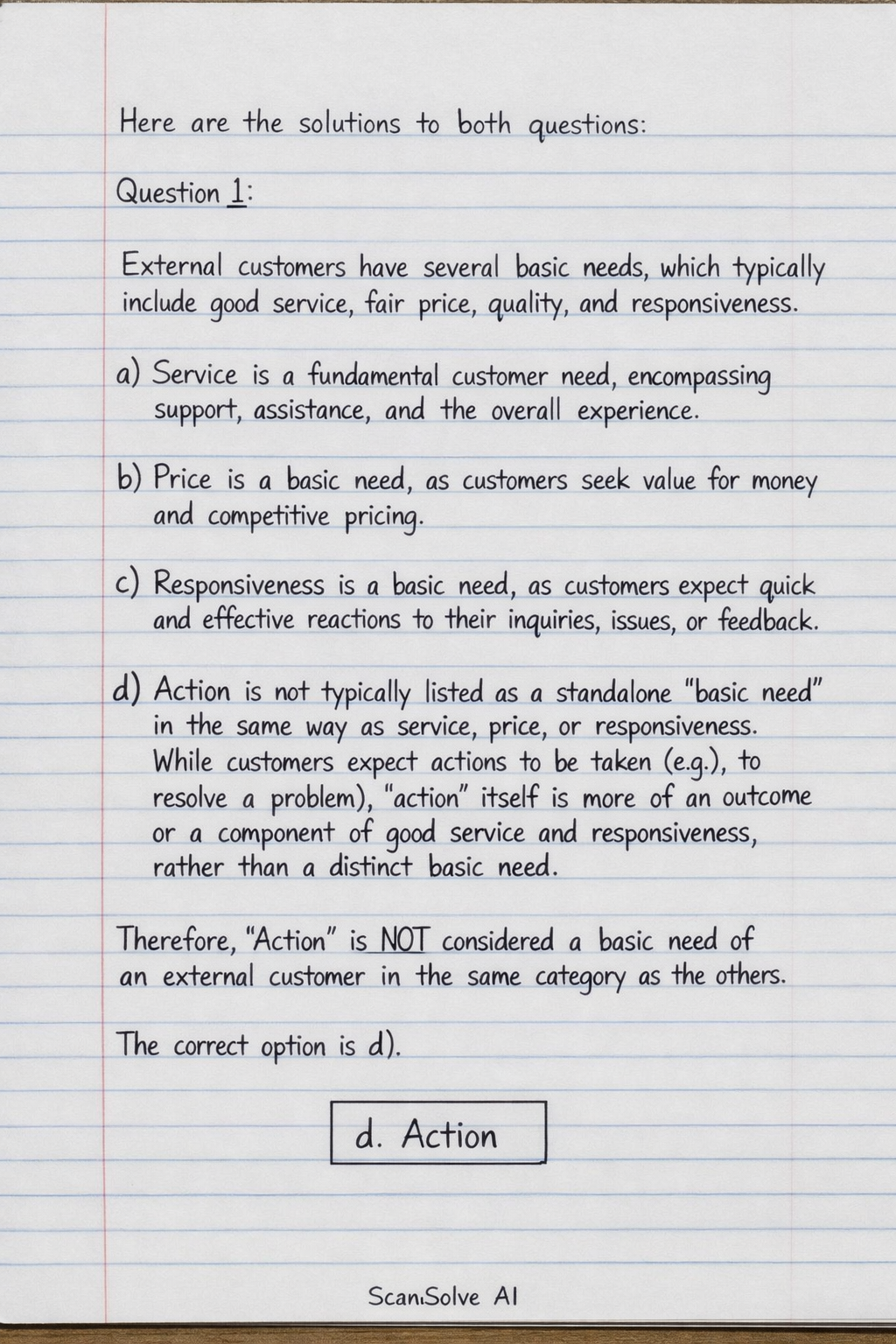
Here are the solutions to both questions:
Question 1:
External customers have several basic needs, which typically include good service, fair price, quality, and responsiveness.
- a) Service is a fundamental customer need, encompassing support, assistance, and the overall experience.
- b) Price is a basic need, as customers seek value for money and competitive pricing.
- c) Responsiveness is a basic need, as customers expect quick and effective reactions to their inquiries, issues, or feedback.
- d) Action is not typically listed as a standalone "basic need" in the same way as service, price, or responsiveness. While customers expect actions to be taken (e.g., to resolve a problem), "action" itself is more of an outcome or a component of good service and responsiveness, rather than a distinct basic need.
Therefore, "Action" is NOT considered a basic need of an external customer in the same category as the others.
The correct option is d).
Question 2:
The question describes CelluX using an emotional appeal in a new TV advertisement to differentiate its product in a "highly competitive market." It asks during which phase of the integrated marketing communication strategy this would be most appropriate.
Let's consider the product life cycle phases:
- a) Introductory phase: The focus is on creating awareness and encouraging trial. Differentiation might be present, but the primary goal is often to introduce the product.
- b) Growth phase: Sales are rapidly increasing, and the focus shifts to building brand preference and expanding market share. Differentiation becomes more important as competitors enter.
- c) Maturity phase: This phase is characterized by intense competition, market saturation, and slowing sales growth. Differentiation becomes crucial to maintain market share and stand out from numerous competitors. Emotional appeals are often used here to build brand loyalty and create a unique perception in a crowded market. The phrase "highly competitive market" where differentiation is "most important" strongly points to this phase.
- d) Declining phase: Sales are falling, and companies typically reduce marketing efforts, focusing on niche markets or phasing out the product. Extensive differentiation through emotional appeals is less common.
Given that the market is "highly competitive" and emotional appeal is used for "differentiating a product from competing products," the Maturity phase is the most appropriate time for such a marketing communication decision.
The correct option is c).
Try one yourself
A new problem that tests the same skill.
Still stuck on this one?
Ask a follow-up, and the answer starts from this question.
More Business/Management Questions
Handwritten Step-by-Step Solution
Get this as a handwritten image on WhatsApp — like a tutor wrote it for you.
Try on WhatsApp