
Explain heat loss by thermoflask
Business/Management
ScanSolve AI Answer
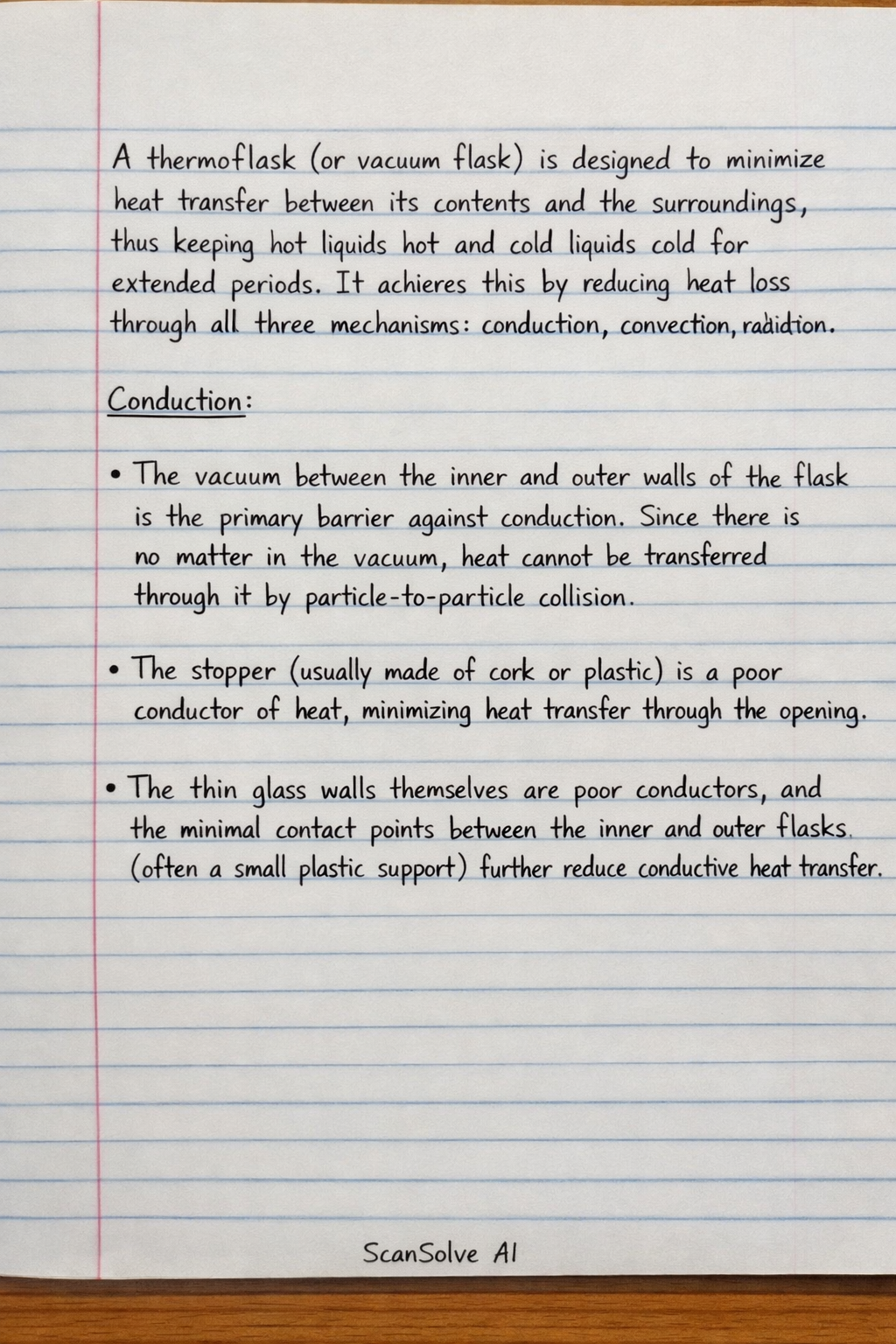
A thermoflask (or vacuum flask) is designed to minimize heat transfer between its contents and the surroundings, thus keeping hot liquids hot and cold liquids cold for extended periods. It achieves this by reducing heat loss through all three mechanisms: conduction, convection, and radiation.
-
Conduction:
- The vacuum between the inner and outer walls of the flask is the primary barrier against conduction. Since there is no matter in the vacuum, heat cannot be transferred through it by particle-to-particle collision.
- The stopper (usually made of cork or plastic) is a poor conductor of heat, minimizing heat transfer through the opening.
- The thin glass walls themselves are poor conductors, and the minimal contact points between the inner and outer flasks (often a small plastic support) further reduce conductive heat transfer.
-
Convection:
- The vacuum between the walls also prevents convection. There is no air or fluid to circulate and carry heat from one wall to the other.
- The stopper prevents air currents from entering or leaving the flask, which would otherwise lead to convective heat loss or gain through the opening.
-
Radiation:
- The inner and outer surfaces of the vacuum gap are silvered (coated with a reflective material). These shiny surfaces reflect infrared radiation. If the liquid inside is hot, the silvered inner surface reflects the emitted thermal radiation back into the liquid. If the liquid is cold, the silvered outer surface reflects external thermal radiation away from the flask, preventing it from reaching the cold liquid.
Was this helpful?
Still stuck on this one?
Ask a follow-up, and the answer starts from this question.
Got a different question?Ask your own question
More Business/Management Questions
QExplain heat loss and heat gain by a thermoflaskQExplain how the features labelled in Figure 5 of a vacuum flask reduce heat transfer.QThe main reason for making the cover of a vacuum flask airtight is to prevent heat loss byQHeat loss to the surroundings: Not all the heat energy supplied by the heat source will be absorbed…QDescribe when and how the skin reduces loss of heat in the body
Handwritten Step-by-Step Solution
Get this as a handwritten image on WhatsApp — like a tutor wrote it for you.
Try on WhatsApp